Clinical Documentation in Therapy: A Guide to Mindora's 28 Clinical Note Types and Systematic Record-Keeping
From assessment to formulation, treatment planning to termination, a comprehensive map showing which note type to use at each stage of the therapy process.
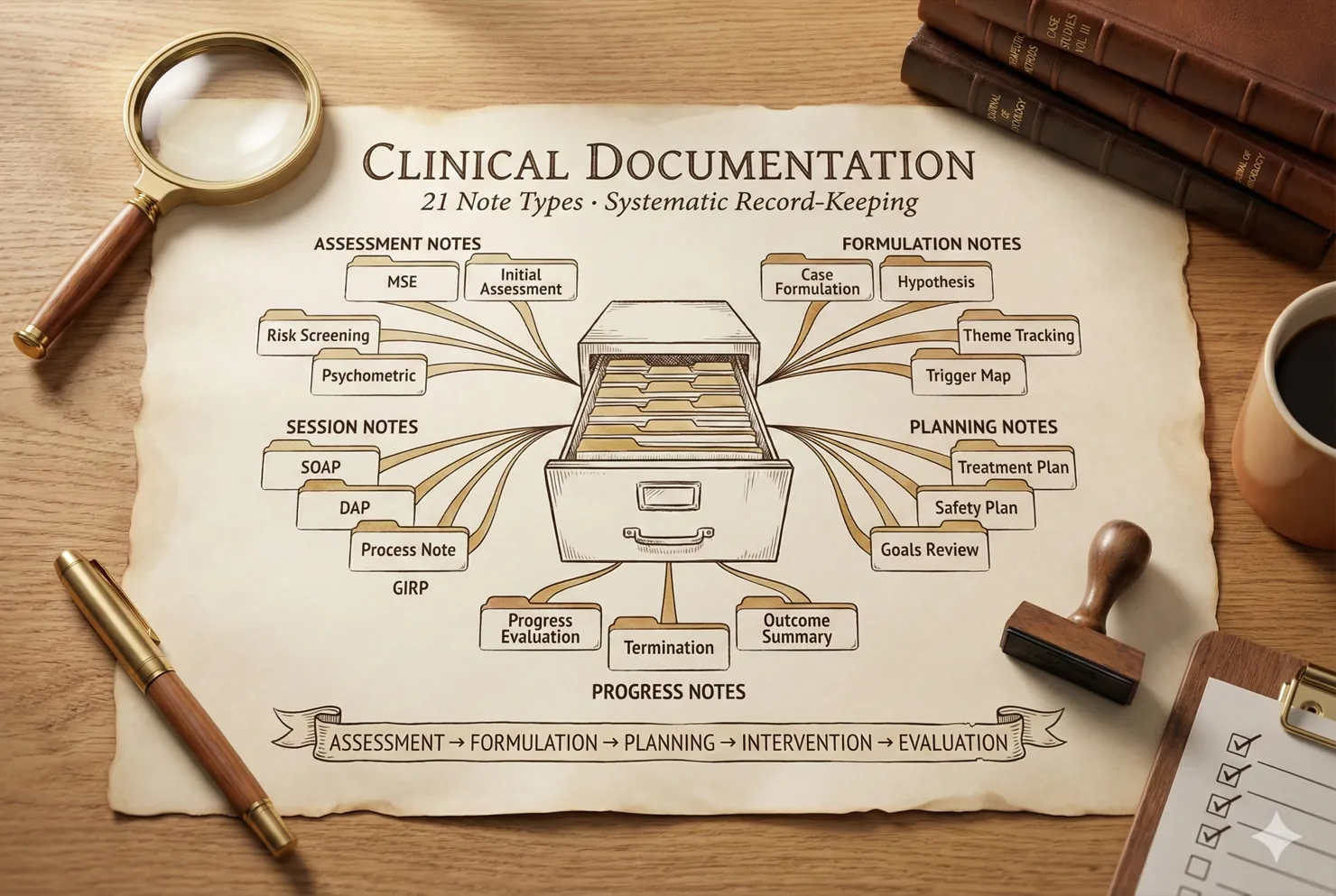
Clinical documentation is the practice of recording observations, clinical thinking, and treatment decisions about a client in a structured way at every stage of the therapy process. This guide maps the clinical workflow from assessment through formulation to termination, using the 29 clinical note types available in Mindora as a working framework.
You Wrote the Session Note. What About the Big Picture?
The session ended, you wrote your SOAP note. Intervention, response, plan — everything in its place. But a month later you find yourself asking: "What has changed since the first session? Is my formulation still valid? How close are we to the treatment goals?" And you realize the answers aren't in your session notes.
Many therapists treat session notes as the entirety of clinical documentation. Yet Wiger (2012) emphasizes that the primary purpose of clinical documentation is to structure the therapist's own thinking process: a session note records what happened in that meeting, but it isn't designed to carry the client's comprehensive picture, treatment strategy, or progress evaluation. Cameron and Turtle-Song (2002) demonstrated that structured documentation is not merely information transfer but an instrument of clinical thinking discipline.
In this guide, we examine the 29 clinical note types available in Mindora across the six clinical stages of the therapy process and the ongoing transverse processes. Our goal is not to explore each type in depth, most are covered in detail in our assessment series, formulation series, and session notes guide. Here, we clarify each type's place in your clinical workflow and how they connect to one another.
The Clinical Workflow: 6 Stages and Ongoing Processes
Clinical documentation follows a logical flow. Clinical stages build sequentially on the previous one, while ongoing processes (session, crisis, communication) accompany every phase of therapy:
- Assessment: Understanding who the client is and what they are experiencing
- Formulation: Transforming data into a coherent clinical narrative
- Planning: Establishing treatment goals and strategies
- Intervention: Applying and documenting therapeutic techniques
- Monitoring: Evaluating treatment progress
- Termination: A structured close to the therapy process
- Ongoing Processes (Transverse): Session documentation, crisis management, and administrative communication
Assessment
The foundation of the therapy process, where the client's biopsychosocial history, symptom mechanisms, patterns, and psychometric data are systematically gathered. In Mindora, this phase includes 6 note types and 14 structured templates: four standard types plus two approach-specific (schema, trauma).
Mindora note types
- Initial Assessment: Structured first-session documentation capturing the client's biopsychosocial history, presenting concerns, clinical background, and current support system.
- Problem and Symptom Analysis: Maps the clinical mechanism of the problem as a cycle: trigger → thought → emotion → behavior → consequence (ABC, SORKC, behavioral chain analysis models).
- Symptom Cluster: Groups co-occurring symptoms into clusters to determine treatment priorities (e.g., depressive-somatic, motivational-avoidance clusters).
- Psychometric Assessment: Quantitative client profile via standardized scales (PHQ-9, GAD-7, BDI, BAI); enables objective tracking of treatment effects over time.
- Schema Assessment: Systematic mapping of early maladaptive schemas (abandonment, defectiveness, failure, etc.) in schema therapy and recording the client's core need patterns.
- Trauma Mapping: Structured recording for EMDR and trauma-focused work: chronological ordering of traumatic memories, distress level (SUD), triggers, cognitive-somatic themes, and processing priorities.
Related guides
Initial Assessment & Anamnesis: A Therapist's Comprehensive Guide
Learn biopsychosocial assessment, structured interviewing, mental status examination, and risk screening with concrete clinical examples and practical principles.
Problem & Symptom Analysis: ABC, SORKC and Behavioral Chain Analysis Guide
Compare ABC, SORKC, and Behavioral Chain Analysis frameworks. Learn when to use each method with filled clinical examples and practical documentation principles.
Symptom Clusters & Diagnostic Patterns: Connecting the Dots
Learn transdiagnostic symptom grouping, severity and frequency measurement, temporal pattern analysis, and longitudinal tracking with concrete clinical examples.
Psychometric Assessment in Therapy: Scales, Scoring & Clinical Interpretation
Learn scale selection, scoring interpretation, normative comparison, trend analysis, and treatment plan integration with concrete clinical examples and practical principles.
Formulation
This stage transforms assessment data into a coherent clinical narrative, enabling conceptualization of the client through strengths, values, life experiences, and clinical hypotheses alongside problems. In Mindora, this phase includes 10 note types and 28 structured templates: eight standard types plus two approach-specific (DBT chain analysis, schema mode analysis).
Mindora note types
- Case Formulation: Conceptualizes the client holistically using the 5P model (Predisposing, Precipitating, Perpetuating, Protective, Presenting) or CBT/ACT/Schema/Psychodynamic formulation frameworks.
- Clinical Theme and Pattern: Tracks recurring themes (e.g., not-enoughness, abandonment) and behavioral patterns across sessions to deepen the formulation over time.
- Resource and Strength: Maps the client's internal (personality traits, coping skills) and external (social support, financial security) resources and protective factors.
- Coping Mechanism: Classifies existing coping strategies as functional or dysfunctional, establishing the ground for developing alternative strategies.
- Trigger: Structured recording of external (situation, person, environment) and internal (thought, body sensation, memory) triggers.
- Value: Identifies the client's life values; serves as a source of clinical goals and interventions in ACT and value-driven approaches.
- Critical Life Event: Charts significant life events influencing the clinical picture (loss, trauma, transitions, achievements) along a timeline.
- Clinical Hypothesis: Records clinical hypotheses that explain a specific symptom, behavior, or pattern; tested and refined with data over the course of therapy.
- Chain Analysis: In DBT practice, a step-by-step mapping of the trigger preceding a problem behavior, vulnerability factors, thought-emotion-body responses, and the behavior's consequences.
- Mode Analysis: Identifying the client's dominant modes in schema therapy (Vulnerable Child, Punitive Parent, Healthy Adult, etc.) and recording transitions between modes.
Related guides
Case Formulation Guide: 8 Building Blocks & the 5P Model
A comprehensive guide to case formulation in psychotherapy. Learn the 5P model, 8 building blocks, CBT/ACT/Schema Therapy approaches, and real clinical examples.
Clinical Theme & Pattern Tracking: A Therapist's Guide
Learn how to identify recurring themes using the CCRT model and Schema Therapy framework, with concrete examples and practical principles for theme tracking.
Resource & Strength Analysis: A Therapist's Guide
Learn how to systematically identify and document internal and external resources using strengths-based models, with concrete examples and practical principles.
Coping Mechanisms in Therapy: A Therapist's Guide
Learn to map functional and dysfunctional coping mechanisms, safety behaviors, and comprehensive coping analysis with concrete clinical examples and principles.
Trigger Analysis & Mapping in Therapy: A Therapist's Guide
Learn to map internal and external triggers, understand the activation cycle, and distinguish precipitating from maintaining factors with examples.
Values Work and Life Domains in Therapy: A Therapist's Guide
Learn ACT-based value identification, life domain alignment analysis, and committed action with clinical examples and practical principles for therapists.
Critical Life Events and Turning Points: A Therapist's Guide
Document critical life events, analyze turning points with the Lazarus appraisal model, and integrate life-course analysis through concrete clinical examples.
Clinical Hypothesis Building and Testing: A Therapist's Guide
Learn clinical hypothesis formulation, evidence balance analysis, and hypothesis testing cycles with concrete clinical examples and practical principles.
Ongoing Processes – Session Documentation
The most frequently used documentation tool in therapy; structured recording of interventions applied, client responses, and next steps for each session. In Mindora, this category includes 1 note type and 12 structured templates (SOAP, DAP, GIRP, and approach-specific formats).
Mindora note types
- Session Note: Provides generic formats (SOAP, DAP, GIRP) and approach-specific templates (CBT, Psychodynamic, EMDR, Schema, DBT, Couples/Family, ACT, etc.) as separate structures.
Related guides
Planning
Transforms formulation insights into concrete treatment strategies. Sommers-Flanagan and Sommers-Flanagan (2015) emphasize that the treatment plan serves as a roadmap for both therapist and client. In Mindora, this phase includes 2 note types and 6 structured templates.
Mindora note types
- Treatment Plan: Long-term treatment goals, therapeutic approaches, expected session count, success criteria, and reassessment timing.
- SMART Goal Planning: Structures treatment goals as Specific, Measurable, Achievable, Relevant, and Time-bound. Instead of "reduce anxiety," a target like "reduce GAD-7 from 15 to below 10 within 8 weeks."
Related guides
Ongoing Processes – Crisis Management
A critical documentation tool activated in situations involving suicide risk, self-harm, or acute psychiatric crisis. Luepker (2012) emphasizes that crisis documentation must transparently record which risk factors were assessed, which intervention decisions were made, and their rationales. In Mindora, this category includes 1 note type and 4 structured templates.
Mindora note types
- Crisis and Safety Plan: Risk assessment results, warning signs, coping strategies, emergency contacts, safety arrangements, and referral decisions.
Related guides
Monitoring and Evaluation
A critical stage that prevents treatment from operating on "autopilot." Prieto and Scheel (2002) demonstrated that regular review practice improves both case conceptualization skills and treatment effectiveness. In Mindora, this phase includes 3 note types and 5 structured templates.
Mindora note types
- Process Evaluation: Systematic review every 4-8 sessions: progress toward goals, formulation validity, treatment plan revision needs, therapeutic relationship quality.
- Breakthrough Moment Assessment: Structured recording of critical moments when the client gains significant insight, achieves behavioral change, or experiences an emotional breakthrough.
- Diary Card Review: A weekly tracking tool specific to DBT practice: target behavior frequency, skill use, emotion intensity, and trigger patterns are monitored systematically.
Related guides
Intervention Documentation
Maintains detailed records of applied therapeutic techniques, forming the basis for evaluating intervention effectiveness and refining the treatment plan. In Mindora, this phase includes 2 note types and 7 structured templates: a general intervention note plus a dedicated structure for the 8-phase EMDR protocol.
Mindora note types
- Intervention/Technique Note: Which technique was applied (cognitive restructuring, exposure, mindfulness, etc.), client response, in-session impact, and follow-up plan.
- EMDR Protocol Note: Structured documentation of each phase of the standard 8-phase EMDR protocol: target memory, NC/PC statements, SUD and VOC measures, set counts, and end-of-session closure procedures.
Termination
The structured closure of therapy is a critical stage that consolidates the gains of the process and makes the changes sustainable for the client. In Mindora, this phase includes 1 note type and 2 structured templates.
Mindora note types
- Termination Summary: A structured closure note covering attainment of treatment goals, clinical gains, remaining challenges, relapse prevention planning, and recommendations for future support or referral.
Related guides
Ongoing Processes – Administrative Documentation
Documents the dimension of treatment that continues outside sessions, providing critical reference points for potential legal or ethical inquiries. Luepker (2012) emphasizes that consultation records carry both clinical and legal value in demonstrating how therapists justified clinical decisions. In Mindora, this category includes 2 note types and 6 structured templates.
Mindora note types
- Phone and Communication Record: All professional out-of-session communications: client calls, family member contact, coordination with other health professionals.
- Consultation and Reporting: Colleague consultations, supervision notes, institutional reports, and referral letters.
Applied Example: Ayse, 29, Depression and Work Stress
The following example shows how different note types come together in a client's therapy journey.
Assessment (Sessions 1-3)
Initial Assessment captures biopsychosocial history (perfectionist family, high achievement expectations). Problem Analysis maps the cycle: work pressure → inadequacy → procrastination → guilt. Symptom Cluster identifies depressive-somatic and motivational-avoidance clusters. Psychometric Assessment: PHQ-9: 16.
Formulation (Sessions 3-4)
Case Formulation applies the 5P model. Resource/Strength note maps internal resources (analytical thinking) and external resources (supportive friend). Trigger note analyzes external (deadlines) and internal (perfectionist inner voice) triggers.
Planning (Sessions 4-5)
Treatment Plan creates a 16-session CBT and behavioral activation framework. SMART Goals: (1) reduce PHQ-9 below 10 within 8 weeks, (2) 3 pleasurable activities per week, (3) no overtime or weekend work.
Ongoing Therapy (Sessions 5-12)
SOAP Session Notes after each meeting. Intervention/Technique note records cognitive restructuring and behavioral activation. Clinical Theme note tracks the recurring "not enough" theme. Crisis Plan created proactively in session 7 when passive suicidal ideation is reported.
Mid-Treatment Evaluation (Session 8)
Process Evaluation: PHQ-9 dropped from 16 to 11. Procrastination cycle improving, social withdrawal persists — interpersonal skills work added to the treatment plan.
Breakthrough (Session 10)
Breakthrough Moment Assessment: Ayse responds non-defensively to supervisor criticism for the first time and gains the insight "the thought that I'm not enough was my father's voice."
Out-of-Session (Throughout)
Phone Record documents post-session-7 crisis communication. Consultation note records supervisor discussion and psychiatrist referral assessment.
5 Principles of Effective Documentation
The 24-Hour Rule
Clinical notes should be completed within 24 hours. Memory research shows clinical details blur significantly after this window. Cameron and Turtle-Song (2002) demonstrated that structured formats shorten documentation time and facilitate timely record-keeping.
Choose the Note Type Based on Content
A newly discovered trigger in a session may require a Trigger note alongside the session note. A crisis situation requires a separate Crisis Plan. Choosing note types by content nature keeps information in the right category and improves future accessibility.
Describe, Don't Interpret
Maintain the distinction between observation (client avoided eye contact for the first 10 minutes) and inference (client was feeling ashamed). Wiger (2012) recommends recording behavioral observations first, then stating clinical impressions separately.
Create Links Between Notes
The true value of clinical notes comes from connections between them as much as individual contents. Does a session observation support a formulation hypothesis? Does psychometric change align with a treatment goal? A knowledge network of interconnected documents directly affects clinical decision-making quality.
Review and Update Regularly
Formulations should be refined with new data, treatment plans revised based on progress, crisis plans updated as risks change. Prieto and Scheel (2002) demonstrated that regular review improves both case conceptualization and treatment effectiveness. Conduct a comprehensive file review every 4-8 sessions.
Common Mistakes
Cramming Everything into Session Notes
A session note records what happened in that meeting — it's not designed to carry formulation, treatment plan, or progress analysis. Writing everything into session notes reduces readability and buries important information within lengthy documents.
Never Changing Note Types
A common tendency is to keep using the same format for all clients and situations. However, different treatment stages require different note types: assessment notes predominate early on, while monitoring and intervention notes come to the forefront as treatment progresses.
Documenting Only Problems
A common tendency is to document only symptoms and risks. However, the client's strengths, resources, and protective factors are integral to formulation. A file that focuses only on problems cannot present a complete picture.
Viewing Notes as Legal Requirements Only
Viewing documentation solely as legal compliance makes notes superficial and disconnected from clinical thinking. Wiger (2012) emphasizes that therapists who position documentation as integral to practice make better clinical decisions and are more resilient against burnout.
Systematic Documentation with Mindora
Mindora brings together all 29 clinical note types discussed in this guide with structured templates for each, on a single platform. The table below shows how many ready-made templates are available for each note type:
| Stage | Note Type | Templates |
|---|---|---|
| Assessment | Initial Assessment | 4 |
| Problem and Symptom Analysis | 2 | |
| Symptom Cluster | 1 | |
| Psychometric Assessment | 5 | |
| Schema Assessment | 1 | |
| Trauma Mapping | 1 | |
| Formulation | Clinical Theme and Pattern | 2 |
| Resource / Strength | 4 | |
| Coping Mechanism | 4 | |
| Trigger | 4 | |
| Value | 3 | |
| Critical Life Event | 2 | |
| Clinical Hypothesis | 2 | |
| Chain Analysis | 1 | |
| Mode Analysis | 1 | |
| Case Formulation | 5 | |
| Planning | SMART Goal | 4 |
| Treatment Plan | 2 | |
| Intervention | Intervention / Technique | 6 |
| EMDR Protocol | 1 | |
| Monitoring | Process Evaluation | 2 |
| Breakthrough Moment | 2 | |
| Diary Card Review | 1 | |
| Termination | Termination Summary | 2 |
| Ongoing | Session Note | 12 |
| Crisis and Safety Plan | 4 | |
| Phone and Communication Record | 3 | |
| Consultation and Reporting | 3 | |
| Total | 84 | |
A total of 29 clinical note types and 87 structured templates. In addition, the Knowledge Network feature links documents across note types to reveal the client's comprehensive picture. All templates can be used as-is or customized to your clinical needs.
In addition to clinical note types, Mindora also offers 7 personal note types and 21 structured templates for the therapist's own professional and personal development:
| Note Type | Templates |
|---|---|
| Reflection | 4 |
| Supervision Notes | 3 |
| Personal Growth and Awareness | 5 |
| Academic Work and Research | 3 |
| Article and Literature Review | 2 |
| Training and Workshop Records | 2 |
| Research and Project Development | 2 |
| Total | 21 |
Frequently Asked Questions
References
- Wiger, D. E. (2012). The Psychotherapy Documentation Primer (3rd ed.). Wiley.
- Luepker, E. T. (2012). Record Keeping in Psychotherapy and Counseling (2nd ed.). Routledge.
- Prieto, L. R. & Scheel, K. R. (2002). Using case documentation to strengthen counselor trainees' case conceptualization skills. Journal of Counseling & Development, 80(1), 11-21.
- Sommers-Flanagan, J. & Sommers-Flanagan, R. (2015). Clinical Interviewing (5th ed.). Wiley.
- Cameron, S. & Turtle-Song, I. (2002). Learning to write case notes using the SOAP format. Journal of Counseling & Development, 80(3), 286-292.