Crisis & Safety Planning: Risk Assessment, the Stanley-Brown Model, and Clinical Practice
Learn suicide risk assessment, the 6 steps of the Stanley-Brown safety planning model, and post-crisis follow-up through filled clinical examples.
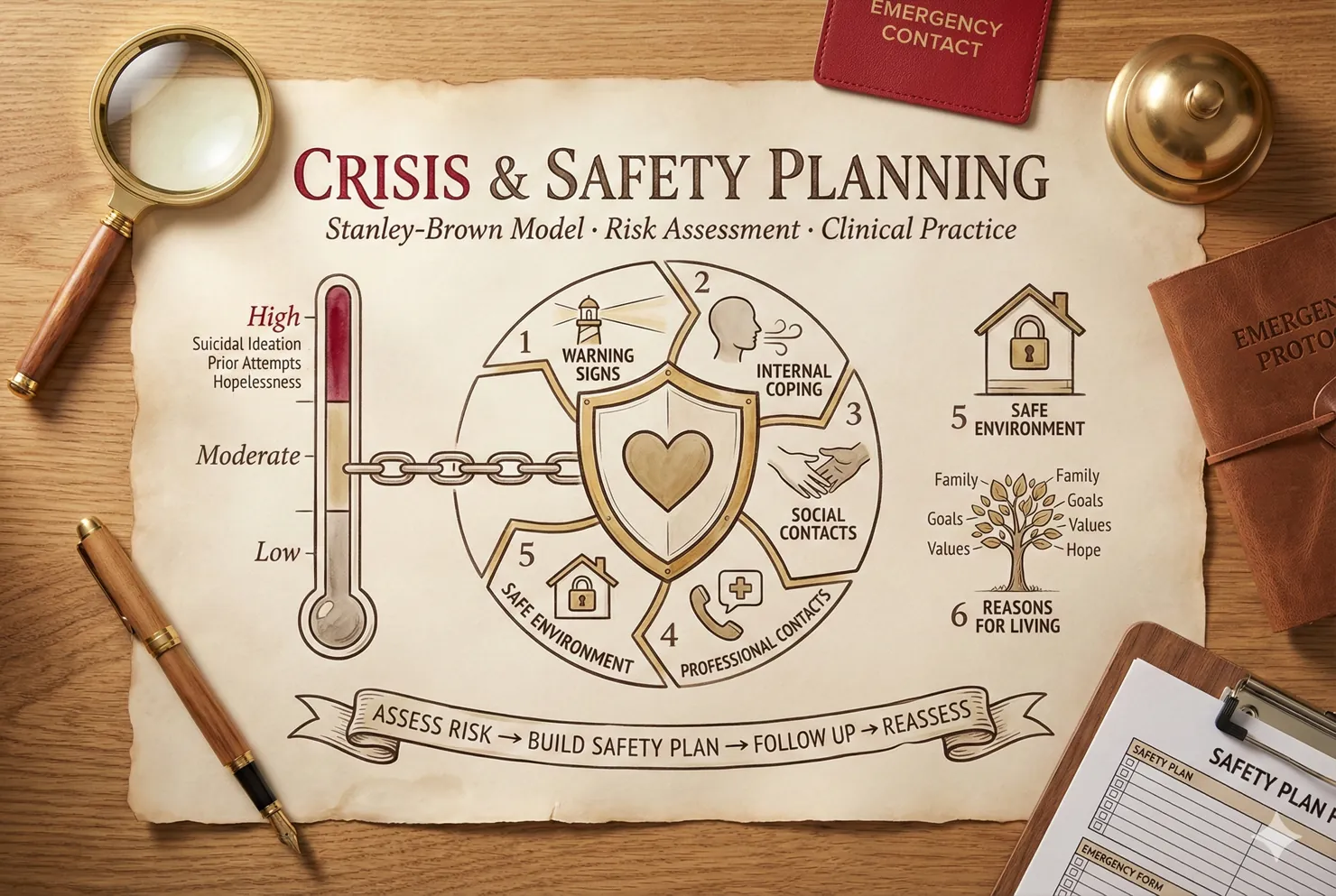
The most widely used model during a crisis is Stanley and Brown's (2012) 6-step safety plan: warning signs, internal coping, social distraction, people to ask for help, professional support, and making the environment safe. This guide walks through the plan's 6 steps with a completed case example.
When You Hear That Sentence
The session is flowing normally. Your client is talking about the past week, mentioning an argument with a friend. Then they pause mid-sentence, look away, and add: "Sometimes I think it would be easier to just not exist."
Most therapists remember this moment. Your heart rate jumps, you stop taking notes, and your mind begins a rapid risk assessment. This moment marks a critical turning point that requires documentation beyond your session note.
In this post, we cover the entire crisis and safety planning process: how to structure a risk assessment, the 6 steps of Stanley and Brown's (2012) evidence-based safety planning model, the post-crisis follow-up process, and how all of this comes together in a concrete clinical example.
Why Safety Plans Should Be Created Before, Not During, a Crisis
Many therapists create safety plans in the moment of crisis. Yet Stanley and Brown (2012) emphasize that safety plans are most effective when created before a crisis emerges, at the time risk is first assessed. Proactive planning provides assurance for both therapist and client: the client knows what to do during a crisis, and the therapist knows their clinical decisions are documented.
Jobes (2016) demonstrated that working with suicide risk is one of the most anxiety-provoking clinical situations for therapists and that this anxiety directly affects documentation quality. A structured crisis plan provides a framework that enables the therapist to act systematically even in moments of panic.
Luepker (2012) emphasizes that crisis documentation carries not only clinical but also legal value. Transparently recording which risk factors were assessed, which intervention decisions were made, and their rationales both improves care quality and protects the therapist in potential legal proceedings.
Risk Assessment: What to Ask, How to Document
Risk assessment has two dimensions: risk factors and protective factors. The Columbia-Suicide Severity Rating Scale (C-SSRS) developed by Posner et al. (2011) evaluates suicidal ideation on a continuum. This continuum forms the basis for determining the level of intervention:
- Passive ideation: Decreased wish to live, such as "I wish I didn't exist." Does not include an active desire for death or a plan.
- Active ideation, no plan: "I want to die but I don't know how." The thought is not specific.
- Active ideation, specific plan: Method, place, or time has been identified. Access to means becomes a critical question.
- Active ideation with intent: "I am going to do this." There is determination beyond the thought.
- Preparatory behavior: Concrete steps such as writing farewell letters, giving away possessions, or acquiring means. Requires immediate psychiatric evaluation.
Each point on this continuum requires a different level of intervention. Passive ideation can generally be managed in outpatient treatment, while preparatory behavior requires emergency psychiatric evaluation and possible hospitalization.
Risk Factors
Previous suicide attempt history (the strongest predictor), active plan and intent, access to lethal means, hopelessness and helplessness, social isolation, substance use, recent loss or crisis, chronic pain or physical illness, family history of suicide.
Protective Factors
Strong social connections and family support, future plans and goals, religious or cultural beliefs, therapeutic alliance and treatment adherence, sense of responsibility for children or dependents, problem-solving skills.
The Stanley-Brown Safety Plan: 6 Steps
Stanley and Brown's (2012) safety planning intervention aims to create a concrete action plan that the client can follow step by step during a crisis. Randomized controlled trials have shown that this model significantly reduces suicidal behavior. The plan's effectiveness comes from being created collaboratively with the client and being prepared before the crisis moment.
Each step operates on a ladder logic where each activates when the previous one proves insufficient. The client first tries to cope alone; if that is not enough, they turn to their social circle; if that is not enough, they contact professional support.
Step 1: Warning Signs
Personal signals indicating the crisis is escalating. These may be thoughts ("nothing matters"), physical sensations (chest tightness, shortness of breath), emotions (sudden feeling of emptiness), or behaviors (self-isolation, turning off the phone). Each client's warning signs are different; building this list from the client's own experiences is essential.
Step 2: Internal Coping Strategies
Methods that can be done alone, without contacting anyone. Going for a walk, washing the face with cold water, breathing exercises (such as the 4-7-8 technique), listening to music, or physical activity. The goal is to temporarily reduce the intensity of crisis thoughts enough to move to the next step.
Step 3: Social Distraction
People to contact or places to go solely for changing the environment and being around others, without mentioning the crisis. Inviting a friend for tea, going to the library, or visiting a neighbor. The purpose at this step is not to talk about the crisis but to break isolation.
Step 4: Trusted People to Ask for Help
People to whom the crisis can be openly disclosed and support requested. Family members or close friends to whom one can say "I am not okay, I need help." Names and contact information should be written down; decision-making becomes difficult during a crisis, so having numbers ready is critical.
Step 5: Professional Support and Resources
Therapist phone number, psychiatrist contact information, crisis hotline, emergency services, and nearest emergency room address. Clarifying which number to call during off-hours is particularly important.
Step 6: Making the Environment Safe
Restricting access to means of harm. Safely storing medications (keeping only daily doses at home), locking sharp objects, removing firearms from the environment if present. Bryan and Rudd (2018) emphasize that means restriction is the single most effective intervention in reducing suicidal behavior.
Clinical Example: Deniz, 22, University Student, Major Depression
Deniz is a third-year psychology student living away from family for university. He recently experienced a breakup, failed 2 courses, and his social circle has narrowed. During session 7, he reported passive suicidal ideation.
Risk Assessment
Risk Factors: Passive suicidal ideation (past 2 weeks, 2-3 times per week), social isolation (new city, limited friend circle), academic failure (2 courses failed), recent relationship loss. Active plan was queried and not present. Access to means was queried with no identified risk.
Protective Factors: Close relationship with mother (weekly video calls), career goal (becoming an engineer), regular therapy attendance, no substance use, no history of prior attempts.
Risk Level: Moderate. Passive ideation present, no active plan or intent, protective factors functional.
Safety Plan
Warning Signs: The thought "nothing matters" arising, the urge to shut himself in his room and turn off his phone, lying awake staring at the ceiling.
Internal Coping: Going for a walk around campus, washing face with cold water, listening to his favorite playlist, 4-7-8 breathing exercise.
Social Distraction: Inviting roommate Mert for tea, going to the campus library (being around people).
People to Ask for Help: Mother Sevgi (phone number on file), roommate Mert (same apartment).
Professional Support: Therapist (phone number on file, office hours), university counseling center, national crisis hotline, nearest emergency room.
Environmental Safety: No excess medication kept at home (daily doses only). Sharp objects in locked kitchen drawer.
Clinical Decision
Continue outpatient treatment. Session frequency increased from weekly to twice weekly. Safety plan created collaboratively with client and saved to his phone. Mother informed with client's consent. Psychiatry consultation planned.
Post-Crisis: Follow-Up and Review
The first session following a crisis episode is one of the most critical moments in treatment. This session serves three core functions: crisis analysis (what triggered it, how it escalated, how it resolved), safety plan review (which steps were used, which worked, which couldn't be applied), and plan revision.
Post-crisis evaluation also serves as a trigger for reviewing the treatment plan. A crisis may signal that something in the formulation needs updating or that treatment goals require reprioritization. Increasing session frequency, psychiatry consultation, or stepping up to a more intensive level of care are also evaluated at this stage.
5 Core Principles of Crisis Management
Create the Safety Plan Together With Your Client
Stanley and Brown (2012) emphasize that the safety plan's effectiveness comes from the client's active participation. A form filled out by the therapist alone becomes a piece of paper the client doesn't own during a crisis. Having the client fill each step in their own words, with details specific to their life, increases the likelihood of the plan being used in real situations.
Keep the Plan Accessible
A safety plan stored in a filing cabinet is useless during a crisis. Take concrete accessibility steps: save a copy to the client's phone, create a wallet card, or post it on the refrigerator. Decision-making capacity decreases during a crisis, so having the plan physically reachable is vital.
Repeat Risk Assessments
Risk assessment is not a one-time procedure. Reassess when life circumstances change (loss, relationship crisis, job loss), when clinical deterioration is observed, or when significant mood shifts occur. Regular risk screening helps prevent unexpected crises.
Document Your Clinical Decisions With Rationale
Luepker (2012) emphasizes that crisis documentation must clearly record what information was gathered, what decisions were made, and why. "Continued outpatient treatment" alone is insufficient; rationale such as "no active plan or intent, protective factors functional, session frequency increased" makes your clinical reasoning visible.
Update the Safety Plan After Every Crisis
Every crisis episode tests the safety plan. Steps that couldn't be applied, people who couldn't be reached, or strategies that proved ineffective may emerge. Reviewing and updating the plan in the first post-crisis session provides stronger preparation for the next potential crisis.
Common Mistakes
Only Creating Plans for Active Suicidal Ideation
Safety plans should be created not only when active suicidal ideation is present, but also when passive ideation, self-harm risk, or acute crisis potential is identified. Proactive planning is far more effective than reactive intervention during a crisis. Even when risk level is low, having a written plan provides security for both client and therapist.
Filling Out the Safety Plan Without the Client
A safety plan that the therapist fills out alone after the session and files away cannot go beyond being a form. The client should identify their own warning signs, coping strategies, and trusted people. This process is also a therapeutic intervention in itself: it helps the client recognize their own resources.
Not Documenting the Risk Assessment
When risk assessment is conducted but not documented, serious gaps arise in both clinical tracking and potential legal proceedings. Which questions were asked, the client's responses, assessed risk and protective factors, and the clinical decision with its rationale should all be recorded in writing.
Not Following Up After a Crisis
Returning to the normal session flow after an acute crisis has passed is a common tendency. However, the post-crisis period is the most vulnerable window for a new crisis. Bryan and Rudd (2018) demonstrated that the first 4 weeks post-crisis represent a critical risk window. Increasing session frequency, reviewing the safety plan, and revising the treatment plan should be prioritized during this period.
Crisis Management and Documentation with Mindora
Mindora offers structured templates for every stage of crisis management:
- Emergency Risk Assessment (Triage): Rapid risk screening at the first moment of crisis, risk indicator checklist, protective factors, and emergency decision.
- Crisis Assessment and Safety Plan: A structure combining comprehensive risk assessment with the 6 steps of the Stanley-Brown safety plan in a single template.
- Stanley-Brown Safety Plan: A template focused on the evidence-based 6-step safety plan, designed to be completed collaboratively with the client.
- Post-Crisis Follow-Up (Debriefing): A structured follow-up template for crisis analysis, safety plan review, and stabilization steps.
All crisis documents can be linked to other client notes (formulation, session notes, treatment plan) within the clinical documentation system. When the crisis plan is updated, previous versions are preserved so the change process can be tracked.
Frequently Asked Questions
References
- Stanley, B. & Brown, G. K. (2012). Safety planning intervention: A brief intervention to mitigate suicide risk. Cognitive and Behavioral Practice, 19(2), 256-264.
- Jobes, D. A. (2016). Managing Suicidal Risk: A Collaborative Approach (2nd ed.). Guilford Press.
- Bryan, C. J. & Rudd, M. D. (2018). Brief Cognitive-Behavioral Therapy for Suicide Prevention. Guilford Press.
- Luepker, E. T. (2012). Record Keeping in Psychotherapy and Counseling (2nd ed.). Routledge.
- Posner, K., Brown, G. K., Stanley, B., Brent, D. A., Yershova, K. V., Oquendo, M. A., ... & Mann, J. J. (2011). The Columbia-Suicide Severity Rating Scale: Initial validity and internal consistency findings from three multisite studies with adolescents and adults. American Journal of Psychiatry, 168(12), 1266-1277.