Clinical Hypothesis: The Formulate, Test, and Update Cycle
Selin's panic attacks looked like "panic disorder" — but when three months of interoceptive exposure produced limited progress, the problem was the hypothesis itself. The attacks were tied not to bodily sensations but to evaluation situations. Therapists who systematically test clinical hypotheses and update them based on evidence use formulation as a "living working document." In this guide, we'll examine the clinical hypothesis building and testing cycle through a concrete case, drawing on theoretical ground from Popper's falsifiability principle to Kuyken and colleagues' collaborative conceptualization model, Wason's confirmation bias research to Bennett-Levy's behavioral experiments framework.
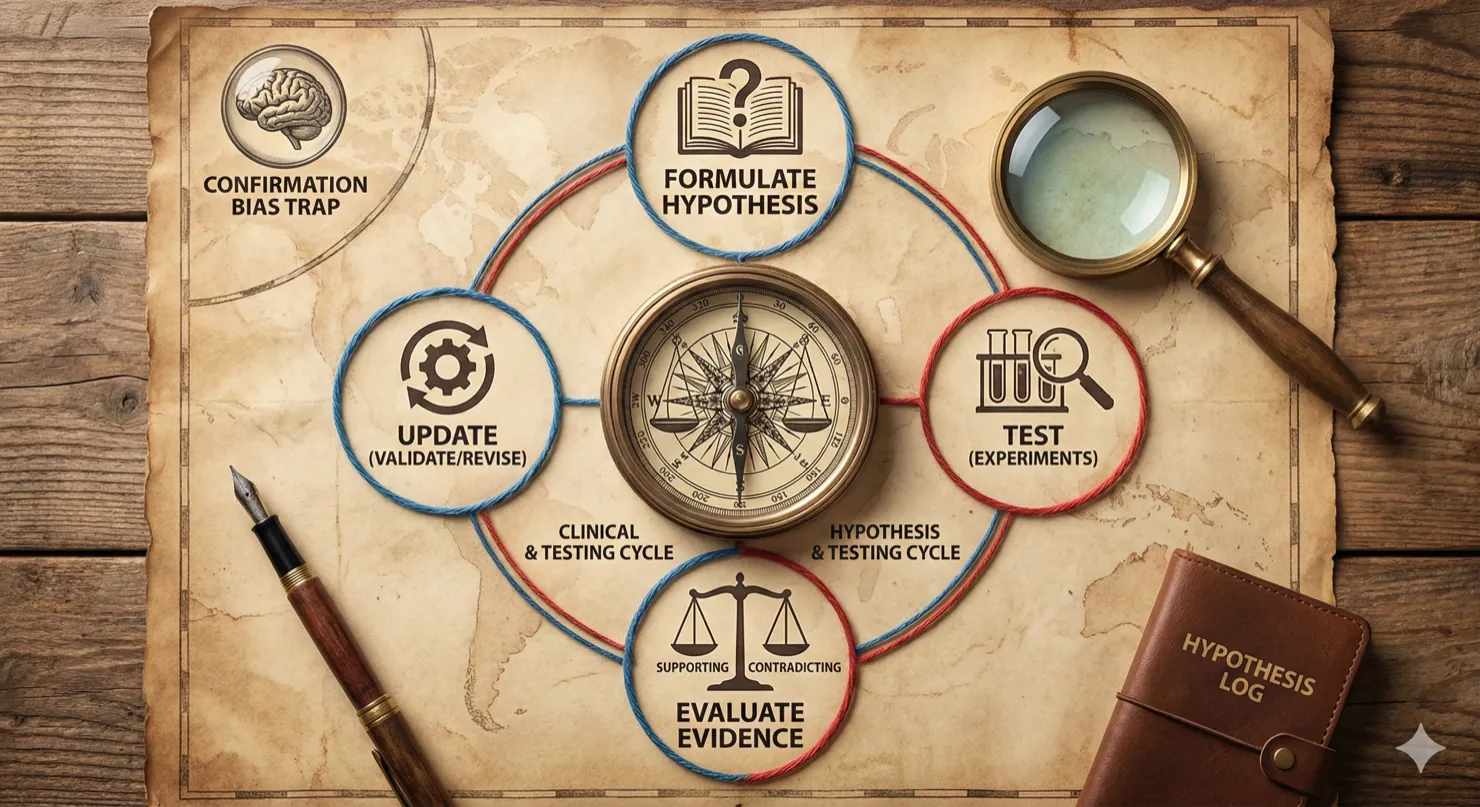
Effective clinical hypothesis work follows a four-step cycle: Generate, Test, Evaluate, Update. This guide covers hypothesis categories, the evidence-balance method (protection against confirmation bias), and a completed hypothesis example.
"Panic Disorder" or Wrong Hypothesis?
You've been seeing Selin for three months. She's 28, a graphic designer. She's been having panic attacks for six months — heart palpitations, shortness of breath, a feeling of "I'm dying." Her previous therapist worked with a "panic disorder" diagnosis: breathing exercises, interoceptive exposure, bodily sensation diary. After three months, Selin quit therapy: "I'm doing the breathing exercises but the attacks continue." Now she's sitting across from you, asking the same question: "Why am I not getting better?"
In your first few sessions, you listened carefully — and noticed a pattern. Selin's panic attacks weren't random: before client presentations, when asked for her opinion in work meetings, when friends asked "what do you think?" at dinner. At home alone, while jogging, or at a café with a close friend — never a single attack. The bodily sensations (heart palpitations, sweating) weren't triggers but consequences — the real trigger was "being evaluated." The previous therapist's hypothesis wasn't wrong, it was incomplete: instead of "fear of bodily sensations," "panic responses tied to social evaluation anxiety" was a more accurate explanation. When the hypothesis changed, the treatment direction changed — and Selin started improving.
In this article, we'll examine how to build clinical hypotheses, systematically test them, and update them in light of new evidence. We'll explore the clinical hypothesis building and testing cycle through a concrete case, on the theoretical ground spanning Popper's (1963) falsifiability principle to Kuyken, Padesky, and Dudley's (2009) collaborative conceptualization model, Wason's (1960) confirmation bias research to Bennett-Levy and colleagues' (2004) behavioral experiments framework.
What does systematically testing and updating a clinical hypothesis add to a formulation?
- Mechanism, not just diagnosis: A DSM label answers "what"; a hypothesis drills into "through which mechanism, in this client."
- Confirmation bias is broken: Evidence balance forces you to see the disconfirming evidence for every hypothesis, not just the supporting evidence.
- The wrong direction is caught early: An incomplete hypothesis doesn't drag on for months; the direction is corrected the moment disconfirming evidence appears.
- The formulation stays alive: Because the hypothesis status can be updated, the formulation becomes a working tool rather than a frozen document.
Why the First Hypothesis Is Usually Incomplete
A common tendency in clinical work is equating diagnosis with hypothesis. As Persons (1989) emphasizes, a DSM diagnosis is a starting point but not an individualized formulation. The DSM-5 "panic disorder" diagnosis fits Selin — but it doesn't explain why her panic specifically occurs in evaluation situations. A clinical hypothesis goes one step beyond diagnosis to explain the individual mechanism: "Selin's panic responses are triggered by activation of a 'defectiveness' schema in evaluation situations." This statement is testable, falsifiable, and determines the treatment direction — in ways a diagnostic label cannot.
As Eells (2007) emphasizes, hypothesis-driven therapy — treating the formulation as a hypothesis and testing it in each session — produces more effective outcomes. But for most therapists, a hypothesis is the first impression formed in their mind and is rarely systematically tested. Wason's (1960) famous 2-4-6 experiment showed that people tend to seek evidence confirming their hypotheses — rather than searching for disconfirming evidence. Nickerson (1998) emphasizes that this confirmation bias is a powerful threat in clinical work as well: the therapist notices session material supporting the initial hypothesis and overlooks contradicting material.
In Selin's case, confirmation bias operated like this: after the previous therapist established the "panic disorder — bodily sensation fear" hypothesis, every session involved questioning bodily symptoms — and Selin responded to these questions, because of course there are heart palpitations and shortness of breath during panic. But the question "when do these attacks NOT happen?" was never asked. The formulation components we examined in our previous articles — triggers, themes, coping mechanisms, values, critical life events — are natural evidence sources that test the hypothesis's accuracy. Selin's trigger map (social evaluation situations), theme analysis ("defectiveness" schema), and critical life events (mother's perfectionist criticism patterns) — all contradicted the "interoceptive fear" hypothesis and supported the "social evaluation" hypothesis.
Clinical Hypothesis: Definition and Categories
Popper's (1963) fundamental principle in philosophy of science — that a statement must be falsifiable to count as scientific — applies to clinical hypotheses as well. "Selin's problems stem from her childhood" is not a hypothesis but an observation; it's unfalsifiable because any problem can somehow be linked to childhood. "Selin's panic responses are triggered by activation of a 'defectiveness' schema in evaluation situations" is a hypothesis — it's testable (panic occurring in a non-evaluative situation would refute it), specific (which schema, which trigger), and determines the treatment direction (schema work and behavioral experiments in social evaluation situations).
Eells (2007) categorizes clinical hypotheses by function, and this classification is critical for systematic formulation. In Selin's case, four categories work together.
- Trigger hypothesis (when?): Explains when the problem occurs; for Selin, "before client presentations, when evaluation expectation is present."
- Maintaining factor hypothesis (why does it continue?): Explains why it continues; after each panic Selin avoids the presentation for short-term relief, and this avoidance reinforces the "I'll look incompetent" belief without ever testing it.
- Underlying mechanism hypothesis (how does it work?): Explains how it works; evaluation situation → schema activation → catastrophic interpretation → physiological alarm → panic.
- Origin hypothesis (where did it start?): Explains where it started; mother's perfectionist criticism patterns, conditional approval in childhood.
These categories complement each other and together create a holistic formulation.
Different therapeutic approaches generate different hypotheses for the same case — and this richness is not a weakness but the strength of clinical pluralism. From a CBT perspective, Selin's hypothesis: "Automatic thoughts in evaluation situations trigger catastrophic interpretation, leading to physiological alarm." From a schema therapy perspective: "An early maladaptive defectiveness schema activates in performance situations, engaging a maladaptive coping mode." From a psychodynamic perspective: "The conditional approval experience in the relationship with the mother repeats as a transference reaction in performance situations." As Tarrier and Johnson (2015) emphasize, these hypotheses don't exclude each other — they explain different levels of the same phenomenon. A clinical hypothesis is not about "finding the right answer" but about "building the most explanatory framework."
Hypothesis Testing Cycle: Formulate, Test, Evaluate, Update
Kuyken, Padesky, and Dudley's (2009) collaborative conceptualization model places hypothesis testing at the center of therapy. The model follows a four-stage cycle: hypothesis formulation (developing a clinical explanation from session material), hypothesis testing (through behavioral experiments, Socratic questioning, or observation), evidence evaluation (weighing supporting and contradicting findings), and hypothesis updating (confirming, refuting, or revising). In Selin's therapy, this cycle operated concretely: "My panics are caused by bodily sensations" hypothesis → experiment observing bodily sensations in a non-evaluative situation (gym — high heart rate but no panic) → finding that bodily sensations alone don't create panic → hypothesis revised: "My panics are caused not by bodily sensations but by fear of evaluation."
Bennett-Levy and colleagues' (2004) behavioral experiments guide presents the most powerful clinical tool for hypothesis testing. A behavioral experiment tests the client's belief through direct experience — far more effective than verbal discussion. Three behavioral experiments were used in Selin's hypothesis testing. First experiment: high heart rate but no evaluation — climbing stairs, heart palpitations, no panic; bodily sensation alone is not the trigger. Second experiment: low physiological arousal but evaluation present — being asked for an opinion in a quiet meeting, normal starting heart rate, "everyone's watching me" thought, then heart rate rising and panic starting; evaluation expectation is the actual trigger. Third experiment: making a "small mistake" in an evaluation situation — deliberately skipping a detail in a presentation, expecting "catastrophe" but the actual result: nobody noticed; catastrophic interpretation refuted.
Padesky's (1993) Socratic questioning approach is a hypothesis testing tool that complements behavioral experiments. Socratic questioning guides the client's own discovery — the therapist doesn't impose a conclusion but opens discovery through questions. In Selin's therapy, this questioning progressed as follows: "In your last panic attack, you thought 'everyone will see my inadequacy' — what supported this thought?" (Selin: "My voice trembled, someone must have noticed.") "Is there evidence they noticed?" (Selin: "Actually, nobody said anything.") "When you consider the possibility they didn't notice, what do you feel?" (Selin: "Maybe I was blowing it out of proportion.") This process enables the client to test their own hypothesis and evaluate the evidence themselves.
Evidence Balance: Protecting Against Confirmation Bias
Wason's (1960) classic 2-4-6 experiment revealed the fundamental weakness in how people test hypotheses: participants sought examples that would confirm their hypothesis, never thinking to try examples that would refute it. In clinical work, this confirmation bias operates silently: when the therapist establishes the "Selin's problem is bodily sensation fear" hypothesis, they listen to sessions through this framework. They ask "Did you have heart palpitations today?" — yes, hypothesis confirmed. But they don't ask "Did you experience a social evaluation situation without a panic attack?" Nickerson (1998) states that confirmation bias is "one of the most common and most harmful cognitive biases" — because it's hard to detect and continuously self-reinforcing.
Evidence balance analysis is a structured protection mechanism against confirmation bias. The therapist collects evidence supporting the hypothesis on one side, contradicting evidence on the other, and evaluates both sides' strength on a 0-10 scale. For Selin's "bodily sensation fear" hypothesis: supporting — intense bodily symptoms during panic (strength: 6/10), bodily sensation focus expressed in some sessions (strength: 4/10). Contradicting — panic attacks occurring only in evaluation situations (strength: 9/10), bodily sensations during exercise or alone not creating panic (strength: 8/10), clear social evaluation pattern in trigger map (strength: 8/10). Total supporting strength: 5/10. Total contradicting strength: 8/10. This balance clearly indicates the hypothesis needs revision.
The critical question Bieling and Kuyken (2003) ask — "Is cognitive case formulation science or science fiction?" — depends on hypothesis updating culture. Formulation becomes science only when hypotheses are revised based on evidence. In Selin's therapy, the hypothesis updating process progressed in three stages: initial hypothesis ("bodily sensation fear → panic") → contradicting evidence and behavioral experiments → revised hypothesis ("defectiveness schema activation in evaluation situations → social anxiety-based panic responses") → new testing (schema work and behavioral experiments in social evaluation situations) → confirming evidence (deliberate mistake in presentation → no catastrophe, panic level decreased). Tarrier and Johnson (2015) call this cyclical updating a "living formulation" — the formulation is not a document written once but a continuously updated working hypothesis.
Filled Example: Clinical Hypothesis and Evidence Balance
Selin, 28 years old, graphic designer. Has been experiencing panic attacks for six months. Previous therapist worked with "panic disorder — interoceptive fear" hypothesis for three months with limited progress. New therapist revised the hypothesis following trigger mapping and theme analysis.
Section 1 — Clinical Hypothesis Record (Revised Hypothesis)
Hypothesis Title: Panic responses tied to social evaluation anxiety — defectiveness schema. Hypothesis Explanation: Selin's panic responses originate not from sensitivity to bodily sensations but from activation of the "I'll look incompetent" schema in evaluation situations. When the schema activates, a catastrophic interpretation ("everyone will see my mistake") → physiological alarm → panic symptoms chain engages. Bodily symptoms are not the trigger but the consequence of this chain. Hypothesis Category: Underlying Mechanism Hypothesis (How does it work?). Related Themes: "Defectiveness/Shame" schema — within the early maladaptive schemas framework. Related Triggers: Client presentation, being asked for opinion in meetings, "what do you think?" question at social dinner — all situations containing performance evaluation. Related Coping Mechanisms: Avoidance (last-minute withdrawal from presentations), over-preparation (compensation), post-presentation rumination. Related Symptoms: Panic attacks, sleep disturbance the night before presentations, chronic tension. Hypothesis Status: Validated — evidence supports it. Status Explanation: Following three behavioral experiments and evidence balance analysis, the bodily sensation hypothesis was refuted and the social evaluation hypothesis was validated.
Section 2 — Hypothesis Testing and Evidence Balance
Observations Supporting the Hypothesis: (1) All panic attacks occur in social evaluation situations — meetings, presentations, social dinners — without exception. (2) No panic attacks while alone, during exercise, or with close friends; high heart rate during exercise doesn't create panic. (3) "Defectiveness" schema dominant in theme analysis — childhood-rooted "they'll see my mistakes" belief. (4) Behavioral experiment: deliberate mistake in presentation → catastrophe expectation didn't materialize → panic level notably decreased compared to previous presentations. Supporting Evidence Strength: 9/10. Observations Contradicting the Hypothesis: (1) In some sessions, Selin expresses bodily sensation focus — however, this focus occurs only in situations with evaluation expectation, not randomly. (2) Once experienced "strange heart palpitations" while alone at home — but it didn't develop into a panic attack. Contradicting Evidence Strength: 3/10. Evidence Balance Analysis: Supporting evidence clearly dominant (9/10 vs 3/10). Bodily sensation focus is not an independent trigger but a symptom of social evaluation anxiety. Hypothesis Status Update: "Social evaluation → defectiveness schema activation → panic" VALIDATED. "Bodily sensation fear → panic" REFUTED. Alternative Hypotheses: (1) Mixed model: social evaluation as primary trigger, bodily sensation as secondary amplifier — to be monitored. (2) Perfectionism dimension: high standards schema may also contribute alongside defectiveness — to be tested through detailed examination of the mother relationship.
5 Principles for Effective Clinical Hypothesis Work
Formulate the Hypothesis in Falsifiable Terms
Popper's (1963) principle directly applies to clinical work: a hypothesis provides information only when it's falsifiable. "Selin's problems stem from her childhood" is unfalsifiable — but "Selin's panic responses originate from a defectiveness schema activated in evaluation situations" is falsifiable. When formulating each hypothesis, the question "what would refute this hypothesis?" should be asked. For Selin: "If panic occurs in a non-evaluative situation, the hypothesis is refuted." This question guarantees the hypothesis's testability and shows the therapist what to look for.
Track the Evidence Balance Systematically
The confirmation bias demonstrated by Wason (1960) and Nickerson (1998) is the most silent yet most powerful trap in clinical work. As a structured defense mechanism, evidence balance analysis should be used: for each hypothesis, collect supporting evidence on one side and contradicting evidence on the other, and evaluate both sides' strength. In Selin's therapy, this balance enabled the refutation of the "bodily sensation fear" hypothesis and the validation of the "social evaluation" hypothesis. Documenting at least one disconfirmation attempt for each hypothesis is the most effective protection against confirmation bias.
Build the Hypothesis Collaboratively with the Client
In Kuyken, Padesky, and Dudley's (2009) collaborative conceptualization model, a hypothesis is not an interpretation the therapist presents to the client but an explanation built together. The client's sense of ownership over the hypothesis directly affects treatment engagement and participation in hypothesis testing. In Selin's therapy, the hypothesis was built like this: "Have you noticed something — when do the panic attacks usually happen?" Selin thought and noticed the pattern herself: "Always situations where someone is watching me." This discovery is Selin's own insight — and creates a much more powerful therapeutic effect than an explanation imposed by the therapist.
Connect Each Hypothesis to Other Formulation Components
In Persons's (1989) individualized case formulation approach, a hypothesis is not an isolated component — it's directly connected to triggers, themes, coping mechanisms, values, and critical life events. Selin's hypothesis ("evaluation → defectiveness schema → panic") is fed by the trigger map (social evaluation situations), theme analysis ("defectiveness" schema), coping record (avoidance and over-preparation), values work (creativity value suppressed by performance fear), and critical life events (mother's perfectionist criticism patterns). A hypothesis that explicitly documents these connections ensures the formulation's integrity.
Use Behavioral Experiments to Test Hypotheses
As Bennett-Levy and colleagues (2004) demonstrate, behavioral experiments are the most powerful tool for hypothesis testing — because they test the client's belief through direct experience rather than verbal discussion. At least one behavioral experiment can be designed for each hypothesis: "If my hypothesis is correct, we should observe Y in situation X." In Selin's "evaluation fear" hypothesis, the experiment was clear: high bodily arousal but no evaluation (exercise) → no panic → bodily sensation alone is insufficient. Whatever the experiment's outcome, it generates clinical information: the hypothesis is either confirmed or refuted — both outcomes advance therapy.
4 Mistakes to Avoid
Anchoring to One Hypothesis While Ignoring Alternatives
The anchoring effect described by Nickerson (1998) is powerful in clinical work too: the first hypothesis formed serves as an "anchor" and the therapist unconsciously interprets all new information relative to this anchor. When Selin's previous therapist anchored to the "panic disorder — bodily sensation fear" hypothesis, they interpreted Selin's "it happens more in meetings" statement as "meeting stress increases bodily sensations" — without considering the alternative explanation (evaluation fear). When formulating each hypothesis, asking "what other explanation could there be for these symptoms?" and actively documenting at least one alternative hypothesis provides strong protection against the anchoring effect.
Basing the Hypothesis on Diagnosis While Skipping Individual Mechanism
The distinction Persons (1989) persistently emphasizes — diagnosis does not equal hypothesis — is frequently violated in practice. The logic of "the client has panic disorder, therefore the treatment protocol is interoceptive exposure" jumps directly from diagnosis to treatment, skipping the individual mechanism. In Selin's case, this logic failed: the DSM diagnosis was correct (panic disorder criteria were met) but the individual mechanism was different (not bodily sensation fear but social evaluation anxiety). A clinical hypothesis should go beyond the diagnostic category to answer "through which individual mechanism does this problem operate in this client?" Ten clients receiving the same diagnosis may have ten different mechanisms.
Never Updating the Hypothesis Status
As Bieling and Kuyken (2003) emphasize, formulation becoming "science" depends on hypotheses being updated based on evidence — but in practice, most hypotheses remain in the state they were first created. A hypothesis starts in "active inquiry" status and should be updated to "validated," "refuted," or "revised" as evidence accumulates. In Selin's previous therapy, the hypothesis was never updated for three months — even when contradicting evidence (no panic in non-evaluative situations) was observed, the hypothesis remained "bodily sensation fear." Regularly reviewing hypothesis status and evaluating it after each session is the fundamental condition of a "living formulation."
Treating a Validated Hypothesis as Permanent Truth
As Eells (2007) emphasizes, a clinical hypothesis is always a provisional explanation — even "validated" status means "supported by current evidence," not "definitive truth." Selin's "social evaluation → defectiveness schema → panic" hypothesis was validated and treatment progressed in this direction. But as therapy advances, a new layer may emerge: perhaps beneath the defectiveness schema there's also an "abandonment" schema, perhaps the evaluation fear is only related to authority figures and differs with peers. Keeping a validated hypothesis "open to updating in light of new evidence" rather than closing it as "completed" preserves the formulation's flexibility.
Clinical Hypothesis Work with Mindora
The hypothesis definition, six-category classification, connection to formulation components, four-stage status tracking, evidence balance analysis, and test planning we discussed in this article — documenting all of these in a structured way requires a systematic framework. Mindora's Clinical Hypothesis module offers two different templates for this need.
Clinical Hypothesis: Documents the comprehensive record of a clinical hypothesis. Includes hypothesis title and detailed explanation, six-category classification (trigger, maintaining, mechanism, origin, relational dynamic, other), connection to related themes, triggers, coping mechanisms and symptoms, four-stage status tracking (active inquiry, validated, refuted, revised), test methods, six-strategy test plan, and expected results sections.
Hypothesis Testing and Evidence Balance: Provides systematic analysis of supporting and contradicting evidence for a hypothesis. Includes notes and observations supporting the hypothesis, 0-10 supporting evidence strength, notes and observations contradicting the hypothesis, 0-10 contradicting evidence strength, evidence balance analysis, hypothesis status update, and alternative hypotheses sections. Functions as a structured protection mechanism against the confirmation bias discussed in this article.
You use these templates embedded in Mindora's clinical workflow: hypotheses and test cycles sit alongside the other formulation components in the client file. You create the records in a structured note editor where the six-category classification, four-stage status labels, and 0-10 evidence strength scales guide you toward systematic hypothesis testing.
MINDORA KNOWLEDGE GRAPHConnect the hypothesis to the whole formulationReference a hypothesis to its related theme note, trigger record, coping analysis, or critical life event so the entire formulation forms an interconnected whole.Explore the Knowledge GraphFrequently Asked Questions
References
- Bennett-Levy, J., Butler, G., Fennell, M., Hackmann, A., Mueller, M., & Westbrook, D. (2004). Oxford Guide to Behavioural Experiments in Cognitive Therapy. Oxford University Press.
- Bieling, P. J., & Kuyken, W. (2003). Is cognitive case formulation science or science fiction? Clinical Psychology: Science and Practice, 10(1), 52–69.
- Eells, T. D. (2007). Handbook of Psychotherapy Case Formulation (2nd ed.). Guilford Press.
- Kuyken, W., Padesky, C. A., & Dudley, R. (2009). Collaborative Case Conceptualization: Working Effectively with Clients in Cognitive-Behavioral Therapy. Guilford Press.
- Nickerson, R. S. (1998). Confirmation bias: A ubiquitous phenomenon in many guises. Review of General Psychology, 2(2), 175–220.
- Padesky, C. A. (1993). Socratic questioning: Changing minds or guiding discovery? Keynote address, European Congress of Behavioural and Cognitive Therapies, London.
- Persons, J. B. (1989). Cognitive Therapy in Practice: A Case Formulation Approach. W. W. Norton.
- Popper, K. R. (1963). Conjectures and Refutations: The Growth of Scientific Knowledge. Routledge.
- Tarrier, N., & Johnson, J. (2015). Case Formulation in Cognitive Behaviour Therapy (2nd ed.). Routledge.
- Wason, P. C. (1960). On the failure to eliminate hypotheses in a conceptual task. Quarterly Journal of Experimental Psychology, 12(3), 129–140.
This Article Is Part of the Formulation Series
This article is one of the deep-dive posts in the formulation series. You can access all posts in the series below.
Case Formulation Guide: 8 Building Blocks & the 5P Model
A comprehensive guide to case formulation in psychotherapy. Learn the 5P model, 8 building blocks, CBT/ACT/Schema Therapy approaches, and real clinical examples.
Session Notes in Therapy: Formats, Principles & Examples
Explore SOAP, DAP, and GIRP formats with real filled-out examples, plus approach-specific components, documentation principles, and common pitfalls to avoid.
Clinical Theme & Pattern Tracking: A Therapist's Guide
Learn how to identify recurring themes using the CCRT model and Schema Therapy framework, with concrete examples and practical principles for theme tracking.
Resource & Strength Analysis: A Therapist's Guide
Learn how to systematically identify and document internal and external resources using strengths-based models, with concrete examples and practical principles.
Coping Mechanisms in Therapy: A Therapist's Guide
Learn to map functional and dysfunctional coping mechanisms, safety behaviors, and comprehensive coping analysis with concrete clinical examples and principles.
Trigger Analysis & Mapping in Therapy: A Therapist's Guide
Learn to map internal and external triggers, understand the activation cycle, and distinguish precipitating from maintaining factors with examples.
Values Work and Life Domains in Therapy: A Therapist's Guide
Learn ACT-based value identification, life domain alignment analysis, and committed action with clinical examples and practical principles for therapists.
Critical Life Events and Turning Points: A Therapist's Guide
Document critical life events, analyze turning points with the Lazarus appraisal model, and integrate life-course analysis through concrete clinical examples.