Trigger Mapping: Understanding the Activation Cycle and Integrating It into Formulation
Writing "work stress" in the "trigger" box of your formulation is easy — but clinically insufficient. A trigger is far more than an external event: it's a chain formed by the interaction of internal cues, external context, and activated themes. In this guide, you'll learn to systematically map internal and external triggers and integrate the activation cycle into your formulation, drawing on evidence-based frameworks such as Clark's panic model and Ehlers and Clark's PTSD model, with concrete examples.
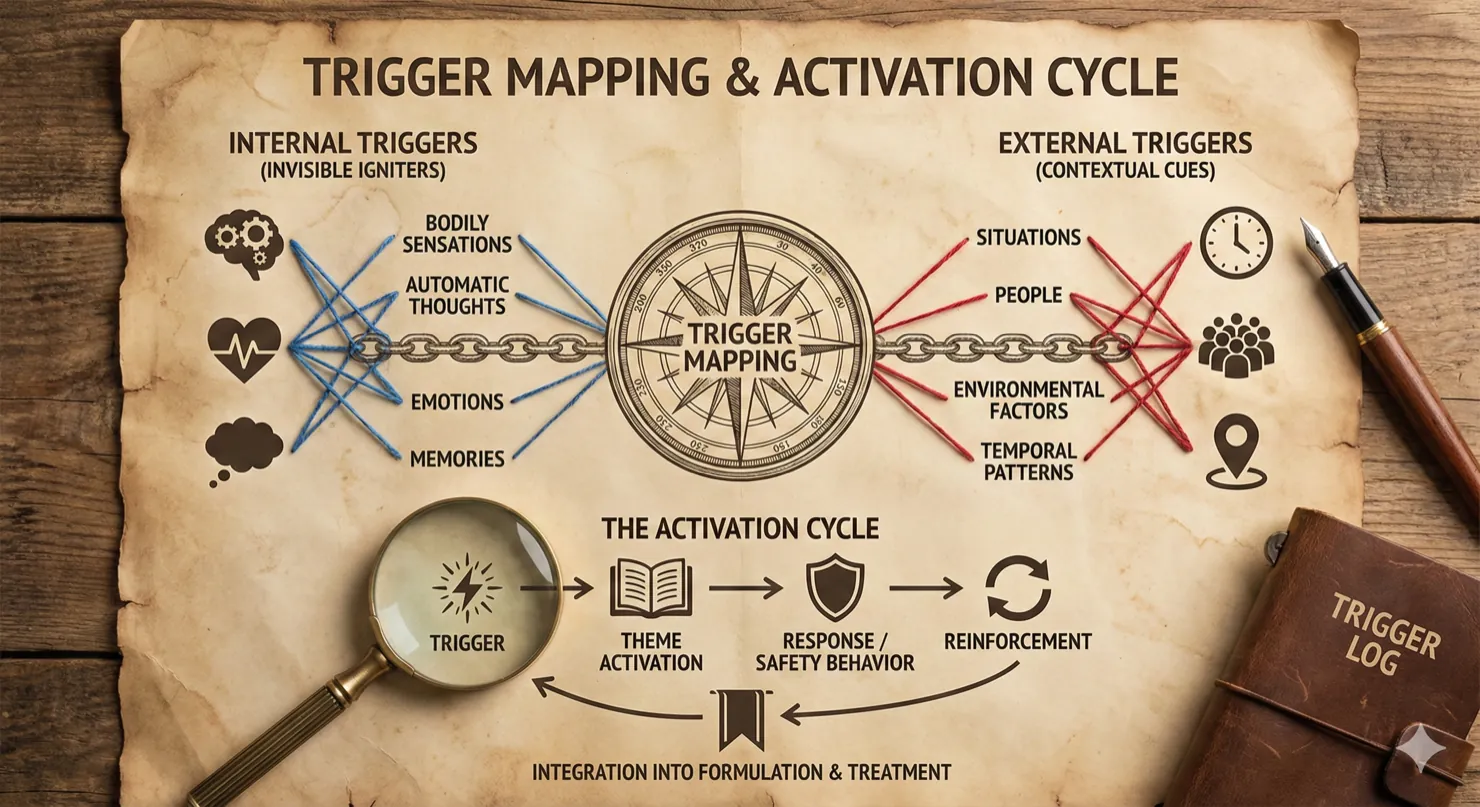
Is "Crowded Places" Really the Trigger?
You've been seeing Deniz for three months for panic attacks. When you asked about triggers in the first sessions, she said "crowded places," and you wrote that in your formulation. Your treatment plan shaped accordingly: gradual exposure to crowded environments. But in the sixth session, Deniz mentioned she had a panic attack in an empty office. There was no crowd — but there was panic. Your formulation's "trigger" definition is now insufficient.
A more careful examination reveals the picture is far more complex: the common feature of Deniz's panic attacks isn't crowds but "enclosed spaces where exit is difficult." And this external context alone isn't enough — the panic cycle begins with an increase in heart rate (interoceptive cue), intensifies with the automatic thought "I'm having a heart attack," and "resolves" with a safety behavior (heading for the exit). The "crowded places" label in the formulation was capturing only the most visible context of this three-link chain.
In this article, we'll examine why triggers need to be documented not with simple labels but with a systematic map — spanning the theoretical ground from Clark's (1986) panic model and Ehlers and Clark's (2000) PTSD model to Haynes and O'Brien's (2000) functional analysis framework and the precipitating-perpetuating distinction in Johnstone and Dallos's (2014) 5P model — through a concrete case.
Documenting triggers as a map provides four concrete gains:
- Intervention targets the right link: It becomes clear where to enter the trigger chain, so treatment doesn't stay superficial.
- Invisible triggers surface: Igniters the client doesn't notice — interoceptive cues and automatic thoughts — enter the record.
- Change becomes measurable: A 0-10 strength score for each trigger makes progress trackable throughout treatment.
- Precipitating and maintaining separate: The event that first triggered the problem is distinguished from the cycle that keeps it alive today, setting the right treatment sequence.
Why a Trigger List Isn't Enough
In clinical formulation, the term "trigger" is frequently used to mean "the event that started the problem" — but this definition greatly impoverishes the concept's clinical richness. Haynes and O'Brien's (2000) functional analysis framework defines a trigger not as an isolated event but as the starting link of a functional chain: trigger → theme/schema activation → coping mechanism → outcome → reinforcement. Skipping any link in this chain can misdirect the treatment plan. In Deniz's case, focusing only on the "enclosed space" external trigger ignores the interoceptive trigger (heart rate change) and the cognitive trigger (catastrophic interpretation) — and exposure therapy is applied without targeting the links that carry the chain's real power.
Persons's (2008) case formulation approach emphasizes the central role of trigger identification in formulation: correctly identified triggers show which schemas activate when, which coping mechanisms engage in which context, and which point treatment should target. The coping mechanisms we examined in our previous article are responses to triggers — without a trigger map, the coping map also remains incomplete.
Johnstone and Dallos's (2014) 5P model further differentiates the trigger concept: precipitating factors (life events that first triggered the problem) and perpetuating factors (current mechanisms that maintain the problem) are different and require different interventions. The event that started Deniz's panic disorder was a traffic accident three years ago (precipitating) — but what keeps the panic alive today is the cycle reinforced by interoceptive triggers, catastrophic interpretations, and safety behaviors (perpetuating). This distinction determines the treatment focus.
Internal Triggers: The Invisible Igniters
Internal triggers are stimuli arising from within the client's inner world that activate problematic cycles: emotions, automatic thoughts, bodily sensations, memories, and impulses. Clark's (1986) cognitive model of panic disorder most clearly demonstrates the power of internal triggers. According to the model, the panic cycle begins when a bodily sensation (heart palpitations, dizziness, shortness of breath) is paired with a catastrophic interpretation: "My heart is racing → I'm having a heart attack." This interoceptive trigger can activate anywhere, independent of external context — Deniz's panic attack in an empty office reflects precisely this mechanism.
Ehlers and Clark's (2000) post-traumatic stress disorder (PTSD) model reveals another powerful form of internal triggers: involuntary memory intrusions. Traumatic experience is stored in memory with its sensory details — a smell, a sound, a touch — out of context. These sensory fragments function as triggers in daily life at unexpected moments: a braking sound, a particular perfume, or a specific body position can "take" the person back to the trauma moment. These triggers are often not even in the client's awareness — the person suddenly feels anxious or panicked but cannot answer the "why" question. The therapist's task is to uncover these invisible connections through in-session observation and careful inquiry.
In Beck's (1976) cognitive model, automatic thoughts are a critical link in the trigger chain. Automatic thoughts — rapid, involuntary interpretations operating just below the threshold of awareness — activate emotional responses by framing an external event as "threat" or "loss." Deniz's noticing "My heart is beating very fast" as a bodily sensation doesn't create panic on its own — the real trigger is the interpretation "I'm having a heart attack" added to this sensation. When documenting internal triggers in the formulation, differentiating these layers — bodily sensation, automatic thought, emotional response — and drawing the causal chain between them is critically important.
From the perspective of Young and colleagues' (2003) Schema Therapy, internal triggers gain an additional dimension: internal experiences that activate early maladaptive schemas. A client with an "abandonment" schema doesn't just experience the external trigger (partner not calling) when their partner calls late — they also experience an internal emotional cue: a sudden sense of emptiness, chest tightness, the thought "they're going to leave me again." Schema activation cannot be explained by a single trigger dimension — the external cue (phone), bodily sensation (tightness), automatic thought ("will leave"), and emotional response (panic-mixed sadness) are intertwined. Comprehensive trigger mapping captures these layers together.
External Triggers: The Power of Context
External triggers are stimuli arising from the client's environment that initiate problematic cycles: situations, people, environmental factors, temporal patterns, and social contexts. Mowrer's (1960) two-factor learning theory explains how external triggers form: through classical conditioning, a neutral stimulus (enclosed space) becomes paired with a threat stimulus (traffic accident experience) and becomes a conditioned trigger; then through operant conditioning, avoidance behavior is reinforced because avoidance reduces anxiety in the short term. The combined operation of these two mechanisms increases the trigger's power over time — each successful avoidance raises anxiety even higher at the next encounter.
Using a categorical framework when documenting external triggers increases systematicity:
- Situations: Meetings, exams, air travel.
- People: Critical manager, rejecting partner, controlling parent.
- Environmental factors: Noise, crowds, darkness, enclosed spaces.
- Temporal patterns: Morning anxiety, Sunday evening restlessness, anniversary reactions.
- Social contexts: Loneliness, conflict, performance expectation.
These categories make it easier to see where triggers cluster. In Deniz's map, external triggers converge on the common theme of "spaces where exit is difficult": elevator, meeting room, airplane, subway, being stuck in traffic — not crowdedness but enclosure and perceived loss of control is the actual common factor.
A dimension emphasized in Barlow's (2002) anxiety disorders model is the predictability and controllability of external triggers. Predictable triggers (Monday morning meeting every week) create anticipatory anxiety but also offer preparation opportunity; unpredictable triggers (an elevator suddenly getting stuck) lead to more intense reactions because the sense of control is zero. Recording the frequency and predictability dimensions for each external trigger in documentation determines which triggers to target first in treatment planning: high frequency + low predictability combination generally has the highest clinical priority.
The Activation Cycle: From Trigger to Reinforcement
Trigger mapping gains meaning not just by listing triggers but by fully drawing the trigger → theme activation → coping → outcome → reinforcement chain. Haynes and O'Brien's (2000) functional analysis framework recommends documenting every link in this chain — because intervention can enter at any point. In Deniz's case, the cycle operates as follows: enclosed space (external trigger) → heart rate increase (interoceptive trigger) → "I'm having a heart attack" (catastrophic interpretation) → panic activation → heading for the exit (safety behavior) → relief → "good thing I left" attribution → safety behavior reinforcement → increased anticipatory anxiety at the next enclosed space.
The critical feature of this cycle is that it is self-feeding: the "success" of the safety behavior (panic passed because I left) prevents the catastrophic belief from being tested and increases anxiety at the next trigger encounter. Salkovskis's (1991) safety behaviors concept, which we examined in our previous article, reappears here — but this time from the trigger perspective: the safety behavior is not just a coping mechanism but also a maintaining factor that increases the trigger's power.
Comprehensive trigger analysis includes a "trigger → theme → response chain" section to make this cycle visible. Documenting the chains offers multiple entry points for treatment: targeting the trigger itself (exposure), targeting the interpretation given to the trigger (cognitive restructuring), targeting the coping response (safety behavior dropping), or targeting the outcome that reinforces the cycle (attribution change). Which link to target depends on the overall trigger map and the client's readiness level.
Precipitating and Maintaining: Two Different Trigger Layers
Johnstone and Dallos's (2014) 5P model clarifies a critical distinction in clinical formulation: precipitating factors are the life events that first triggered the problem; perpetuating factors are the mechanisms that maintain the problem today. The event that started Deniz's panic disorder was a traffic accident three years ago — the experience of losing control in an enclosed space (car) laid the groundwork for loading catastrophic meanings onto bodily sensations (heart rate, shortness of breath). But what keeps the panic alive today is not this past event: it's the cycle formed by current interoceptive triggers, catastrophic interpretations, and safety behaviors.
This distinction directly determines the treatment focus. Focusing on the precipitating factor (trauma processing, working with the past event) and focusing on perpetuating factors (breaking the current cycle) require different intervention strategies — and often both are needed, but sequencing matters. For Deniz, breaking the current cycle (interoceptive exposure, cognitive restructuring, safety behavior dropping) likely takes priority; processing the traffic accident experience can be addressed after the cycle is brought under control.
Structured documentation of precipitating factors — the primary precipitating event, secondary events, event types (traumatic experience, loss, relational crisis, health crisis, transition period), which problems they triggered, and clinical importance level — adds developmental depth to the formulation when read alongside the current trigger map. In Deniz's case, why the traffic accident (precipitating) so powerfully activates the "enclosed space + loss of control" theme cannot be understood by looking only at the current trigger map — but when the context of the precipitating event is added (being trapped in a car, helplessness until help arrived), it becomes clear why the current triggers took this specific form.
Filled Example: Comprehensive Trigger Analysis
Deniz, 28 years old, graphic designer. Presented for panic attacks. Had a traffic accident three years ago. Below is a completed comprehensive trigger analysis template for Deniz.
Section 1 — Internal Triggers
Internal Triggers Inventory: Increased heart rate (bodily sensation) — strongest interoceptive trigger, activates "I'm having a heart attack" automatic thought. Shortness of breath sensation (bodily sensation) — directly initiates the panic cycle. "I'm going to lose control" automatic thought — continuously active in the background in enclosed spaces. Anticipatory anxiety (emotion) — bodily tension increases from the morning before meetings or travel. Traffic accident memory (memory) — triggered by braking sounds or sudden deceleration.
Overall Internal Trigger Strength: 8/10
Section 2 — External Triggers
External Triggers Inventory: Enclosed spaces with difficult exits (elevator, meeting room, airplane) — strongest external trigger category. Work meetings, especially with manager present (situation + person) — reinforced by performance evaluation expectation. Being stuck in traffic (environmental factor) — directly connected to "I can't escape" feeling, reminiscent of the accident. Subway (crowd + enclosed space combination). Monday mornings (temporal pattern) — anticipatory anxiety peaks with the expectation of meetings throughout the week.
Overall External Trigger Strength: 7/10
Section 3 — Functional Analysis
Trigger → Theme → Response Chain: Enclosed space (external) → heart rate increase (interoceptive detection) → "I'm having a heart attack" (catastrophic interpretation) → panic activation (increased heart rate, sweating, trembling) → safety behavior (heading for exit, drinking water, calling spouse) → relief → "Good thing I left/called" attribution → safety behavior reinforcement → increased anticipatory anxiety at next enclosed space. Secondary chain: Braking sound (external) → accident memory (intrusion) → "It's going to happen again" thought → sudden anxiety increase → traffic avoidance.
Trigger Map: Internal triggers (interoceptive cues: heart rate, shortness of breath) create stronger activation than external triggers — Deniz can have panic attacks in empty offices because the interoceptive trigger operates independently of external context. The common theme of external triggers is "enclosure without escape route" — not crowdedness, but perceived loss of control is the actual factor. The connection between interoceptive detection (heart rate change) and catastrophic interpretation ("heart attack") is at the center of the panic cycle. Anticipatory anxiety spreads the cycle into daily life: Deniz begins to be triggered hours before a meeting.
Section 4 — Intervention Plan
Trigger-Focused Intervention Plan: Priority target — reducing the power of the interoceptive trigger: interoceptive exposure through exercises that deliberately increase heart rate (stair running, running in place), weakening the "heart rate increase = danger" connection. Second target — cognitive restructuring of catastrophic interpretation: testing the "heart rate increase = heart attack" belief with evidence, creating alternative explanations (exercise, excitement, caffeine also increase heart rate). Third target — gradual dropping of safety behaviors: first experiment of sitting in a meeting without a water bottle, then elevator use experiment. Fourth target — processing the traffic accident memory (after the cycle is brought under control). Strategies: Exposure, changing trigger response, theme-focused interventions.
5 Principles for Effective Trigger Documentation
Define Triggers Specifically, Avoid Generic Labels
As emphasized in Persons's (2008) case formulation approach, the quality of trigger identification directly determines the quality of the formulation. "Work stress" is a generic label — "the expectation of presenting at the weekly meeting with the manager present on Monday morning" is a specific trigger. Specificity also makes intervention specific: instead of generic "stress management," targeted interventions like pre-presentation breathing exercises and cognitive testing of catastrophic expectations can be planned.
Document the Interaction Between Internal and External Triggers
As Clark's (1986) model demonstrates, most clinical activations cannot be explained by a single trigger dimension — internal and external triggers interact to initiate the cycle. Deniz's panic is explained neither by "enclosed space" alone (external) nor by "heart palpitations" alone (internal): the increase in heart rate in an enclosed space combined with the catastrophic interpretation of this increase together activate the panic cycle. In documentation, draw this interaction explicitly: "In X external context, Y internal cue emerges and combines with Z interpretation to initiate activation."
Measure Trigger Strength Numerically
Assigning a 0-10 strength score to each trigger is valuable in three ways: it enables prioritization between triggers at initial assessment (the strongest triggers are typically treatment priorities), it allows tracking change during treatment (did the heart rate trigger's strength drop from 8 to 4 after interoceptive exposure?), and it creates a shared language with the client (Deniz can say "the meeting trigger was around 6 today"). Numerical measurement transforms subjective experience into an objective tracking tool.
Record the Temporal Patterns of Triggers
Triggers are not random — they show temporal patterns: specific times of day (morning anxiety), specific days of the week (Sunday evening restlessness), seasonal cycles (winter depression), and life periods (anniversary reactions). Deniz's anticipatory anxiety peaking on Monday mornings is a temporal trigger pattern. Documenting these patterns enables proactive intervention planning: preventive strategies like "Monday morning preparation routine" can be more effective than reactive intervention.
Transform the Trigger Map into Treatment Prioritization
The trigger map is valuable as an inventory — but its ultimate purpose is to inform the treatment plan. Three criteria guide prioritization: frequency (the most frequently encountered triggers impact daily life the most), intensity (the triggers creating the strongest activation cause the most distress), and modifiability (some triggers are more amenable to intervention — interoceptive triggers can be directly targeted with exposure, while a "critical manager" external trigger cannot be directly changed, but the response to it can).
4 Mistakes to Avoid
Limiting Triggers to Only What the Client Reports
Clients may not be aware of their triggers — especially internal triggers (interoceptive cues, automatic thoughts) and automatic schema activations can operate below the threshold of awareness. As demonstrated in Ehlers and Clark's (2000) PTSD model, sensory triggers (a smell, a sound) often cannot be identified by the client; the person suddenly feels anxious but cannot answer the "why" question. In-session observation (voice tone changes, body language, emotional shifts) and careful inquiry ("What did you notice in your body at that moment?") enable you to go beyond the client's self-report.
Confusing the Precipitating Event with the Maintaining Trigger
The precipitating-perpetuating distinction in Johnstone and Dallos's (2014) 5P model forms the foundation of the treatment plan. Focusing on the traffic accident that started Deniz's panic disorder (precipitating) and doing trauma processing work may seem logical — but without addressing the interoceptive triggers and safety behaviors that keep the current panic alive (perpetuating), the cycle won't break. Conversely, focusing only on current triggers while completely ignoring the precipitating event means missing the origin of the maintaining cycle. In your formulation, clearly separate these two layers and plan treatment sequencing accordingly.
Making a Trigger List While Skipping the Activation Mechanism
As emphasized in Haynes and O'Brien's (2000) functional analysis framework, it's not the trigger itself but the mechanism the trigger activates that is the target of treatment. Listing the "enclosed spaces" trigger doesn't answer "WHY do enclosed spaces create panic?" Which schema does it activate? Which automatic thought does it trigger? Which coping mechanism does it engage? And how does this coping mechanism reinforce the cycle? A trigger list that doesn't answer these questions adds no value to the formulation — the treatment plan also remains superficial, like "exposure to enclosed spaces."
Leaving the Trigger Map as a Static Document
Triggers change during treatment: some lose power (the heart rate trigger weakens after interoceptive exposure), new ones emerge (as progress is made in treatment, previously avoided situations are encountered and new triggers are discovered), and interaction patterns shift. Not updating the trigger map created at initial assessment causes the treatment plan to remain based on old data. Review the trigger map at regular intervals — especially when the treatment focus changes or new triggers are reported.
Trigger Mapping with Mindora
The internal-external distinction, activation cycle, functional analysis, and precipitating-perpetuating layers we discussed in this article — documenting all of these in a structured way requires a systematic framework. Mindora's Trigger module offers four different templates for this need.
Internal Trigger: Documents internal triggers in the form of emotions, thoughts, bodily sensations, memories, or impulses. Includes trigger type classification, client quotes, a 0-10 triggering strength scale, which themes it activates, triggered response, and intervention strategies (cognitive restructuring, exposure, mindfulness, emotion regulation).
External Trigger: Documents external triggers in the form of situations, people, environmental factors, temporal patterns, or social contexts. In addition to all dimensions of the internal trigger template, includes a frequency and predictability field — the ideal structure for the "frequency + predictability = clinical priority" assessment discussed in this article.
Comprehensive Trigger Analysis: Combines internal and external triggers in a single map. The Trigger → Theme → Response Chain section makes the activation cycle visible. Bridges from formulation to treatment through trigger map analysis and intervention plan sections.
Precipitating Factors: Documents the life events that started the problem: primary and secondary precipitating events, event types (traumatic event, loss, relational crisis, health crisis, work/career crisis, transition period, other), which problems they triggered, and clinical importance level (0-10). When read alongside the current trigger map, provides a developmental answer to "why are these triggers so powerful?"
In Mindora, trigger templates live in the client's clinical timeline; each trigger is documented in the structured note editor alongside its session, building a consistent trigger history over time.
MINDORA KNOWLEDGE GRAPHConnect triggers to the whole formulationLink each trigger to its related theme, schema, or coping note, and make the trigger → theme → coping chain visible in the Knowledge Graph.Explore the Knowledge GraphReferences
- Barlow, D. H. (2002). Anxiety and Its Disorders: The Nature and Treatment of Anxiety and Panic (2nd ed.). Guilford Press.
- Beck, A. T. (1976). Cognitive Therapy and the Emotional Disorders. International Universities Press.
- Clark, D. M. (1986). A cognitive approach to panic. Behaviour Research and Therapy, 24(4), 461–470.
- Ehlers, A., & Clark, D. M. (2000). A cognitive model of posttraumatic stress disorder. Behaviour Research and Therapy, 38(4), 319–345.
- Haynes, S. N., & O'Brien, W. H. (2000). Principles and Practice of Behavioral Assessment. Kluwer Academic.
- Johnstone, L., & Dallos, R. (2014). Formulation in Psychology and Psychotherapy (2nd ed.). Routledge.
- Mowrer, O. H. (1960). Learning Theory and Behavior. Wiley.
- Persons, J. B. (2008). The Case Formulation Approach to Cognitive-Behavior Therapy. Guilford Press.
- Salkovskis, P. M. (1991). The importance of behaviour in the maintenance of anxiety and panic: A cognitive account. Behavioural Psychotherapy, 19(1), 6–19.
- Young, J. E., Klosko, J. S., & Weishaar, M. E. (2003). Schema Therapy: A Practitioner's Guide. Guilford Press.
This Article Is Part of the Formulation Series
This article is one of the deep-dive posts in the formulation series. You can access all posts in the series below.
Case Formulation Guide: 8 Building Blocks & the 5P Model
A comprehensive guide to case formulation in psychotherapy. Learn the 5P model, 8 building blocks, CBT/ACT/Schema Therapy approaches, and real clinical examples.
Session Notes in Therapy: Formats, Principles & Examples
Explore SOAP, DAP, and GIRP formats with real filled-out examples, plus approach-specific components, documentation principles, and common pitfalls to avoid.
Clinical Theme & Pattern Tracking: A Therapist's Guide
Learn how to identify recurring themes using the CCRT model and Schema Therapy framework, with concrete examples and practical principles for theme tracking.
Resource & Strength Analysis: A Therapist's Guide
Learn how to systematically identify and document internal and external resources using strengths-based models, with concrete examples and practical principles.
Coping Mechanisms in Therapy: A Therapist's Guide
Learn to map functional and dysfunctional coping mechanisms, safety behaviors, and comprehensive coping analysis with concrete clinical examples and principles.
Values Work and Life Domains in Therapy: A Therapist's Guide
Learn ACT-based value identification, life domain alignment analysis, and committed action with clinical examples and practical principles for therapists.
Critical Life Events and Turning Points: A Therapist's Guide
Document critical life events, analyze turning points with the Lazarus appraisal model, and integrate life-course analysis through concrete clinical examples.
Clinical Hypothesis Building and Testing: A Therapist's Guide
Learn clinical hypothesis formulation, evidence balance analysis, and hypothesis testing cycles with concrete clinical examples and practical principles.