Critical Life Events: Integrating Developmental Context into Formulation
Can's grief response appeared "complicated" — but the complexity's source wasn't the magnitude of the loss but the unresolved layers of the father-son relationship. Therapists who document critical life events not as isolated incidents but as parts of a developmental context answer the formulation's "why" question. In this guide, we'll examine critical event recording and life periods analysis through a concrete case, drawing on theoretical ground from Lazarus and Folkman's cognitive appraisal theory to Elder's life course perspective, Neimeyer's meaning reconstruction to Rutter's turning point concept.
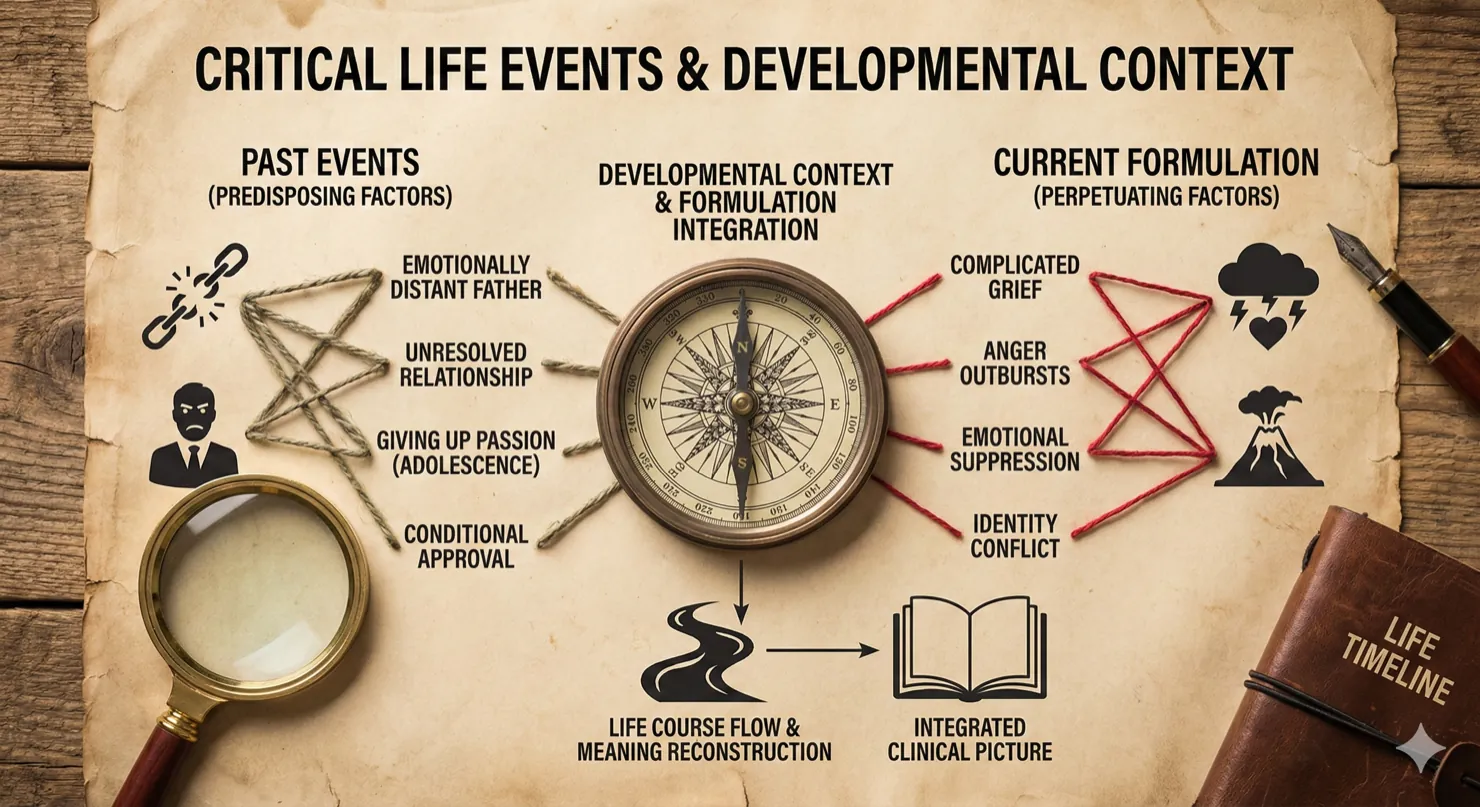
"Complicated Grief" or Unresolved Relationship?
You've been seeing Can for six months. He's 40, an elementary school teacher. He lost his father to lung cancer — after a three-month illness. Presenting concerns: anger outbursts, sleep disturbance, declining work concentration. Your initial formulation centered on "complicated grief": processing the loss, grief tasks, emotional expression. A reasonable framework — but in the eighth session, Can said something unexpected while talking about his father: "I'm not sad that I lost him — I'm angry that I never got to know him."
This sentence revealed a missing dimension in your formulation. Can's grief had become "complicated" not because of the loss's magnitude but because of the unresolved layers of the father-son relationship. An emotionally distant father in childhood ("boys don't cry"), the conflict between Can's passion for painting and his father's "get a real profession" pressure in adolescence, the attempt to get closer in adulthood but the regret of "things I couldn't say" — and finally, the hope during the illness that "maybe now we can talk" and the permanent closure of this hope with the father's death. The father's loss wasn't just a loss — it was the end of a dialogue that was never completed.
In this article, we'll examine why critical life events need to be documented not as isolated incidents but as parts of a developmental context. We'll explore critical event recording and life periods analysis through a concrete case, on the theoretical ground spanning Lazarus and Folkman's (1984) cognitive appraisal theory to Elder's (1998) life course perspective, Bowlby's (1980) attachment and loss framework to Neimeyer's (2001) meaning reconstruction approach.
What does documenting critical life events within their developmental context add to a formulation?
- The formulation's why question gets answered: Triggers, coping, and values describe what is happening; the developmental record answers why.
- Isolated events become a pattern: Cross-period thematic connections become visible instead of disconnected incidents.
- The past's present power becomes measurable: Scoring initial and current impact separately surfaces unprocessed losses.
- Positive turning points become resources: Not just traumas but protective turning points get added to the resource map.
Why an Event List Isn't Enough
Holmes and Rahe's (1967) Social Readjustment Rating Scale was a groundbreaking study that assigned objective stress scores to life events — but it falls short for clinical formulation. On the scale, "death of spouse" is 100 points, "job change" is 36; yet in clinical reality, it's commonplace for the same event to create entirely different effects in two different people. For Can, the father's loss wasn't just a 63-point stressor — it was the final closure of an unresolved relationship. Lazarus and Folkman's (1984) cognitive appraisal theory explains this difference: an event's impact is determined not by its objective magnitude but by the meaning the person assigns to it. Primary appraisal ("What does this mean for me?") and secondary appraisal ("Can I cope with this?") shape the event's clinical impact.
In Johnstone and Dallos's (2014) 5P model, the precipitating factors section documents life events that started current problems — we expand this concept with its developmental dimension here, having previously examined it from a trigger perspective. An event recorded as a precipitating factor offers a much richer formulation when read in the context of predisposing factors. When Can's father's loss (precipitating) is read in the context of childhood conditional love experiences (predisposing), it becomes clear why the grief is "complicated": Can didn't just lose his father — he permanently lost the possibility of gaining his father's approval.
Critical life events provide the answer to the "why" question for all other formulation components. The triggers, coping mechanisms, and values we examined in our previous articles answer "what's happening?"; but the answers to "why are these triggers so powerful?", "why are these coping mechanisms preferred?", and "why are these values so suppressed?" lie in the developmental context. Can's anger outbursts (trigger), emotional suppression (coping), and suppression of the creativity value (value misalignment) — all point to the same developmental root: a father figure who blocked emotional expression and offered conditional approval. Without this developmental record, the formulation describes "what" but skips "why."
Critical Life Events: Definition and Impact Dimensions
In Rutter's (1987) work, the turning point concept is defined as experiences that permanently alter the life course — and this definition encompasses not just traumatic events but positive transformations as well. A promotion, a marriage, a city change, a child's birth — these also reshape the life course and are events that need clinical documentation. In Can's life, the father's death is the most visible critical event; but giving up his passion for painting in adolescence (a silent loss), choosing teaching as a "compromise profession" at university (direction change), and having his first emotional conversation with his father five years ago (a closeness attempt) are also turning points.
Categorizing critical life events is necessary for systematic documentation:
- Trauma (accident, violence, abuse)
- Loss (death, separation, divorce)
- Transitions (moving, job change, graduation)
- Relational events (marriage, breakup, conflict)
- Health events (illness, surgery)
- Success/failure (promotion, rejection, achievement)
However, squeezing events into categories risks missing the individual meaning. "Father's death" is a loss event — but in Can's experience, this loss simultaneously contains relational (unresolved bond), transitional (identity redefinition), and paradoxically failure (inability to reach his father) dimensions.
In Lazarus and Folkman's (1984) model, an event's clinical impact is assessed across three layers: emotional impact (what emotions emerged at the time — in Can, shock, relief, and guilt were intertwined), cognitive impact (what beliefs the event shaped or reinforced — the "I have no right to express my emotions" schema strengthened), and behavioral impact (what coping mechanisms engaged after the event — Can tried to grieve alone, told his wife and friends "I'm fine"). Therapists who document these three layers together capture the event's full impact.
Bowlby's (1980) attachment and loss framework explains how critical life events — especially loss experiences — interact with attachment patterns. Securely attached individuals can process loss more healthily, while anxiously or avoidantly attached individuals experience more difficulty during grief. Can's relationship with his father carried avoidant attachment characteristics: emotional distance, blocked proximity-seeking, "be strong" messages. This attachment pattern directly shapes the loss processing: Can is trying to "stay strong" instead of grieving — just as his father taught him. A formulation that documents the loss event without attachment history remains incomplete.
Life Periods Analysis: Developmental Context
Elder's (1998) life course theory frames individual development not as a series of isolated events but as a flow of interconnected periods. Experiences in each period shape the options and vulnerabilities of subsequent periods. Can's childhood (0-12) experience — an emotionally distant father, "boys don't cry" messages, achievement-conditional love — directly influenced adolescent choices: giving up the painting passion, conforming to "get a real profession" pressure. This conformity in turn shaped adulthood: teaching as a compromise rather than a passion, the creativity value suppressed, difficulty with emotional expression seeping into relationships. A record that documents a single event cannot capture this developmental flow.
Bronfenbrenner's (1979) ecological systems theory emphasizes that life events need to be addressed not only at the individual level but also at the microsystem (family, school), mesosystem (family-school interaction), exosystem (parents' work conditions), and macrosystem (cultural values, societal norms) levels. Can's "boys don't cry" experience isn't just his father's individual attitude but also a macrosystem effect — the reflection of societal gender norms in the family. A life periods analysis that documents these contextual layers adds sociocultural depth to the formulation and provides a beyond-individual answer to "why was this event so powerful?"
An important concept emphasized by Rutter (1987) is "protective factors" and "risk chains." A single adverse life event generally doesn't create lasting damage — but chains of adverse events that feed each other increase vulnerability; protective factors can break these chains. In Can's life, the risk chain is clearly visible: emotional distance (childhood) → giving up creativity (adolescence) → misaligned career choice (young adulthood) → emotional suppression (adulthood) → inability to process father's loss (current crisis). However, protective factors also exist: a supportive spouse, strong bonds with students, the closeness attempt with his father five years ago, the "I'll be different" decision that came with his son's birth. Life periods analysis makes these risk-protection balances visible.
Processing and Meaning-Making: From Event to Formulation
Neimeyer's (2001) meaning reconstruction approach emphasizes that the key factor determining the clinical impact of critical life events — especially loss experiences — is not the event itself but the meaning the person assigns to it. The meaning Can assigns to his father's loss is multilayered: "I lost him without ever knowing him" (incomplete relationship), "I'll never be able to say what I couldn't say" (permanent regret), and "While trying not to be like him, I became just like him" (identity conflict — Can has started keeping emotional distance from his own son). Adding the client's meaning-making next to the event record in the formulation directly feeds treatment goals: Can's treatment should focus not on "coping with grief" but on "meaning reconstruction."
Worden's (2009) tasks of mourning model frames the loss processing process as four tasks: accepting the reality of the loss, processing the pain of grief, adjusting to a world without the deceased, and finding an enduring connection with the deceased. Can struggles with the second and fourth tasks: processing grief pain (emotional suppression prevents this) and finding a new connection with his father (unresolved anger and regret block this reconnection). A formulation that documents which task is stuck clarifies the treatment focus.
Tedeschi and Calhoun's (2004) post-traumatic growth concept demonstrates that critical life events can create not only damage but also transformation: discovery of personal strength, new possibilities, deepened relationships, increased appreciation for life, and spiritual-existential change. Can's father's loss is a painful experience — but it also carries transformation potential: building a different relationship with his own son, rediscovering the suppressed creativity value, learning emotional expression. Therapists who also document this growth potential in the formulation design treatment focused not just on recovery but on development. The "current impact level" and "processing status" fields in the critical event record enable tracking this transformation during treatment.
Filled Example: Critical Life Event and Life Periods
Can, 40 years old, elementary school teacher. Lost his father to lung cancer six months ago. Presented with anger outbursts, sleep disturbance, and declining work concentration.
Section 1 — Critical Life Event Record
Event Name and Date: Father's death — August 2025. Event Description (Client's words): "My father was sick for three months. I went to the hospital every day, took care of him. During those three months, I hoped we could talk — but we couldn't. I always felt I needed to appear strong to everyone. When he died, the first thing I felt wasn't sadness but anger — and I still don't know who that anger is directed at." Event Category: Loss (death) + Relational event (unresolved bond). Emotional Response at the Time: Anger (dominant), relief (the hospital process ending — and guilt for this relief), shock (the death "registering" took several weeks), loneliness. Cognitive Impact: "I have no right to express my emotions" schema reinforced; "I couldn't say what I needed to say" regret became a chronic thought loop; "I'm becoming like him" fear emerged (toward his son). Impact Severity: 9/10.
Section 2 — Relationship to Themes and Precipitating Factor
Themes Triggered/Reinforced: "Emotional expression is dangerous" (originating from childhood, reinforced by father's loss), "I must meet others' expectations" (continuation of conditional love theme), "I have no right to show my true self" (extension of giving up creativity). Precipitating Factor Analysis: Father's loss is the direct precipitating factor for current problems (anger, sleep disturbance, concentration decline) — however, predisposing factors that amplify this event's impact should be documented: childhood conditional love experience, learned emotional suppression behavior, and the identity conflict experienced in adolescence. "Father's loss" alone is insufficient as a precipitating factor — "father's loss in the context of an unresolved father-son relationship" is a more accurate definition.
Section 3 — Current Impact and Processing Status
Current Reflections: Anger outbursts — especially in interactions with his son (when he notices repeating his father's behavioral patterns), decreased patience in the classroom at work. Sleep disturbance — waking at midnight, memories from the hospital period. Chronic regret loop — "I wish I had said it" thoughts. Emotional withdrawal in marriage — the reflex of saying "I'm fine." Current Impact Level: 8/10 (still very high after 6 months). Processing and Meaning-Making: Grief has not yet been healthily processed — emotional suppression is preventing the grief from being experienced. Stuck at Worden's tasks 2 (processing pain) and 4 (finding new connection). At meaning-making stage: "I lost him without ever knowing him" expression is dominant, no alternative meaning has been constructed yet.
Section 4 — Life Periods Analysis
Childhood (0-12): Critical events — father emotionally distant, "boys don't cry" and "be strong" messages, achievement-oriented conditional love (attention when grades were good, silence when poor), mother warmer but unable to intervene in father's authority. Period characteristics — academic achievement high but emotional expression suppressed, early interest in art and painting (hidden from father). Adolescence and Young Adulthood (13-25): Critical events — painting passion vs. father's "find a real profession" pressure, choosing education instead of art faculty ("compromise profession"), difficulty with emotional expression in first serious relationship, graduating and starting teaching. Period characteristics — creativity suppressed, "compliant" identity constructed, relationship with father superficial and distant. Adulthood (26+): Critical events — son's birth (at age 35 — "I won't be like him" decision), first emotional conversation attempt with father five years ago (partially successful), father's cancer diagnosis (3 months prior), three-month hospital caregiving period, father's death. Cross-Period Connections: The "suppress emotions" message learned in childhood permeates all periods — giving up creativity in adolescence, emotional distance in adult relationships, inability to experience grief. The "conditional approval" theme from the father-son relationship continues in different forms across three periods: through grades in childhood, career choice in adolescence, "stay strong" reflex in adulthood. Son's birth is a turning point — intention to be different from father exists but tools (emotional expression skills) are missing.
5 Principles for Effective Critical Event Documentation
Document the Event with the Client's Meaning-Making
As Neimeyer (2001) emphasizes, what determines a critical life event's clinical impact is not the event's objective characteristics but the meaning the client assigns to it. Can's father's loss is a death in official records — but in Can's experience, it's "the end of a dialogue that was never completed." Adding the client's own statement (client quote) next to the event in the formulation and explicitly documenting the meaning the client assigns to the event directly feeds treatment goals. Meaning reconstruction work begins from this documentation.
Assess Impact Severity at Initial and Current Levels Separately
An event's initial impact severity and current impact level can differ — and this difference is clinically highly informative. Can's father's loss had an initial severity of 9/10, and after six months it's still 8/10 — this minimal decrease indicates the processing is stuck. In some events, the reverse occurs: low initial severity increases over time (delayed response). Recording both scores enables tracking change during treatment and brings the question "why is this event still so powerful?" to the center of the clinical agenda.
Record All Turning Points, Not Just Traumas
Rutter's (1987) turning point concept encompasses every experience that permanently changes the life course — these can be traumatic but don't have to be. Can's life contains quiet but powerful turning points: giving up painting (identity loss), choosing teaching (direction change), his son's birth (potential transformation). Skipping these events as "small" or "normal" means missing critical links in the developmental context. Asking "how did this event change the life course?" when documenting each event makes turning points visible.
Draw Thematic Connections Across Life Periods
As emphasized in Elder's (1998) life course theory, life periods are not isolated chapters but a flowing process. Chronological recording is a starting point — but the real clinical value comes from drawing thematic connections between periods. Can's "suppress emotions" theme spans from childhood to adulthood; the "conditional approval" theme manifests differently in each period. A formulation that documents these connections provides a developmental answer to "why do these problems exist?" and adds a longitudinal perspective to the treatment plan.
Connect Critical Events to Other Formulation Components
Critical life events are not an isolated formulation component — they're directly related to triggers, coping mechanisms, values, and themes. Can's anger outbursts (trigger: seeing his childhood experience in his son), emotional suppression (coping: what his father taught), suppression of the creativity value (value misalignment: legacy of the adolescent turning point), and the "emotional expression is dangerous" schema (theme: cognitive legacy of childhood experience) — all connect to the same developmental root. Explicitly drawing these connections in the formulation ensures the treatment plan's integrity.
4 Mistakes to Avoid
Equating Objective Magnitude with Clinical Impact
The limitation of Holmes and Rahe's (1967) scale lies precisely here: objective magnitude doesn't guarantee clinical impact. An event considered "major" (divorce, job loss) can create low impact; an event considered "minor" (a sentence a teacher said in class, a message a friend gave without noticing) can change the life course. Can's giving up painting in adolescence looks like "a normal choice" from the outside — but its clinical impact may be even deeper than his father's death, because it fundamentally shaped his identity construction. Lazarus and Folkman's (1984) cognitive appraisal theory reminds us: what determines impact isn't objective magnitude but personal meaning.
Probing Events Before the Client Is Ready
The need to systematically document critical life events can lead to overlooking the client's emotional readiness. Even Worden's (2009) grief tasks aren't linear — deeply probing pain-processing material (task 2) when the client hasn't yet accepted the loss's reality (task 1) stalls the therapeutic process rather than accelerating it. In Can's therapy, the unresolved layers of the father-son relationship emerged in the eighth session, initiated by Can himself — had the therapist probed this material in the second session, it could have strengthened Can's "I'm fine" defense and damaged the therapeutic alliance. Critical event documentation must respect the therapeutic window when the client is ready to access this material — timing is at least as important as content.
Assuming the Event Is Processed Without Checking Current Impact
Past events don't stay in the past — as Worden's (2009) tasks of mourning model demonstrates, an unprocessed loss can create active clinical impact even years later. "That was 20 years ago, it's in the past" is an assumption that both therapist and client can fall into. Can's giving up painting in adolescence was 25 years ago — but asking this "old" event's current impact level (0-10) will likely yield a high score, because the suppression in the creativity value still continues. Asking the "current impact level" score for every critical event makes past events' present power visible.
Documenting Only Negative Events
Tedeschi and Calhoun's (2004) post-traumatic growth research and Rutter's (1987) protective factors concept demonstrate that critical life events can create not only risk but also protection and transformation. Negative events dominate Can's life — but protective turning points also exist: marrying a supportive spouse, the strong bond built with students, the closeness attempt with his father five years ago, the "I'll be different" decision that came with his son's birth. Documenting these positive turning points adds not just a risk map but a resource map to the formulation — and enriches the treatment plan with strength-based interventions.
Critical Life Event Recording with Mindora
The event definition, multilayered impact analysis, theme connections, precipitating factor assessment, and life periods analysis we discussed in this article — documenting all of these in a structured way requires a systematic framework. Mindora's Critical Events module offers two different templates for this need.
Key Life Event: Documents the detailed record of a single critical event. Includes event name and date, client's own description (client quote), seven-category classification (trauma, loss, transition, relational, health, success/failure, other), emotional and cognitive impact, 0-10 impact severity, triggered themes, precipitating factor analysis, current reflections, 0-10 current impact level, and processing-meaning-making status sections.
Life Periods Analysis: Analyzes the client's life course chronologically and thematically. Documents critical events and period characteristics across three periods: childhood (0-12), adolescence and young adulthood (13-25), adulthood and current period (26+). The cross-period connections section emphasized in this article analyzes how events in different periods affected each other and which themes persisted across periods.
These templates are embedded in Mindora's clinical workflow: critical events and life periods appear together on each client's timeline. You create the records in a structured note editor where ready-made fields, 0-10 scales, and category lists guide you toward systematic documentation.
MINDORA KNOWLEDGE GRAPHConnect critical events to the whole formulationReference a critical life event to its related theme note, trigger record, or value definition.Explore the Knowledge GraphReferences
- Bowlby, J. (1980). Attachment and Loss: Vol. 3. Loss, Sadness and Depression. Basic Books.
- Bronfenbrenner, U. (1979). The Ecology of Human Development: Experiments by Nature and Design. Harvard University Press.
- Elder, G. H. (1998). The life course as developmental theory. Child Development, 69(1), 1–12.
- Holmes, T. H., & Rahe, R. H. (1967). The social readjustment rating scale. Journal of Psychosomatic Research, 11(2), 213–218.
- Johnstone, L., & Dallos, R. (2014). Formulation in Psychology and Psychotherapy (2nd ed.). Routledge.
- Lazarus, R. S., & Folkman, S. (1984). Stress, Appraisal, and Coping. Springer.
- Neimeyer, R. A. (2001). Meaning Reconstruction and the Experience of Loss. American Psychological Association.
- Rutter, M. (1987). Psychosocial resilience and protective mechanisms. American Journal of Orthopsychiatry, 57(3), 316–331.
- Tedeschi, R. G., & Calhoun, L. G. (2004). Posttraumatic growth: Conceptual foundations and empirical evidence. Psychological Inquiry, 15(1), 1–18.
- Worden, J. W. (2009). Grief Counseling and Grief Therapy: A Handbook for the Mental Health Practitioner (4th ed.). Springer.
This Article Is Part of the Formulation Series
This article is one of the deep-dive posts in the formulation series. You can access all posts in the series below.
Case Formulation Guide: 8 Building Blocks & the 5P Model
A comprehensive guide to case formulation in psychotherapy. Learn the 5P model, 8 building blocks, CBT/ACT/Schema Therapy approaches, and real clinical examples.
Session Notes in Therapy: Formats, Principles & Examples
Explore SOAP, DAP, and GIRP formats with real filled-out examples, plus approach-specific components, documentation principles, and common pitfalls to avoid.
Clinical Theme & Pattern Tracking: A Therapist's Guide
Learn how to identify recurring themes using the CCRT model and Schema Therapy framework, with concrete examples and practical principles for theme tracking.
Resource & Strength Analysis: A Therapist's Guide
Learn how to systematically identify and document internal and external resources using strengths-based models, with concrete examples and practical principles.
Coping Mechanisms in Therapy: A Therapist's Guide
Learn to map functional and dysfunctional coping mechanisms, safety behaviors, and comprehensive coping analysis with concrete clinical examples and principles.
Trigger Analysis & Mapping in Therapy: A Therapist's Guide
Learn to map internal and external triggers, understand the activation cycle, and distinguish precipitating from maintaining factors with examples.
Values Work and Life Domains in Therapy: A Therapist's Guide
Learn ACT-based value identification, life domain alignment analysis, and committed action with clinical examples and practical principles for therapists.
Clinical Hypothesis Building and Testing: A Therapist's Guide
Learn clinical hypothesis formulation, evidence balance analysis, and hypothesis testing cycles with concrete clinical examples and practical principles.