Build Meaning Between Your Notes
Build Meaning Between Your Notes
Build Meaning Between Your Notes
Link observations to treatment goals, connect supporting notes, mark contradictions; sharpen the clinical picture with 10 semantic connection types.

Creating Connections Is This Easy
Select a sentence from your clinical note, choose a target, pick a relationship type; the connection is created instantly and appears in the right panel.
Session Focus
Reviewed thought records from past two weeks. Sarah completed 5 entries and showed good understanding of cognitive distortions. Transitioned to behavioral activation and exposure planning.
Progress
Sarah voluntarily spoke up in a team meeting (exposure level 4/10). She reported initial anxiety (7/10) that decreased to 3/10 within 5 minutes.
This "Sarah voluntarily spoke up in a team meeting (exposure level 4/10)" phrase signals progress toward the Reduce avoidance behaviors related to social/evaluative situations by 70% within 12 sessions goal.
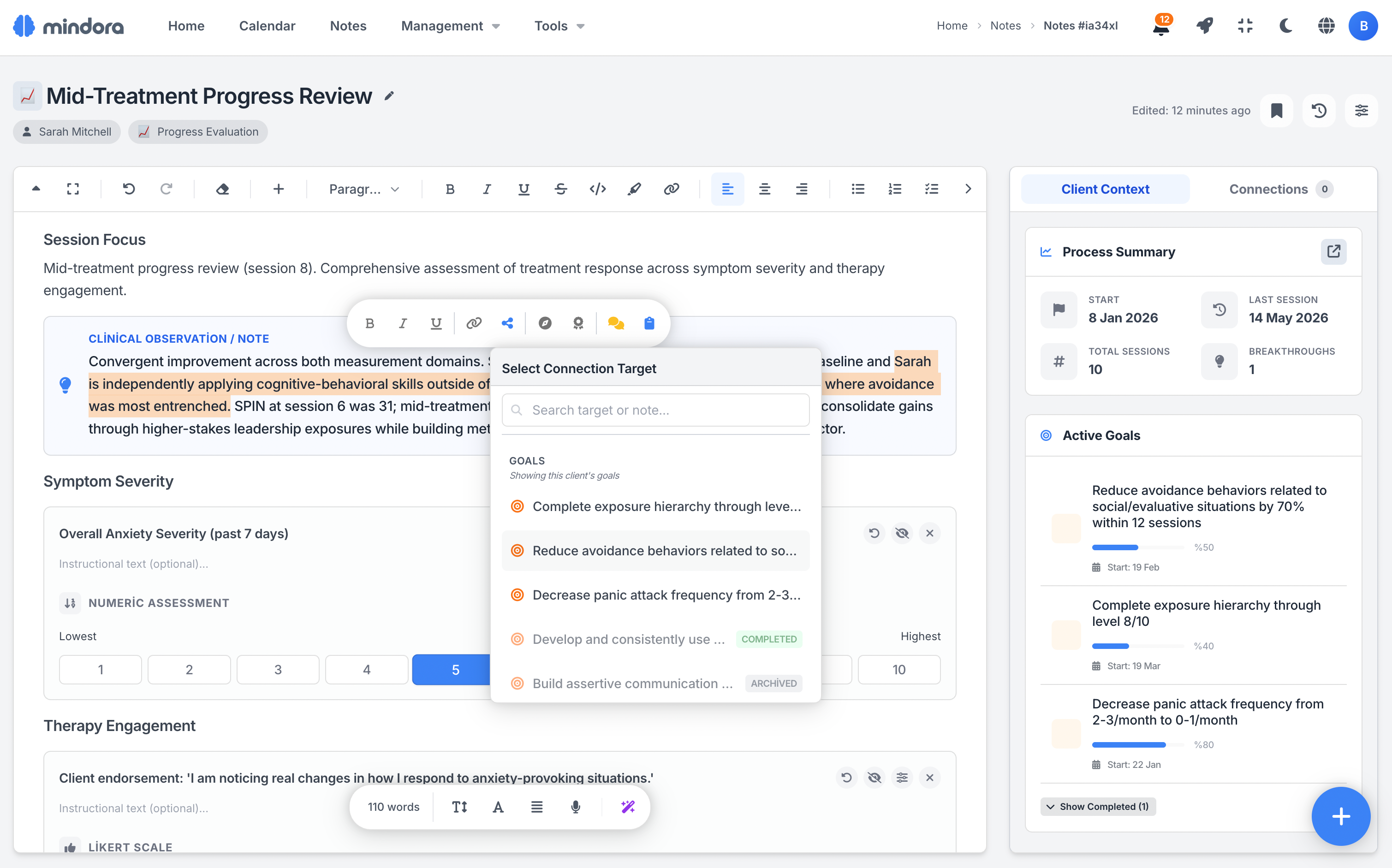
1. Select Text
Highlight the sentence in your clinical note you want to link; a floating toolbar appears and clicking "Create Connection" opens the target search menu.
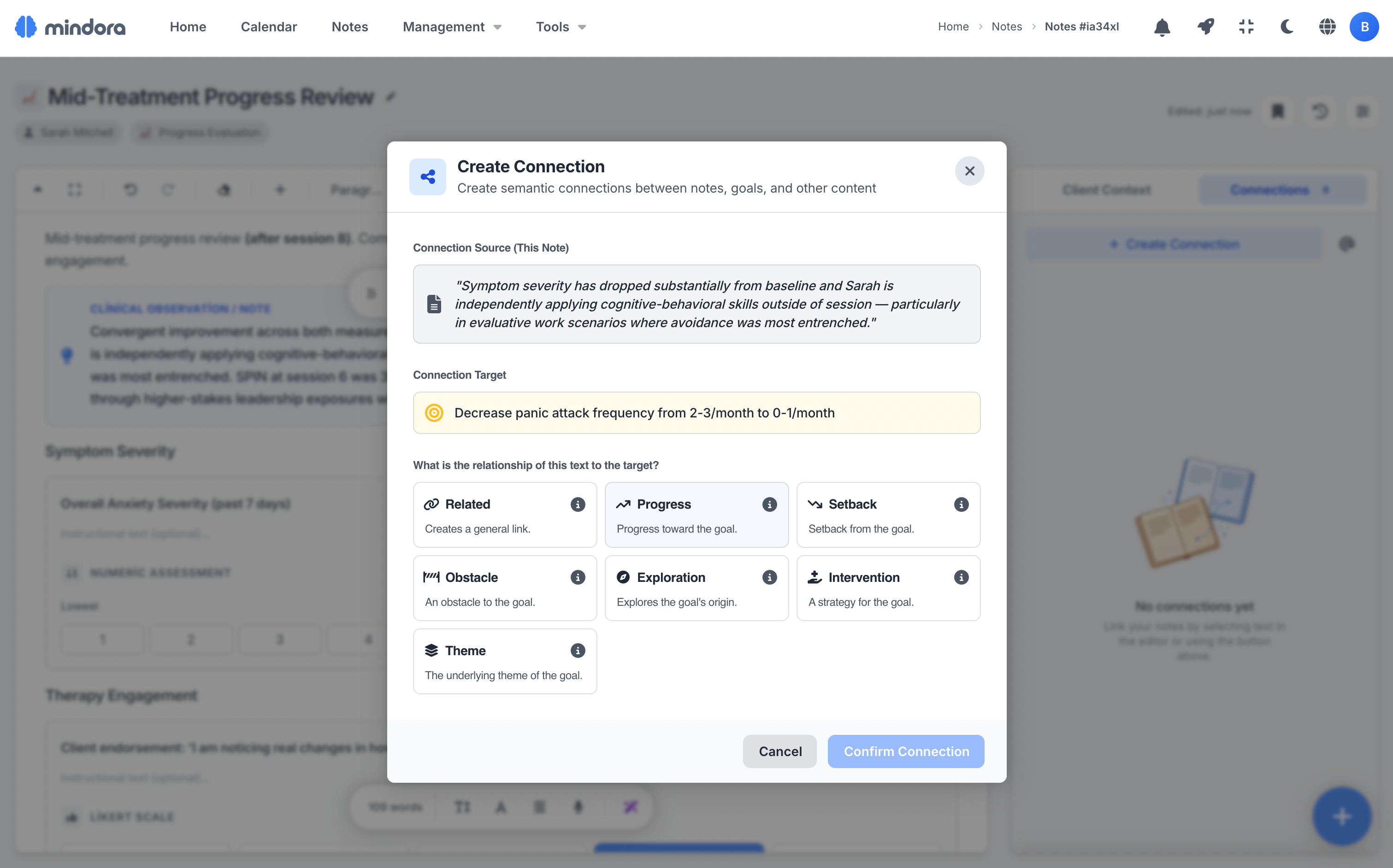
2. Choose a Target
The dialog confirms the source text and chosen target; pick a relationship type: Related, Progress, Setback, Obstacle, Exploration, Intervention, or Theme.
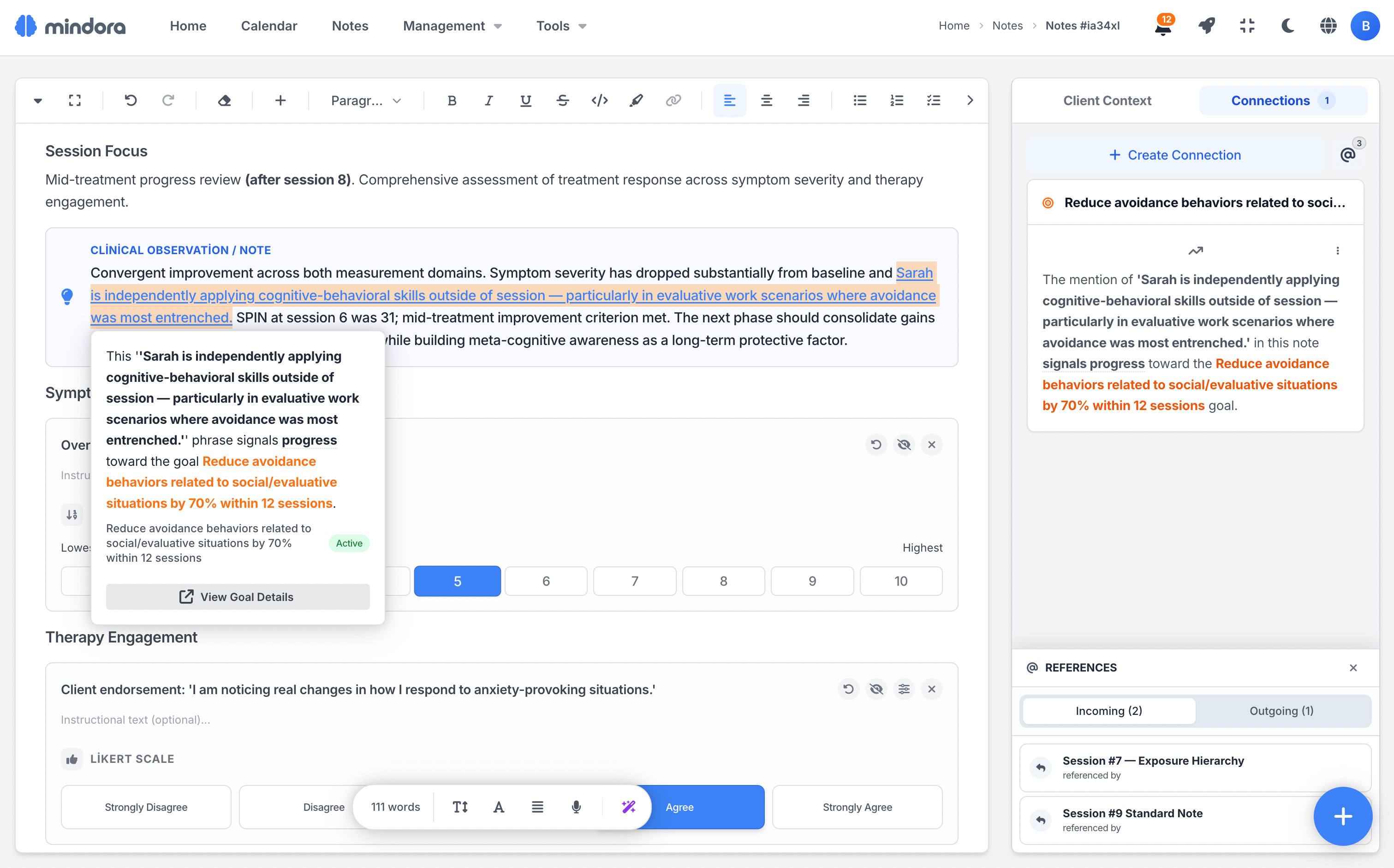
3. See the Connection
The connection shows up both in the editor (highlighted phrase + detail popover on hover) and in the right panel (as incoming and outgoing connection lists).
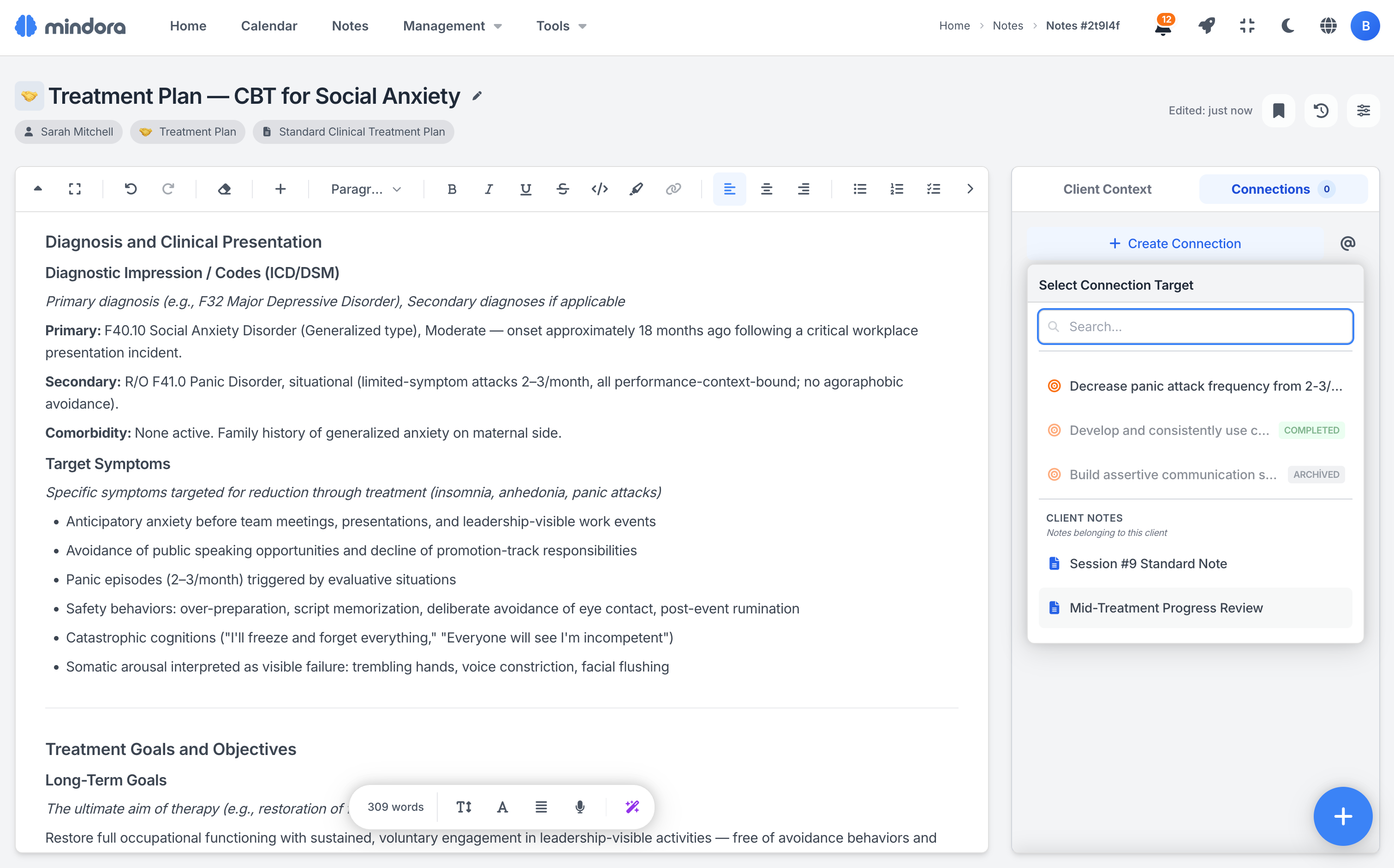
Alternative: Note-Level Connections
For notes like treatment plans, case formulations, or initial assessments, the entire document targets a goal. Skip text selection and link the whole note via the "Create Connection" button in the right panel.
Note-to-Note Connections
Semantically relate two clinical notes or an excerpt within a note; strengthen your formulation, hypothesis-building, and treatment planning.
Related
A general, non-causal link between two notes; connect similar topics or observations from the same period.
Supports
A note or an excerpt confirms another's finding or hypothesis; link evidence that strengthens your formulation.
Opposes
A note or an excerpt presents a contradicting finding; mark counter-evidence to clarify the clinical picture.
Note-to-Goal Connections
Link observations or excerpts from your notes to treatment goals with 7 distinct relationship types; concrete evidence accumulates for each goal.
Related
A general link between an observation and a goal, connected without a specific category."Client shared their sleep schedule today" → Sleep routine goal.
Progress
Concrete evidence of progress toward a goal; adds data to the goal progress chart."Client had no panic attacks this week" → Decrease panic attack frequency goal.
Setback
A sign of regression away from the goal; a signal to revisit the treatment plan."Reported 3 panic attacks this week" → Decrease panic attack frequency goal.
Obstacle
An external or internal barrier hindering goal achievement; shapes the intervention strategy."Workplace conflict continues" → Work relationships goal.
Exploration
An observation exploring the origin or psychodynamic context of the goal."Childhood attachment pattern" → Secure attachment goal.
Intervention
A therapeutic strategy, technique, or assignment deliberately applied to advance the goal."Exposure homework assigned" → Social comfort goal.
Theme
A recurring underlying pattern or theme of the goal; adds depth to clinical formulation."Recurring fear of rejection" → Secure attachment goal.
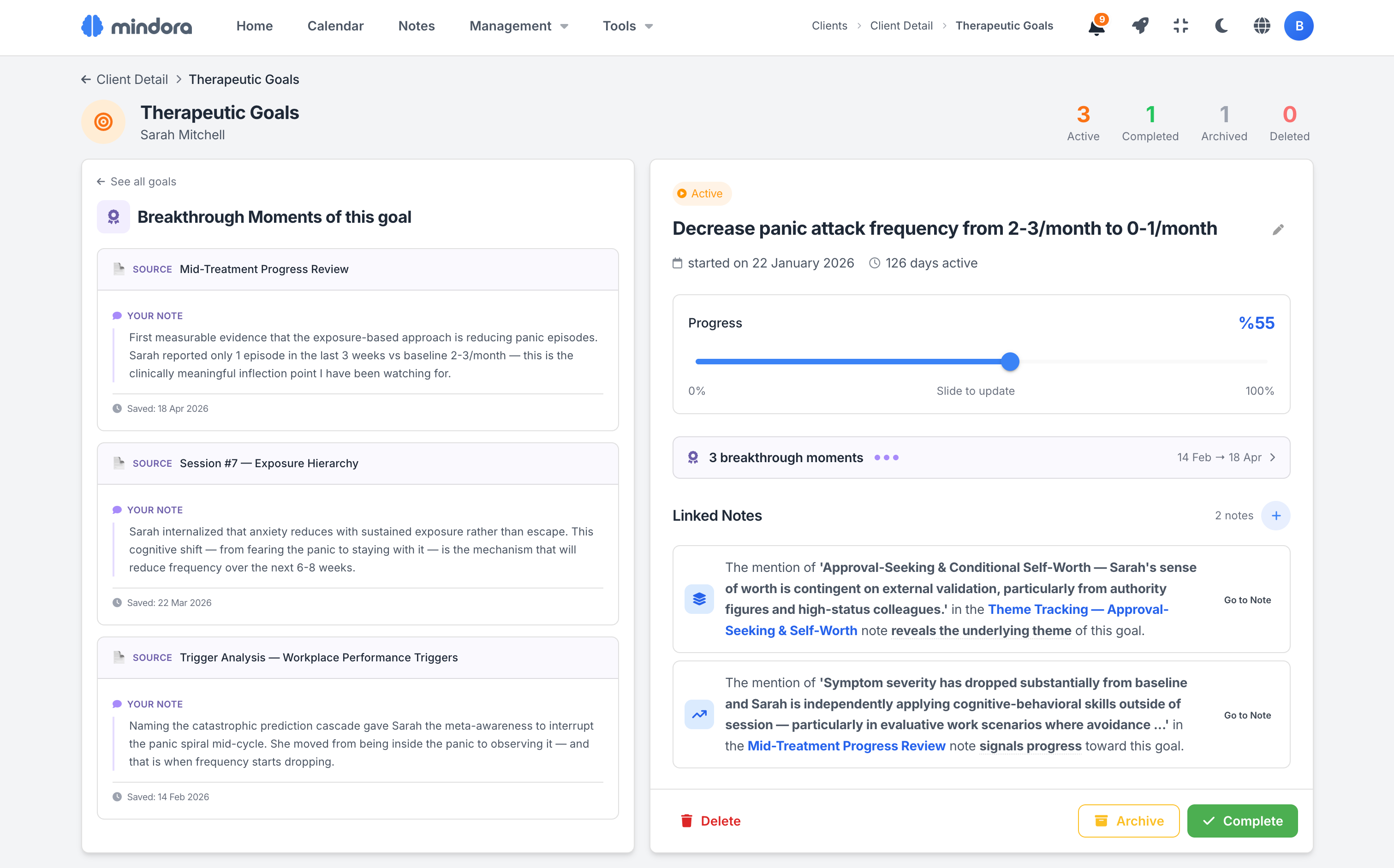
Breakthrough Moments
Mark and track turning points in the therapeutic process; visualize the client's story of change with concrete moments.
Mark the Moment
Select an important sentence or the whole session and mark it as a "Breakthrough Moment"; capture the meaning before it fades.
Link to a Goal
Connect the breakthrough to one or more treatment goals; see clearly which progress contributes to which goal, and track it over time.
Add Context
Explain why this moment is a breakthrough or add your reflection; use these records when preparing for supervision and clinical reflection.
"I went to the store on my own, without my water bottle. Even when the panic came, I now know it won't kill me."
Completed an exposure without any safety behavior for the first time. Clear softening in the "I'll lose control" catastrophic belief.
What You Can Do
Core capabilities of the connections module; the tools that bind clinical thinking to structure.
10 Semantic Connection Types
Not simple links, meaningful clinical relationships. 3 for Note→Note (related/supports/opposes) and 7 for Note→Goal (related/progress/setback/obstacle/exploration/intervention/theme).
Note-to-Note Connections
Link two notes or an excerpt as "related", "supports", or "opposes"; strengthen your formulation and hypothesis.
Note-to-Goal Connections
Link observations from your notes to treatment goals with 7 distinct relationship types (related, progress, setback, obstacle, exploration, intervention, theme); see progress with concrete evidence.
Sentence-Level Connections
Not just notes — select a word, sentence, or paragraph to link at any granularity; attribute it precisely ("this sentence is progress evidence for that goal").
Breakthrough Moments
Mark important insights in the therapeutic process as breakthrough moments; link them to goals and add your clinical context.
Auto-Linked Reflections
When you create a reflection from a session note, the source links automatically; the semantic type can't be changed, preserving therapist self-care.
Clinical Ethics & Context Safety
Clinical notes link only to the same client's notes, goals, or your personal notes; strict isolation rules protect client confidentiality and clinical ethics.
Scenarios from Your Daily Practice
See how the connections module lives inside your clinical workflow.
Case Formulation
While writing a session note, you link today's finding to last week's note as "supports"; concrete evidence strengthens your formulation hypothesis.
Treatment Plan Tracking
After each session, you link observations to treatment goals as "progress", "setback", or "obstacle"; at month-end, the progress per goal is clearly visible on the chart.
Supervision Prep
Before supervision, you quickly surface breakthrough moments and contradicting notes; connections let you prepare a case presentation in minutes.
Learn More
Detailed guides about the connections system.
Frequently Asked Questions About Clinical Connections
Common questions about 10 relationship types, sentence-level @mention, knowledge graph visualization, breakthrough moments, and AI suggestion roadmap.
Start Building Your Clinical Map
Create meaningful connections between your notes; bind your clinical thinking to structure and deepen your therapeutic processes.