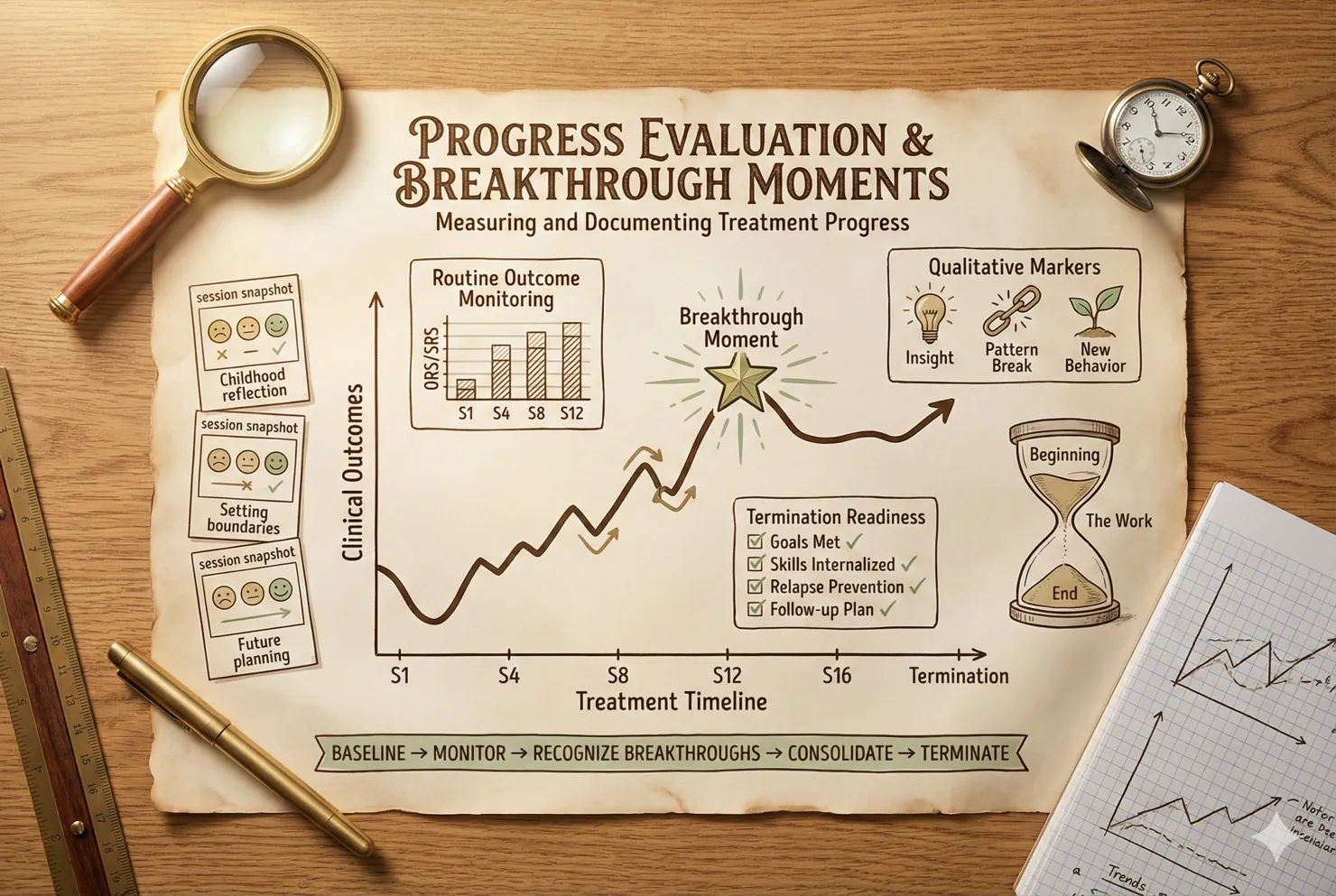
Progress Evaluation & Breakthrough Moments: Measuring and Documenting Treatment Progress
Learn to systematically track progress with routine outcome monitoring, recognize and transform breakthrough moments into lasting change, and navigate therapy termination through filled clinical examples.
Session 12: Is "I Feel Better" Enough?
At the twelfth session, Selin, a 40-year-old primary school teacher, sits down and smiles: "I feel better now." Three months ago she presented with panic attacks and agoraphobic avoidance. She couldn't enter crowded places, couldn't use public transportation, and even walking into the school cafeteria had become difficult. Now she could go to the grocery store alone. Progress seems apparent, but as a therapist you need to ask yourself: Are we truly progressing, or are we just experiencing a good phase?
This question seems simple at first glance. If the client feels better, there must be progress, right? Lambert (2013) demonstrated that when therapists try to evaluate treatment progress without systematic measurement, they correctly identify only 3% of deteriorating clients. In other words, clinical intuition alone is not a reliable compass.
In this post, we examine how to systematically evaluate progress toward goals set in your treatment plan. We cover two distinct but complementary perspectives: measuring progress through process evaluation and documenting qualitative transformation through breakthrough moments.
Why Clinical Intuition Alone Isn't Enough
Howard et al.'s (1986) dose-response model shows a rapid improvement curve in the early sessions of therapy that then slows. This natural deceleration can lead the therapist to incorrectly interpret "there's no more progress." The client may still be improving; only the pace has changed.
Lambert's (2013) research program spanning over a decade points to a consistent finding: therapists who use Routine Outcome Monitoring (ROM) achieve significantly better outcomes than those who don't. Particularly for clients at risk of deterioration, ROM use cuts treatment failure rates in half. This is because systematic feedback provides early warning to the therapist and allows timely intervention strategy changes.
Breakthrough moments carry a similar risk: a powerful insight occurs in session, both client and therapist feel excited, but the following week everything is back to the way it was. Stiles et al. (1990), through the assimilation model of therapeutic change, showed that for an insight to become lasting it needs to pass through specific stages. An undocumented breakthrough moment is like unreinforced learning; it is easily forgotten.
Progress Evaluation: "Where Are We?"
Progress evaluation means pausing at specific points in treatment to systematically answer: "Where were we at the start, where are we now, where are we going?" This evaluation doesn't only look at symptom change; it also encompasses the quality of the therapeutic alliance, adherence to the treatment plan, barriers, and the client's own perceived progress.
When should you do it? There's no rigid rule, but common practices include: by session count (every 8-12 sessions), by time (every 3 months), or at clinical milestones (before treatment plan revision, before spacing sessions, in termination preparation). What matters is regularity and a predetermined rhythm.
Routine Outcome Monitoring (ROM)
Miller and Duncan's (2004) Feedback-Informed Treatment (FIT) approach recommends tracking the client's status with brief scales at every session. The Outcome Rating Scale (ORS) measures the client's overall functioning in 4 items, while the Session Rating Scale (SRS) evaluates the therapeutic alliance. These two scales take 2-3 minutes total and are administered at the start/end of session.
ROM's power lies in converting individual intuition into data. If ORS scores are dropping while the therapist "feels like things are going well," that's an early warning. The reverse is also true: if the client continues to verbally complain while scores show a steady rise, you might consider that the client hasn't yet verbalized the change.
Periodic Progress Evaluation
While ROM provides session-level snapshots, periodic evaluation offers a broader perspective. This comprehensive review conducted every 8-12 sessions addresses progress toward goals, process barriers, and the need for plan revision together.
Example: Selin, 40, Panic Disorder & Agoraphobic Avoidance — Session 12 Progress Evaluation
Goals and Gains:
Goals Completed / Progress Made: Panic attack frequency dropped from 3-4 per week to 0-1 per week. Goal of going to the grocery store alone achieved. Public transportation has not been attempted yet.
Changes Reported by Client: "Now when heart palpitations start, I know it's not the end of the world. I take a deep breath and wait, and it passes. But getting on the bus still scares me a lot."
Overall Progress Perception: 7/10 (Rated 2/10 at baseline)
Process Analysis:
Therapeutic Alliance and Relationship: Strong collaboration. Selin completes homework regularly, arrives on time. Low resistance to exposure exercises. Mild idealization tendency observed ("if you tell me to, I can do it") — work needed to redirect self-efficacy attribution from therapist to self.
Barriers and Challenges: Her husband's pressure ("why can't you take the bus yet?") creates performance anxiety. Exam season at school raises overall stress levels and slows exposure practice.
Plan Revision:
New Goals and Focus: Public transportation exposure hierarchy to begin (waiting at stop → 1 stop → 3 stops → full route). Psychoeducation session with husband planned on communication.
Session Frequency: Weekly continuing. Spacing to be evaluated at session 20.
Therapy Termination Summary
When therapy ends, whether planned or unplanned, this is the final record summarizing the entire process. It includes the reason for referral, treatment duration, goals achieved, skills acquired, remaining risks, and follow-up plan. This document is a critical reference for both clinical archives and potential future treatment processes.
The termination summary is not a document to be written in the "closing session." Ideally, the last 2-3 sessions involve reviewing the process together with the client, consolidating gains, and planning for the future. The document is completed in the final session.
Example: Selin — Therapy Termination Summary (Session 24)
Process Summary:
Therapy Duration: 24 sessions, 6 months (weekly → last 2 months biweekly).
Reason for Referral: Panic attacks (3-4 per week), agoraphobic avoidance, unable to enter school cafeteria.
Reason for Termination: Goals largely achieved, mutual decision.
Outcome and Gains:
Clinical Outcome: Panic attack frequency dropped from 3-4 per week to 0-1 per month. Agoraphobic avoidance markedly reduced: public transportation, crowded environments, and new places are now tolerated. BAI score dropped from 32 to 8. Eats in the cafeteria, participates in school trips.
Skills Acquired: Diaphragmatic breathing and progressive muscle relaxation. Catching and reappraising catastrophizing thoughts. Independently applying graded exposure practice. Interpreting bodily sensations as signals rather than threats.
Recommendations and Follow-up:
Remaining Risks: Possibility of temporary increase in panic symptoms during high-stress periods (exam week, family crisis). Avoidance risk continues for entirely novel environments (airplane, concert).
Follow-up Plan: Booster session planned in 3 months. Brief 2-3 session support if needed. Early referral encouraged in case of relapse.
Breakthrough Moments: Capturing Qualitative Transformation
While progress evaluation provides a quantitative answer to "is there progress?", breakthrough moments answer a qualitative question: "What changed?" In therapy, certain moments occur when the client becomes aware of an old pattern and actually does something different. These moments are also supported by Tang and DeRubeis's (1999) "sudden gains" research: a significant portion of improvement during treatment occurs not gradually but at specific turning points.
But breakthrough moments don't become lasting on their own. A powerful awareness occurs in session, both client and therapist feel excited, but by the following week that insight may have evaporated. Documenting the breakthrough moment, creating a reinforcement plan, and revisiting it in subsequent sessions is the key to transforming that moment into lasting change.
Insight Deepening: Recognizing and Analyzing the Breakthrough
Insight deepening ensures that a breakthrough moment doesn't remain a superficial observation but is analyzed along with its emotional and cognitive dimensions. According to Stiles et al.'s (1990) assimilation model, for an insight to become lasting it needs to integrate with emotion; purely intellectual comprehension is not enough.
How do you recognize a breakthrough moment? Three signs typically appear together: the client's tone of voice or body language shifts, they express something they've never said before, and a brief silence or emotional intensification follows. When you catch this moment, don't rush; give the client space to process this experience.
Example: Selin's Breakthrough Moment — Session 14
Key Statement: "I'm actually not afraid of the panic itself; I'm afraid of losing control. If I have a panic attack on the bus and nobody helps me... Actually, it was like this when I was little too; when my mother got sick, nobody helped either."
Context and Trigger: While planning the public transportation exposure hierarchy, Selin was trying to answer "what if it happens on the bus?" When the therapist asked "what would happen in the worst-case scenario?" Selin suddenly went to the period of her mother's illness.
Emotional Impact Level: 8/10. Selin cried. When her eyes welled up she said "this is the first time I've seen this so clearly." Not merely an intellectual connection, but a bodily felt awareness.
Changed Belief: The "I'll be abandoned in situations I can't control" schema was shaken. A connection was made between the fear underlying panic and the early abandonment experience. This added a new layer to the formulation.
Integration into Treatment:
Impact on Life: Exposure became not just "getting on the bus" but gained meaning through the frame of "trusting that I can ask for help." Selin entered the next exposure attempt with this new understanding.
Reinforcement Plan:
- This connection will be revisited in the next session.
- The "worst-case scenario" question in exposure exercises will be reprocessed through this new frame.
- Formulation updated: abandonment schema added.
Change Markers: One-Time or Lasting?
Not every breakthrough moment means lasting change. Sometimes the client experiences a powerful insight in session but returns to the old pattern the following week. Change markers tracking allows you to observe over time whether a breakthrough is truly the beginning of transformation or a transient experience.
Two fundamental questions are asked in this tracking: Did the client do something different from their old pattern? And is this different behavior consistent, or was it a one-time event?
Example: Selin's Change Marker — Session 18
New Behavior: Selin spontaneously got on the bus while returning home from school on a weekday. It wasn't a planned exposure attempt; she decided "let me take the bus instead of walking" on the way back from the grocery store. When panic symptoms started, she applied breathing exercises and stayed on the bus for 3 stops.
Old Pattern: Three months ago, Selin avoided even passing by the bus stop. In the exposure hierarchy, "getting on the bus" was the top rung.
Consistency of Change: 7/10. Got on the bus 3 times in the last 2 weeks. Experienced anxiety each time but didn't stop riding. Not yet fully comfortable, but the avoidance pattern is broken.
Therapist's Commentary: This is particularly meaningful because it was a spontaneous decision rather than a planned exercise. It suggests the client has internalized the exposure skill and can apply it without therapist guidance. It also suggests that the breakthrough moment in session 14 (seeing the abandonment schema beneath the fear of losing control) has left a trace at the behavioral level. For reinforcement: increase bus experiences, try different routes, and plan a solo long journey.
How the Two Perspectives Come Together
Progress evaluation and breakthrough moment documentation offer two different but complementary viewpoints. Progress evaluation tracks the overall trajectory of treatment numerically and structurally, while breakthrough moments capture the qualitative turning points beneath that trajectory. In Selin's example: the session 12 progress evaluation showed the BAI score had dropped (quantitative progress), while the session 14 breakthrough revealed the abandonment schema beneath the panic fear (qualitative transformation).
Using both perspectives together also keeps the case formulation alive. Breakthrough moments can add new layers to the formulation, while progress evaluation shows whether the treatment plan needs revision. Together, they answer both "how much are we progressing" and "why are we progressing."
5 Principles of Effective Progress Evaluation
Make Evaluation a Routine
Rather than conducting progress evaluation "when needed," establish a predetermined rhythm from the start. Lambert (2013) emphasizes that ROM is effective only when applied regularly. A periodic evaluation every 8-12 sessions combined with a brief scale (like the ORS) at each session is an achievable starting point.
Include the Client's Voice
Progress evaluation should not consist solely of the therapist's clinical observations. The client's perceived progress, reported changes, and treatment expectations are integral parts of the evaluation. Miller and Duncan (2004) demonstrated that client feedback is one of the most powerful variables in improving treatment outcomes.
Don't Rush Past the Breakthrough
When a breakthrough moment occurs in session, pause instead of immediately moving to the next topic. Give the client space to process this experience. Then document the moment: what was said, in what context it emerged, what was the emotional impact? An undocumented breakthrough moment is easily forgotten once the session ends.
Track Change Over Time
A single breakthrough moment or a single good scale score doesn't mean lasting change. Observe the consistency of change over several weeks. Selin's bus-riding behavior became a meaningful signal when it repeated 3 times, not just once. Change markers tracking provides this time-extended perspective.
Connect Results Back to the Treatment Plan
The purpose of progress evaluation is not just record-keeping but calibrating treatment direction. If goals have been achieved, set new ones. If not, analyze the barriers. If a breakthrough moment adds new information to the formulation, update the treatment plan. Evaluation that doesn't translate into action remains a bureaucratic exercise.
Common Mistakes
Focusing Only on Symptom Scores
A drop in BAI score doesn't always mean the problem is solved. The client's quality of life, relationships, functioning, and self-perceived progress should also be evaluated. A single scale score doesn't reflect the complete clinical picture.
Ignoring Deterioration Signals
When a client improves rapidly in the first weeks then plateaus, or when scores begin to decline, it's tempting to dismiss it as "a temporary fluctuation." But Lambert (2013) showed that taking early warnings seriously is one of the factors determining treatment success. If scores decline for 3 consecutive sessions, that's a clinical decision point.
Overvaluing or Undervaluing Breakthrough Moments
Labeling every emotional moment as a breakthrough dilutes the concept; on the other hand, treating a genuine awareness moment as an ordinary observation causes the opportunity to be missed. The criterion for recognizing a breakthrough is: Did the client see a connection they hadn't seen before? Does this new perspective carry potential to change their behavior?
Ending Therapy Abruptly
Instead of immediately ending sessions when the client improves, plan a gradual termination process. Reduce frequency, consolidate gains, create a relapse plan, and schedule a booster session. Abrupt termination can lead the client to feel "abandoned" and reduce the sustainability of gains.
Progress Tracking with Mindora
Mindora offers structured templates for both perspectives discussed in this post:
- Progress Evaluation — 2 templates: Periodic Progress Evaluation (goals, gains, process analysis, plan revision) and Therapy Termination Summary (process summary, clinical outcome, follow-up plan).
- Breakthrough Moment — 2 templates: Insight Deepening Analysis (key statement, emotional impact, schema change, reinforcement plan) and Change Markers Tracking (old/new behavior, consistency scale, prognosis).
All templates can be used as-is or customized to your clinical needs. Progress evaluation and breakthrough moment records can be linked to treatment plans, formulations, and session notes as part of the clinical documentation system.
References
- Lambert, M. J. (2013). Bergin and Garfield's Handbook of Psychotherapy and Behavior Change (6th ed.). Wiley.
- Miller, S. D. & Duncan, B. L. (2004). The Outcome and Session Rating Scales: Administration and Scoring Manual. ISTC.
- Howard, K. I., Kopta, S. M., Krause, M. S. & Orlinsky, D. E. (1986). The dose-effect relationship in psychotherapy. American Psychologist, 41(2), 159-164.
- Tang, T. Z. & DeRubeis, R. J. (1999). Sudden gains and critical sessions in cognitive-behavioral therapy for depression. Journal of Consulting and Clinical Psychology, 67(6), 894-904.
- Stiles, W. B., Elliott, R., Llewelyn, S. P., Firth-Cozens, J. A., Margison, F. R., Shapiro, D. A. & Hardy, G. (1990). Assimilation of problematic experiences by clients in psychotherapy. Psychotherapy, 27(3), 411-420.
- Norcross, J. C. & Wampold, B. E. (2011). Evidence-based therapy relationships: Research conclusions and clinical practices. Psychotherapy, 48(1), 98-102.