Symptom Clusters & Diagnostic Patterns: Connecting the Dots
Your client presents with insomnia, irritability, concentration difficulties, and muscle tension. Are these four separate symptoms or one cluster? The difference between tracking symptoms individually versus grouping them into patterns changes the clinical picture entirely. In this guide, learn the theoretical foundations of symptom clusters, six-domain classification, severity-frequency measurement, temporal pattern analysis, and the transdiagnostic approach with a concrete case example.
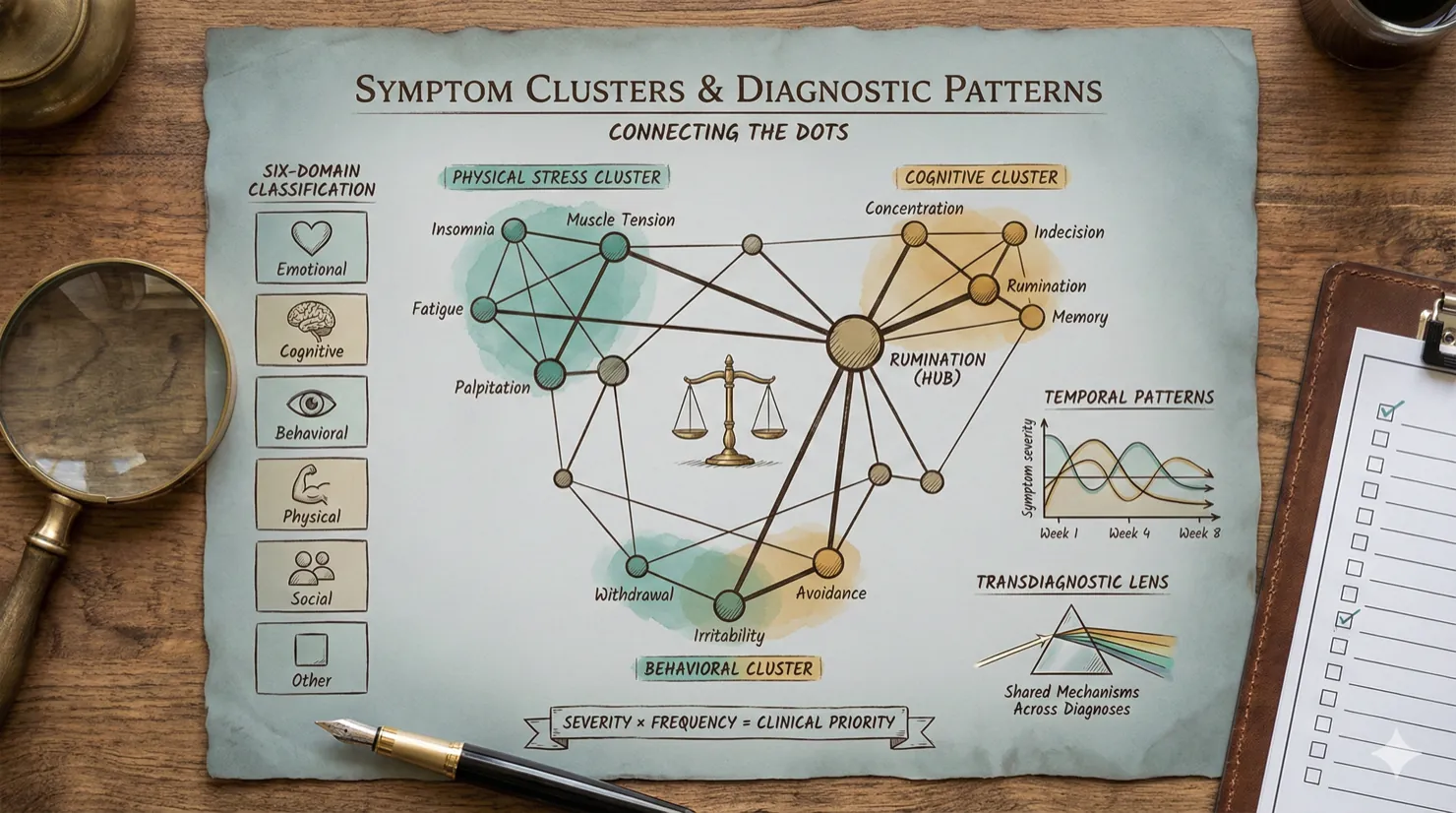
In symptom-cluster analysis, symptoms are mapped across six domains (emotional, cognitive, behavioral, physical, social, other), severity and frequency are measured separately, and the hub symptom at the cluster center becomes the priority treatment target. This guide covers cluster analysis, temporal-pattern assessment, and the transdiagnostic treatment approach through a concrete case example.
Connecting the Dots
Zeynep came to her first session with five separate complaints: I can't sleep, I'm constantly tense, I can't concentrate at work, my stomach hurts, and I don't want to see my friends. If we list these five symptoms separately — insomnia, irritability, concentration difficulty, somatic complaint, social withdrawal — we end up with five independent targets and the treatment plan becomes a fragmented intervention list. But when we step back and look at these symptoms as a "cluster," the picture shifts: sleep disturbance and muscle tension form a physical stress response cluster, while concentration difficulty and social withdrawal may point to a depressive functional impairment cluster.
The concept of a symptom cluster proposes understanding an individual's symptoms not as isolated units but as an interconnected network maintained by shared mechanisms. The clinical value of this approach is substantial: when "sleep" and "social withdrawal" are targeted separately in a treatment plan, progress tends to be slow; but when the shared mechanism underlying both clusters — for example, chronic stress response or rumination — is targeted, multiple symptoms begin to recede simultaneously.
In this article, we will explore the theoretical foundations of symptom clusters, six-domain classification, why severity and frequency must be measured separately, how to analyze temporal patterns, and how a transdiagnostic perspective transforms treatment planning — within the frameworks of Borsboom's (2017) network theory, Harvey et al.'s (2004) transdiagnostic model, and Jacobson and Truax's (1991) clinically significant change concept.
So what does analyzing symptoms as clusters rather than one by one actually gain you in practice? The concrete clinical payoffs:
- Faster improvement: targeting the shared mechanism at the center makes multiple symptoms recede at once.
- Strategy over a fragmented plan: you build treatment around one or two strategic targets instead of five separate interventions.
- Catching the hidden maintainer: the hub symptom that is never directly reported (rumination, for example) becomes visible.
- Measuring real progress: you evaluate recovery by tracking change across the whole cluster, not a single score.
Why Individual Symptoms Don't Tell the Clinical Story
Traditional clinical assessment approaches symptoms as checklists within diagnostic categories: meets five DSM-5 criteria, diagnosis is made; doesn't meet them, subthreshold is assumed. This approach has a practical function — it provides a common language for communication and research. However, Harvey et al.'s (2004) transdiagnostic perspective demonstrated that this approach misses something critical: the same cognitive and behavioral processes are found across multiple diagnostic categories. Sleep disturbance is a symptom of depression just as much as it is a symptom of generalized anxiety disorder, PTSD, and bipolar disorder. In this case, the question is not determining which diagnosis the sleep disturbance belongs to, but understanding which other symptoms it co-occurs with and what mechanism underlies this co-occurrence.
Borsboom's (2017) network theory of psychopathology offers a powerful conceptual framework for this way of thinking. While the traditional approach treats symptoms as indicators of a "latent variable" — the diagnosis — network theory models symptoms themselves as interconnected nodes. In this model, insomnia increases fatigue; fatigue decreases concentration; concentration difficulty impairs work performance; performance decline weakens self-efficacy perception; weakened self-efficacy leads to social withdrawal. This causal chain forms a cluster, and the node with the most connections in the chain — the "hub" symptom in network terminology — should be the priority target in treatment.
In clinical practice, this perspective has a concrete implication: isolated symptom tracking systematically undermeasures treatment effectiveness. A client's anxiety score may have decreased, but if sleep quality and social functioning haven't changed, cluster-level improvement hasn't occurred. Caspi et al.'s (2014) p-factor study also supports this perspective: a large proportion of psychopathological symptoms are explained by a general liability factor (p-factor), and this factor predicts symptom clustering independent of diagnostic categories. The symptom cluster approach is a clinical tool that can be used to map how this general liability manifests at the individual level.
Six-Domain Classification: Mapping Symptoms Systematically
The first step in working with symptom clusters is positioning symptoms within a systematic domain classification rather than listing them randomly. The six-domain classification used in Mindora's Symptom Cluster template includes: emotional (mood symptoms such as depression, anxiety, anger, shame, guilt), cognitive (thought processes such as concentration difficulty, memory problems, rumination, decision-making difficulty), behavioral (observable actions such as avoidance, isolation, aggression, compulsive behaviors), physical (somatic symptoms such as sleep disturbance, appetite changes, pain, fatigue, muscle tension), social (relationship conflicts, work performance decline, social withdrawal, communication difficulties), and other (unique symptoms that don't fit these categories).
The clinical value of this classification is preventing the therapist's "domain blindness." Research shows that therapists tend to focus on specific domains based on their training background: those trained in cognitive-behavioral therapy query cognitive and behavioral symptoms in more detail while potentially missing physical and social symptoms. Psychodynamically oriented therapists may explore the emotional domain in depth while lacking behavioral specificity. Systematic domain scanning balances this natural tendency, ensuring the therapist consciously inquires about symptoms across different domains.
The most dangerous form of domain blindness is staying in a single domain. Tracking only a client's mood — "how was your anxiety this week?" — captures only one dimension of the clinical picture. Yet anxiety's physical expression (muscle tension, palpitations), cognitive expression (rumination, catastrophizing), and behavioral expression (avoidance, reassurance-seeking) manifest across different domains and may follow independent trajectories. In a client whose anxiety score has decreased but whose avoidance behavior has increased, reporting "improvement" based solely on emotional measurement is misleading. The six-domain classification makes it possible to see this multidimensional picture within a single framework.
Severity and Frequency Measurement: Why Both Are Necessary
The most common measurement method in clinical assessment is the 0-10 severity scale known as the Subjective Units of Distress Scale (SUDs). When a client is asked to "rate your current anxiety level from 0 to 10," the resulting score reflects the symptom's intensity. However, severity alone doesn't tell the clinical story. A panic attack occurring once a week at 9/10 severity and chronic tension experienced daily at 4/10 severity represent different clinical pictures — both requiring different intervention strategies. This is why severity and frequency must be measured separately.
Mindora's Symptom Cluster template structurally supports this distinction: severity is measured with a 0-10 numeric scale, while frequency is measured with a five-level frequency scale (never, rarely, sometimes, often, daily). This dual measurement captures the clinical picture in a much richer way. For example, a client's rumination severity might be 5/10 but its frequency might be "daily" — indicating we're dealing with a chronic, low-intensity process, and the intervention strategy differs from intense but rare episodes. When onset and duration information is added — when did this symptom start, how long has it been ongoing — the temporal context is completed.
Jacobson and Truax's (1991) concept of clinically significant change explains why this measurement precision matters. A statistically significant change may not be clinically significant: anxiety severity may have dropped from 8 to 6, but if frequency is still "daily," the client's everyday experience has changed very little. True clinical improvement requires holistic regression across severity, frequency, and daily life impact. Therefore, recording all three dimensions at baseline ensures accurate assessment of progress throughout treatment.
Temporal Patterns and Cluster Analysis
After mapping symptoms across domains and severity-frequency dimensions, the next step is analyzing temporal patterns. Three fundamental pattern types emerge here:
- Co-occurrence: which symptoms appear together.
- Sequential activation: which symptom triggers which.
- Circadian/seasonal patterns: symptoms that intensify during specific time periods.
The co-occurrence pattern provides the first clues to clusters. If a client's muscle tension, sleep disturbance, and irritability intensify on the same days, these three symptoms are likely maintained by a shared mechanism — for instance, autonomic nervous system activation. The sequential activation pattern reveals the cluster's internal dynamics: the client enters rumination first, rumination disrupts sleep quality, sleep disruption increases irritability the next day, irritability creates conflict at work, and conflict retriggers rumination. Making this cyclical chain visible answers the treatment question: "where do we break the chain?"
In Zeynep's case, rumination may be the central node — the hub symptom — feeding sleep disturbance, concentration difficulty, and social withdrawal alike. When rumination is targeted — for instance, through behavioral activation and metacognitive techniques — the entire cluster may begin to recede simultaneously. Identifying the hub symptom transforms the treatment plan from a fragmented intervention list into an integrated strategy.
Circadian and seasonal patterns are also an important component of cluster analysis. Temporal clues such as depressive symptoms intensifying in the morning (diurnal variation), anxiety decreasing on weekends (work stress component), and mood deteriorating at seasonal transitions (seasonal affective component) clarify the cluster's maintaining factors. If a client's symptoms intensify only on workdays, the chronic stress response hypothesis strengthens; if they intensify only in the evenings, loneliness or ruminative thought processes come to the foreground.
The Transdiagnostic Approach: Thinking Beyond Diagnoses
Harvey et al.'s (2004) transdiagnostic model explains why symptom clusters need to be evaluated independently of diagnostic categories. Sleep disturbance is found as a common symptom in depression, generalized anxiety disorder, PTSD, bipolar disorder, and many other diagnoses. Therefore, labeling sleep disturbance as "a symptom of depression" and only implementing depression interventions may be less effective than directly targeting the underlying sleep mechanism. The transdiagnostic approach recommends identifying the processes that maintain symptoms and targeting these processes directly, rather than tying symptoms to diagnoses.
Nolen-Hoeksema's (2000) rumination research provides a concrete example of this approach. Rumination (repetitive, passive, and cyclical focusing on negative thoughts) is a transdiagnostic process that maintains depression, anxiety, eating disorders, and substance use alike. If rumination is central to both the depressive cluster and the anxious cluster in a client, rather than applying two separate protocols for two separate diagnoses, an intervention directly targeting rumination (such as Rumination-Focused CBT) can affect both clusters simultaneously.
Barlow et al.'s (2011) Unified Protocol for Transdiagnostic Treatment of Emotional Disorders is this principle translated to the intervention level. The Unified Protocol targets transdiagnostic processes such as emotion regulation difficulties, experiential avoidance, cognitive appraisal errors, and action tendencies rather than specific diagnoses. Symptom cluster analysis provides a natural assessment framework for such integrated intervention approaches: which symptoms are maintained by which transdiagnostic process, and which is the hub symptom of this process?
Filled Example: Zeynep, 30, Work Stress Presentation
The following example shows a cluster analysis structured with Mindora's Symptom Cluster template. Examine how Zeynep's six separate symptoms form two distinct clusters and how we identify the hub symptom of each cluster.
Cluster 1: Anxious-Somatic Cluster
Symptoms: (1) Muscle tension — physical domain, severity 7/10, frequency: daily, onset: 4 months ago. Client statement: "My shoulders are constantly raised, I don't even notice it." (2) Sleep disturbance — physical domain, severity 6/10, frequency: 5-6 nights/week, onset: 3 months ago. "I want to sleep but my brain won't turn off." (3) Irritability — emotional domain, severity 5/10, frequency: 4-5 days/week, onset: 3 months ago. "I get angry so quickly, even I'm surprised at myself."
Temporal Pattern: Muscle tension was the earliest symptom (4 months). Sleep disturbance and irritability followed 1 month later. Sequential activation: work stressor → muscle tension → sleep disturbance → next-day irritability. Hub symptom: muscle tension (most connections, earliest onset). Significant reduction on weekends (work stress component confirmed).
Cluster 2: Depressive-Withdrawal Cluster
Symptoms: (1) Concentration difficulty — cognitive domain, severity 6/10, frequency: daily, onset: 2 months ago. "I read a page three times and nothing sticks." (2) Social withdrawal — social domain, severity 5/10, frequency: 3-4 days/week, onset: 2 months ago. "My friends call but I don't want to answer." (3) Loss of motivation — behavioral domain, severity 4/10, frequency: often, onset: 6 weeks ago. "I have no enthusiasm even for things I used to enjoy."
Temporal Pattern: Concentration difficulty and social withdrawal started simultaneously (2 months). Loss of motivation followed 2 weeks later. Sequential activation: rumination → concentration difficulty → work performance decline → self-efficacy loss → social withdrawal → loss of motivation. Hub symptom: rumination (hidden node — not directly expressed as a complaint but feeding both clusters).
Cross-Cluster Interaction
Bidirectional interaction exists between the two clusters: Sleep disturbance from Cluster 1 directly feeds concentration difficulty in Cluster 2. Social withdrawal from Cluster 2 increases irritability in Cluster 1 (distancing from support resources). Rumination appears as the central maintaining process for both clusters — the primary target of the treatment plan.
Tracking Plan
Measurement Method: GAD-7 (anxious cluster) and PHQ-9 (depressive cluster) biweekly. Daily log: sleep quality and muscle tension. Treatment targets: (1) Reduce rumination to weekly frequency (8 sessions), (2) improve sleep quality to 7/10 through sleep hygiene (4 weeks), (3) at least 2 social interactions per week through social activation (6 weeks).
5 Principles of Effective Symptom Cluster Analysis
Group Before You Analyze
Moving straight from listing symptoms to planning interventions is a common trap. First, position symptoms within the domain classification, then identify which symptoms move together by examining co-occurrence patterns. Analysis without grouping is like looking at trees while missing the forest — addressing each symptom individually obscures the shared mechanism underneath.
Measure Severity and Frequency Separately
A single-dimensional "how bad is it?" question inadequately captures the clinical picture. Rare but severe episodes (panic attack profile) and frequent but low-intensity symptoms (chronic tension profile) require entirely different intervention strategies. The severity scale captures intensity, the frequency scale captures chronicity, and onset and duration information captures developmental context. Recording all three dimensions together refines the treatment plan.
Track the Temporal Sequence
"When did this symptom start?" is the most powerful clinical question for revealing cluster structure. The first symptom to emerge is typically closest to the cluster's core and represents the starting point of the sequential activation chain. Documenting the temporal sequence makes visible which symptom triggers which, answering the treatment question of "where do we break the chain?" Additionally, circadian and seasonal patterns clarify maintaining factors.
Look for the Hub Symptom
To identify the hub symptom, ask: "If this symptom improved, would the others improve too?" and "When this symptom worsens, do the others worsen as well?" These questions reveal the central symptom of the cluster and enable you to create an integrated treatment strategy rather than fragmented intervention. Sometimes the hub symptom isn't directly expressed as a complaint — in Zeynep's case, rumination was never voiced as "my complaint" but was the maintainer of both clusters.
Reassess Clusters Regularly
Symptom clusters are not static — they evolve as treatment progresses. When a hub symptom is targeted and recedes, the cluster's structure may change: some symptoms may disappear entirely while others may become independent, forming a new cluster. Regular cluster reassessment (every 4-6 sessions) ensures the treatment plan stays current and prevents intervention waste on "dead targets" — symptoms that no longer hold clinical significance.
Common Mistakes
Treating Every Symptom Independently
Creating a symptom list and planning a separate intervention for each is a well-intentioned but inefficient approach. Sleep hygiene for insomnia, breathing exercises for anxiety, social skills training for social withdrawal — this fragmented plan ignores the causal connections between symptoms. If insomnia is driven by rumination, sleep hygiene education without targeting rumination will have limited effect. Cluster analysis makes it possible to organize the treatment plan around "one or two strategic targets" rather than "five separate interventions."
Relying Solely on Diagnosis-Based Grouping
Grouping symptoms as "this client's depression symptoms are these, anxiety symptoms are those" based on diagnosis is not a substitute for cluster analysis. Diagnostic grouping follows the logic of DSM categories; cluster analysis follows how the individual client's symptoms interact. Two clients with the same diagnosis may have completely different symptom clusters: in one, sleep disturbance may be the hub symptom, while in the other, rumination may be central. The diagnostic label provides a general framework, but without an individual cluster map, the treatment plan doesn't personalize.
Measuring Only Severity, Ignoring Frequency and Duration
"What's your anxiety this week?" measures severity but captures only one dimension of the clinical picture. Tension at 4/10 severity experienced daily may impact daily life more than a panic attack at 8/10 severity experienced once a month. Moreover, without duration information, whether a symptom is acute or chronic cannot be determined — and this distinction fundamentally changes the intervention approach. Three-dimensional measurement (severity + frequency + duration) places clinical decision-making on a much more reliable foundation.
Freezing the Cluster Map
Keeping the cluster map created at initial assessment fixed throughout treatment is a common mistake. Symptoms are dynamic: when a hub symptom recedes with treatment, the cluster's structure changes; new life events may add new symptoms; seasonal factors may activate specific clusters. Regularly updating the cluster map — adding new symptoms, marking receding ones, reassessing the hub symptom — ensures the treatment plan remains alive and current.
Symptom Cluster Analysis with Mindora
Mindora's Symptom Cluster note type is designed to transform the principles discussed in this article into a structured documentation workflow. The three-section template supports each step of the systematic approach described above:
Symptom Definition: Includes symptom name and definition, the client's own expression (client quote component), and a six-category domain classification checklist (emotional, cognitive, behavioral, physical, social, other). The "preventing domain blindness" principle emphasized in this article is structurally supported by this checklist — as the therapist records each symptom, they consciously mark which domain it belongs to.
Severity and Frequency Measurement: Includes a 0-10 numeric severity scale, a five-level frequency scale (never, rarely, sometimes, often, daily), onset and duration information, and daily life impact fields. The "measure severity and frequency separately" principle emphasized in this article is applied here — instead of a single-dimensional "how bad," a multidimensional symptom profile is created.
Tracking and Measurement Plan: Includes measurement method (PHQ-9, GAD-7, daily log, etc.), tracking strategies checklist (standard scales, daily log, self-report, behavioral observation, physical measurements), and treatment target fields. The longitudinal tracking and cluster reassessment principle discussed in this article is supported by this section.
Since a separate note can be created for each symptom, symptom notes can be linked to each other and to the case formulation through Mindora's Knowledge Network feature, thereby creating the cluster map digitally.
Moreover, each symptom cluster note appears chronologically in the client's clinical flow with its own note type and date, so you can read at a glance how the cluster evolved across sessions and which hub symptom receded.
And Mindora's smart reminders gently nudge you when a client has completed a few sessions but an assessment note like Symptom Cluster still hasn't been written.
MINDORA NOTE EDITORA structured note editor designed for therapistsTemplates split into sections and fields instead of free text: preventing domain blindness, standardizing severity-frequency measurement, and documenting cluster analysis consistently.Explore Clinical NotesFrequently Asked Questions
References
- Harvey, A. G., Watkins, E., Mansell, W. & Shafran, R. (2004). Cognitive Behavioural Processes across Psychological Disorders: A Transdiagnostic Approach to Research and Treatment. Oxford University Press.
- Borsboom, D. (2017). A network theory of mental disorders. World Psychiatry, 16(1), 5–13.
- Jacobson, N. S. & Truax, P. (1991). Clinical significance: A statistical approach to defining meaningful change in psychotherapy research. Journal of Consulting and Clinical Psychology, 59(1), 12–19.
- Nolen-Hoeksema, S. (2000). The role of rumination in depressive disorders and mixed anxiety/depressive symptoms. Journal of Abnormal Psychology, 109(3), 504–511.
- Caspi, A., Houts, R. M., Belsky, D. W., Goldman-Mellor, S. J., Harrington, H., Israel, S., ... & Moffitt, T. E. (2014). The p factor: One general psychopathology factor in the structure of psychiatric disorders? Clinical Psychological Science, 2(2), 119–137.
- Barlow, D. H., Farchione, T. J., Fairholme, C. P., Ellard, K. K., Boisseau, C. L., Allen, L. B. & Ehrenreich-May, J. (2011). Unified Protocol for Transdiagnostic Treatment of Emotional Disorders: Therapist Guide. Oxford University Press.
This Article Is Part of the Clinical Assessment Series
This article is one of the deep-dive posts in the clinical assessment series. You can access all posts in the series below.
Initial Assessment & Anamnesis: A Therapist's Comprehensive Guide
Learn biopsychosocial assessment, structured interviewing, mental status examination, and risk screening with concrete clinical examples and practical principles.
Problem & Symptom Analysis: ABC, SORKC and Behavioral Chain Analysis Guide
Compare ABC, SORKC, and Behavioral Chain Analysis frameworks. Learn when to use each method with filled clinical examples and practical documentation principles.
Psychometric Assessment in Therapy: Scales, Scoring & Clinical Interpretation
Learn scale selection, scoring interpretation, normative comparison, trend analysis, and treatment plan integration with concrete clinical examples and practical principles.
Comprehensive Clinical Assessment: Integrating All Four Pillars
Learn to integrate initial assessment, symptom analysis, symptom clusters, and psychometric data into a unified clinical picture that bridges assessment to formulation.