Session Notes in Therapy: Formats, Principles and Practical Examples
Explore SOAP, DAP, and GIRP formats with real examples. Learn approach-specific note components, effective documentation principles, and common pitfalls through concrete scenarios.
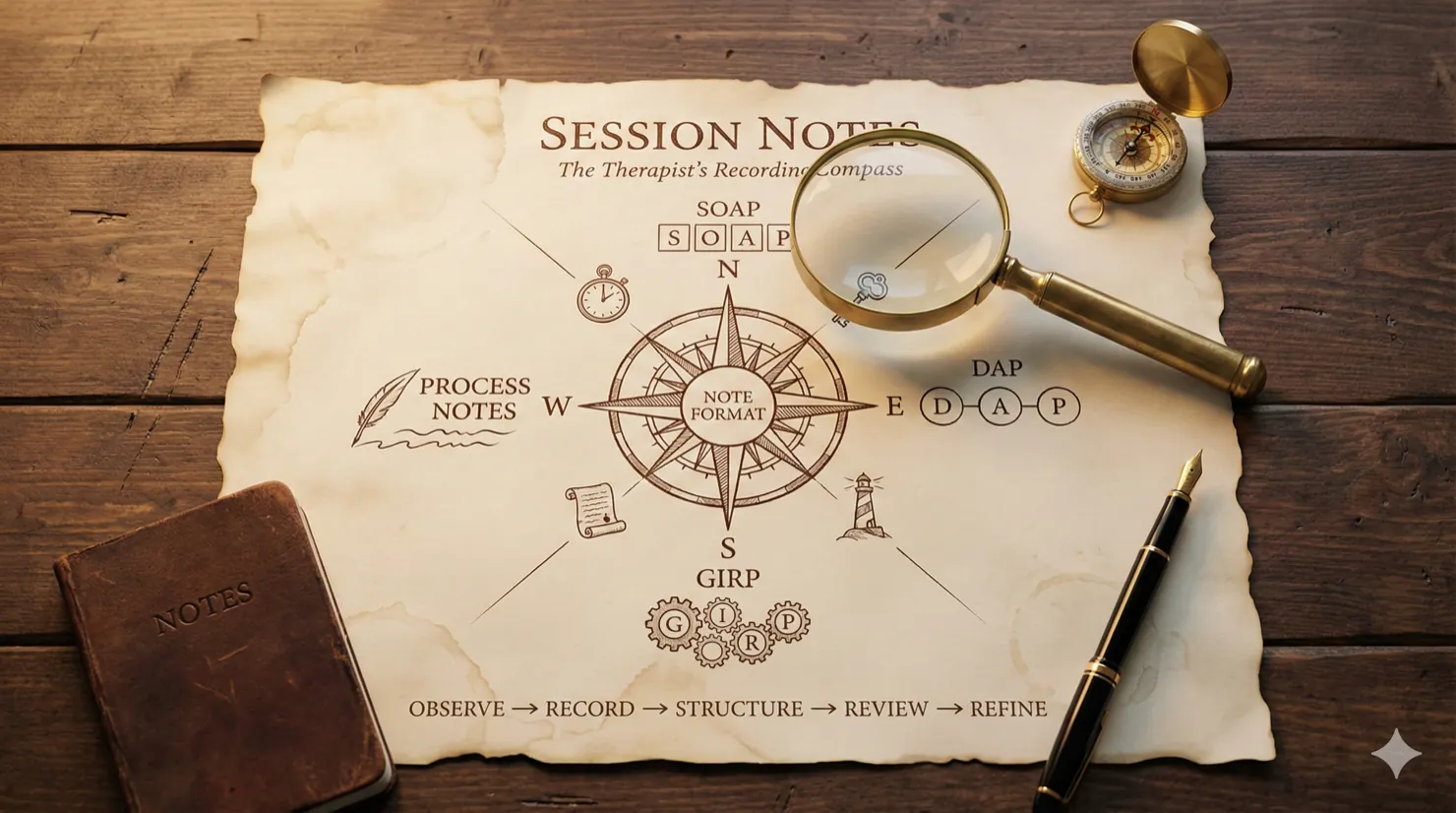
A session note is the clinical document that records what happened in a therapy session in a structured way, capturing the client's statements, the therapist's observations, the clinical assessment, and the next steps. The most common structured formats are SOAP, DAP, and GIRP. This guide examines all three with filled-out examples, then covers approach-specific note components, the principles of effective documentation, and common pitfalls.
The Session Is Over. Now What Do You Write?
Your client just walked out the door. A blank screen waits on your desk. For many therapists, this is the most procrastinated moment of the day — yet paradoxically, your session note is arguably the most critical output of your therapeutic work.
Well-maintained records are not only legal evidence of treatment but also the foundation of clinical continuity (Wiger, 2012). Missing written records create more than a legal weakness; good notes sharpen your clinical thinking, keep your interventions consistent, and strengthen the therapeutic alliance with your client.
In this article, we’ll go beyond surface-level definitions. We’ll examine SOAP, DAP, and GIRP formats with filled-out examples, discuss how different therapeutic approaches shape session notes, and make the difference between a "good note" and a "useful note" concrete.
When you build a structured session-note practice, things change:
- Your clinical thinking sharpens Writing the note means rethinking the session; with each entry you unwittingly test your formulation and clarify the rationale behind your interventions.
- Sessions stay consistent A repeatable skeleton keeps your interventions and progress tracking consistent across sessions.
- Blank-screen paralysis ends A guiding structure removes the "what was I supposed to write here?" hesitation, so you write faster.
- Legal and ethical protection is secured A well-kept note protects you and safeguards continuity of care.
The Point Most Therapists Miss
You already know session notes are required for legal protection and ethical compliance — you hear this in every training. But there’s a less-discussed function of session notes: clinical thinking discipline.
Cameron and Turtle-Song (2002) describe the process of writing session notes as a "thinking exercise." As you translate what happened in session into writing, you unknowingly test your clinical formulation: "Why did I choose this intervention? Was the client’s response what I expected? What should I do differently next session?" Writing the note is rethinking the session.
Prieto and Scheel’s (2002) supervision research supports this: therapists who kept structured notes asked more concrete questions in supervision, articulated intervention rationales more clearly, and adhered more consistently to treatment plans. In other words, your note-taking habit is a direct reflection of your clinical competence.
Structured Session Note Formats
A structured format provides a repeatable skeleton for every session note. Below, we examine the three most common formats with their strengths and limitations.
SOAP Notes
Originating from medicine, this is the most widely used structured note format worldwide. It divides clinical information into four categories:
- S — Subjective: Complaints, emotions, and experiences in the client’s own words. Use direct quotes when possible.
- O — Objective: Your observations — affect, body language, eye contact, speech rate, psychomotor activity.
- A — Assessment: Your clinical interpretation — integration of subjective and objective data, progress evaluation, risk analysis, formulation update.
- P — Plan: Next steps — goals, homework, referral decisions, crisis plan updates.
Example: SOAP Note for a Client with Performance Anxiety
S: "My sleep schedule completely fell apart this week. I can’t stop my thoughts until 3 AM." Client reported anxiety significantly increased after a work presentation, and she has been avoiding social situations for the past week. Evaluated the breathing exercise worked on last session as "I tried it a few times but it didn’t work."
O: Restless appearance at session start, continuous hand-fidgeting observed. Affect anxious and constricted. Eye contact maintainable but notably decreased when discussing performance anxiety. Speech rate above normal. Mid-session emotional intensity increase observed (eyes welled up), followed by rapid composure — possible emotional suppression pattern.
A: Generalized anxiety symptoms intensifying with performance-related triggers. Avoidance behavior (social withdrawal) risks creating a secondary maintaining cycle. Sleep difficulties worsened compared to last session. The breathing exercise "not working" may signal a motivational barrier rather than technical failure — to be revisited next session. Active suicidal ideation assessed, not present.
P: (1) Introduce sleep hygiene psychoeducation and stimulus control technique. (2) Revisit breathing exercise experience using motivational interviewing techniques. (3) Draft graded exposure plan for performance anxiety. (4) Homework: Daily anxiety log (0-10) + sleep diary. Next session: 1 week.
Notice in this example: the S section has direct quotes, the O section has judgment-free observations, the A section has clinical reasoning and formulation updates, and the P section has numbered actionable steps. Each section does its own job.
DAP Notes
A leaner alternative to SOAP. It removes the subjective-objective distinction and combines all data under one roof. A practical choice for therapists with intensive schedules who don’t require insurance reporting.
- D — Data: Everything that happened in the session — client statements, your observations, interventions applied, emerging themes. SOAP’s S and O combined.
- A — Assessment: Your clinical interpretation and progress evaluation.
- P — Plan: Next steps and goals.
GIRP Notes
A goal-oriented format. It links each session to specific treatment goals, enabling systematic tracking of intervention effectiveness. Particularly strong in institutional settings and insurance reporting.
- G — Goal: The treatment goal(s) worked on in the session.
- I — Intervention: Techniques and interventions applied by the therapist.
- R — Response: Client’s response to the intervention — engagement, resistance, insight, emotional reaction.
- P — Plan: Plan for the next session and homework.
Which Format Is Right for You?
All three formats are clinically valid. The determining question is: who will read your note, and for what purpose?
- SOAP — Multidisciplinary settings where other health professionals will read your notes. Insurance reporting. Situations requiring clear subjective-objective separation.
- DAP — Individual practice, no insurance requirements, quick documentation between sessions.
- GIRP — Institutional requirements, mandatory treatment plan tracking, progress-focused reporting.
Approach-Specific Note Components
Regardless of which format you use, your therapeutic approach adds specific components to your session notes. Below you’ll find answers to "what should I add to my base format?" for common approaches.
EMDR
EMDR’s phase structure doesn’t fit a standard session note. You need to record the target memory, negative and positive cognitions, SUD (0-10) and VOC (1-7) scores at session start and end. Your observations during desensitization (response to eye movements, emerging memories, body sensations) and Body Scan results are critical. If the session was incomplete, always note the "open" material and closing stabilization — this determines where you’ll continue next session.
Schema Therapy
The key question in a Schema Therapy note is: "Which schema or mode was activated in this session?" Record activated schemas/modes, observed mode cycles, and limited reparenting interventions. If you used experiential techniques (chair work, imagery), note the client’s response and steps taken to strengthen the Healthy Adult mode.
DBT
DBT’s structured session format requires the target hierarchy (life-threatening > therapy-interfering > quality-of-life-interfering behaviors) and diary card review. If you conducted chain analysis or solution analysis, record the chain from triggering event to outcome and missing skill points. Specify which DBT skill (distress tolerance, emotion regulation, interpersonal effectiveness, mindfulness) was practiced and in what context.
Psychodynamic Approach
The essence of a psychodynamic session note is observed relational dynamics. Record transference and countertransference observations, active defense mechanisms, resistance indicators, and thematic patterns in free association content. If dream material was shared, note the raw content and initial interpretations — dream work typically spans multiple sessions.
Child and Adolescent
Requires developmentally appropriate documentation. If you use play therapy, record play themes and symbolic content — descriptive notes like "The child built a house in the sand and then destroyed it" are critical for tracking the therapeutic process. Add parent/guardian feedback, school information, and age-appropriate risk assessment as separate sections.
Couples, Group, and Family Therapy
When working with multiple people, balanced documentation of each person’s perspective is critical. In couples therapy, record each partner’s core issues and relationship dynamics; in group therapy, the group developmental stage (Tuckman) and therapeutic factors (Yalom); in family therapy, system observations (boundaries, coalitions, roles).
MSE: When Full, When Brief?
The Mental Status Examination (MSE) is a structured snapshot of the client’s current psychological functioning. It can be used as a standalone assessment tool or integrated into any session note’s "Objective" section.
A comprehensive MSE covers:
- Appearance and behavior
- Speech characteristics
- Mood and affect: mood is client-reported, affect is therapist-observed.
- Thought process and content
- Perception
- Cognition
- Insight and judgment
However, administering a full MSE every session is neither practical nor necessary. Sommers-Flanagan and Sommers-Flanagan (2017) identify three situations where MSE is mandatory: initial assessment, crisis situations, and significant clinical changes. In routine sessions, brief MSE observations in your "Objective" section (e.g., "Affect euthymic, eye contact appropriate, thought process organized") are sufficient.
The Difference Between a "Good Note" and a "Useful Note"
The following principles transform your session note from a formality into a clinical tool.
Write as soon as the session ends
Ebbinghaus’s forgetting curve still holds: roughly 40% of details are lost in the first 30 minutes. Notes written at the end of the day are both less detailed and more time-consuming. Reserving a 10-15 minute "note window" between sessions improves both accuracy and efficiency long-term.
Separate the client’s words from your observations
The client said "This week was terrible" — that’s subjective data. You observed the client crying — that’s objective data. You think the client’s depressive symptoms are increasing — that’s clinical assessment. Mixing these three layers undermines your note’s reliability.
Justify your interventions
Compare: "Cognitive restructuring was performed" versus "Cognitive restructuring targeting the client’s catastrophizing pattern was applied; the automatic thought ‘if my presentation goes badly I’ll be fired’ was examined, alternative thoughts were generated, the client partially accepted ‘a bad presentation won’t end my career’ (belief rating: 4/10)." The second version directly tells you where to continue next session.
Make the plan section concrete
"Continue with the same topic next session" is not a plan. A concrete plan looks like this: "(1) Progress to step 3 of the exposure hierarchy. (2) Homework: 5-minute breathing exercise once daily + anxiety log. (3) Evaluate psychiatric consultation if needed." Plans must be actionable.
Always document risk assessment
Even when there’s no risk, writing "active suicidal ideation assessed, not present" is critical. The APA Record Keeping Guidelines (2007) recommend documenting risk assessment every session — because in legal proceedings, this is the first document examined.
Common Pitfalls
The "session conducted" syndrome
Writing only "Met with client, discussed issues, next session planned" is clinically worthless. This note tells a supervisor or legal reviewer who picks it up two years later absolutely nothing. Ask yourself: "If I opened this note six months from now, would I understand what happened in that session?"
Translating the client’s language into medical jargon
When the client says "My chest tightens, I can’t breathe," writing "panic attack symptoms observed" causes information loss. The client’s own words are clinically valuable — preserve subjective data and move your interpretation to the Assessment section.
Writing too much
A session note is not a session transcript. Recording every sentence spoken is both inefficient and buries truly important information in noise. A good session note typically summarizes a 45-50 minute session in 200-400 words.
Timing errors
The "I’ll write them all over the weekend" approach is common but dangerous. A crisis detail from Friday’s session can be lost by Monday. As Cameron and Turtle-Song (2002) recommend, reserving brief note windows between sessions is the most reliable method.
Session Notes with Mindora
In this article we explored formats, principles, and common pitfalls. But how do you bring all this knowledge into clinical practice? Mindora offers purpose-built session note templates for every format and approach discussed here — 14 session note templates in total (including SFBT and EMDR preparation session notes), plus a standalone Mental Status Examination template. Each section includes instructional text explaining what to write there, so you never face a blank screen wondering "what goes in this field?"
Structured Format Templates
The SOAP Note (Classic) template provides the Subjective-Objective-Assessment-Plan structure with ready-made sections. The Subjective section includes a dedicated client quote field, the Objective section has an MSE reference reminder, and the Assessment section features a 0-10 progress scale and a five-item risk screening checklist (suicidal ideation, self-harm, harm to others, substance use, current risk). The "separate observation from interpretation" principle emphasized in this article is built directly into the template’s structure.
The GIRP Note template is designed especially for CBT and solution-focused therapists. The Intervention section includes a 12-item technique checklist: Psychoeducation, Cognitive Restructuring, Exposure, Role Play, Mindfulness, Socratic Questioning, Validation, Emotion Regulation, Schema Work, ACT, Relaxation, and Psychodrama. A 0-10 effectiveness scale in the Response section lets you track which interventions work best across sessions.
The DAP Note template is for therapists who prefer concise documentation. Its three-section structure (Data-Assessment-Plan) enables rapid note-taking when time between sessions is limited. A mood scale and four-item quick flag system (progress observed, regression, risk assessment needed, between-session contact needed) capture maximum clinical data in minimum time.
The Standard Session Note offers a flexible framework for therapists who prefer not to follow structured formats. A session agenda checklist, client quotes, therapist impressions, and a five-item safety screening let you document the natural flow of the session without constraint.
Approach-Specific Templates
The EMDR Protocol Note follows the 8-phase EMDR protocol step by step. Target memory, Negative Cognition (NC) and Positive Cognition (PC) fields, a 1-7 VOC scale, a 0-10 SUD scale, and a body scan section are all built in. The closure checklist (safe place/container used, between-session instructions given, client stabilized) ensures safe session closure. The "always record SUD and VOC scores" principle discussed in this article is already embedded in the template’s natural structure.
The Schema Therapy Session Note systematizes the schema and mode tracking discussed in this article. 11 Early Maladaptive Schemas (from Abandonment to Entitlement) and 10 Schema Modes (from Vulnerable Child to Healthy Adult) are presented as checklists — simply check those active in each session. 8 intervention techniques (including Limited Reparenting, Empathic Confrontation, Imagery Rescripting, and Chair Dialogue) and a 0-10 Healthy Adult strengthening scale let you track schema healing progress concretely.
The DBT Individual Session Note places the target behavior hierarchy at the template’s center. Diary card review, suicide/self-harm screening, and quality-of-life-interfering behaviors are tracked in separate sections. The Chain Analysis section — vulnerability factors, prompting event, thought-emotion-behavior links, and consequences — directly mirrors the "trigger → behavior chain" structure from this article. A weekly usage checklist for 10 core DBT skills (Mindfulness, DEAR MAN, GIVE, FAST, Opposite Action, Ride the Wave, TIPP, ACCEPTS, IMPROVE, Radical Acceptance) lets you monitor skill generalization.
The Psychodynamic Session Note captures the session flow in three layers: opening theme, main content, and closing. An 11-item defense mechanism checklist (Repression, Projection, Displacement, Rationalization, Splitting, Denial, Intellectualization, Reaction Formation, Sublimation, Regression, Idealization/Devaluation), separate sections for transference and countertransference, a dream and free association log, and a 0-10 therapeutic alliance scale let you document all layers of the psychodynamic process.
The Child/Adolescent Session Note addresses this population’s unique requirements. It begins with session format selection (child only, including parent, family session, play therapy). A 7-item behavioral observation checklist (age-appropriateness, attention difficulties, hyperactivity, anxiety, withdrawal, anger/aggression, regressive behaviors) and 5 developmental domains (social skills, emotion regulation, cognitive development, motor skills, language/communication) let you track the child’s holistic development. Separate sections for parent feedback and school/teacher communication support multi-layered collaboration.
Couples, Group, and Family Therapy Templates
Mindora also offers three specialized templates for work beyond individual therapy. The Couples Therapy template captures each partner’s perspective in separate sections and provides an 8-item interaction pattern checklist (criticism-defense cycle, stonewalling, contempt, pursuer-withdrawer, and more). The Group Therapy template documents Yalom’s therapeutic factors, group atmosphere, and individual member contributions in separate sections. The Family Therapy template tracks communication patterns, coalitions and triangulations, power dynamics, and the identified patient (IP) concept through structured sections.
Mental Status Examination (MSE)
All MSE components discussed in this article are available in structured form within Mindora’s Mental Status Examination template: appearance and behavior checklist, speech characteristics, mood and affect, thought process and content (5-item pathological thought checklist), perceptual disturbances, orientation (person, place, time), attention, memory, a 0-10 insight scale, and judgment assessment.
Whichever template you choose, the notes you keep appear chronologically in your client’s client management flow, so each session you can scan previous notes at a glance and recall where the story came from. And Mindora’s structured note editor, designed for therapists, keeps each section in its own field instead of one free-text blob, preventing observation, interpretation, and plan from bleeding into each other.
Frequently Asked Questions
References
- Cameron, S. & Turtle-Song, I. (2002). Learning to write case notes using the SOAP format. Journal of Counseling & Development, 80(3), 286-292.
- Prieto, L. R. & Scheel, K. R. (2002). Using case documentation to strengthen counselor trainees’ case conceptualization skills. Journal of Counseling & Development, 80(1), 11-21.
- Sommers-Flanagan, J. & Sommers-Flanagan, R. (2017). Clinical Interviewing (6th ed.). Wiley.
- Wiger, D. E. (2012). The Psychotherapy Documentation Primer (3rd ed.). Wiley.
- American Psychological Association. (2007). Record Keeping Guidelines. American Psychologist, 62(9), 993-1004.
This Article Is Part of the Formulation Series
This article is one of the deep-dive posts in the formulation series. You can access all posts in the series below.
Case Formulation Guide: 8 Building Blocks & the 5P Model
A comprehensive guide to case formulation in psychotherapy. Learn the 5P model, 8 building blocks, CBT/ACT/Schema Therapy approaches, and real clinical examples.
Clinical Theme & Pattern Tracking: A Therapist's Guide
Learn how to identify recurring themes using the CCRT model and Schema Therapy framework, with concrete examples and practical principles for theme tracking.
Resource & Strength Analysis: A Therapist's Guide
Learn how to systematically identify and document internal and external resources using strengths-based models, with concrete examples and practical principles.
Coping Mechanisms in Therapy: A Therapist's Guide
Learn to map functional and dysfunctional coping mechanisms, safety behaviors, and comprehensive coping analysis with concrete clinical examples and principles.
Trigger Analysis & Mapping in Therapy: A Therapist's Guide
Learn to map internal and external triggers, understand the activation cycle, and distinguish precipitating from maintaining factors with examples.
Values Work and Life Domains in Therapy: A Therapist's Guide
Learn ACT-based value identification, life domain alignment analysis, and committed action with clinical examples and practical principles for therapists.
Critical Life Events and Turning Points: A Therapist's Guide
Document critical life events, analyze turning points with the Lazarus appraisal model, and integrate life-course analysis through concrete clinical examples.
Clinical Hypothesis Building and Testing: A Therapist's Guide
Learn clinical hypothesis formulation, evidence balance analysis, and hypothesis testing cycles with concrete clinical examples and practical principles.