Treatment Planning & SMART Goals: From Formulation to Action
Learn to translate case formulation into concrete treatment strategies, make progress measurable with SMART goals, and explore five template approaches through filled clinical examples.
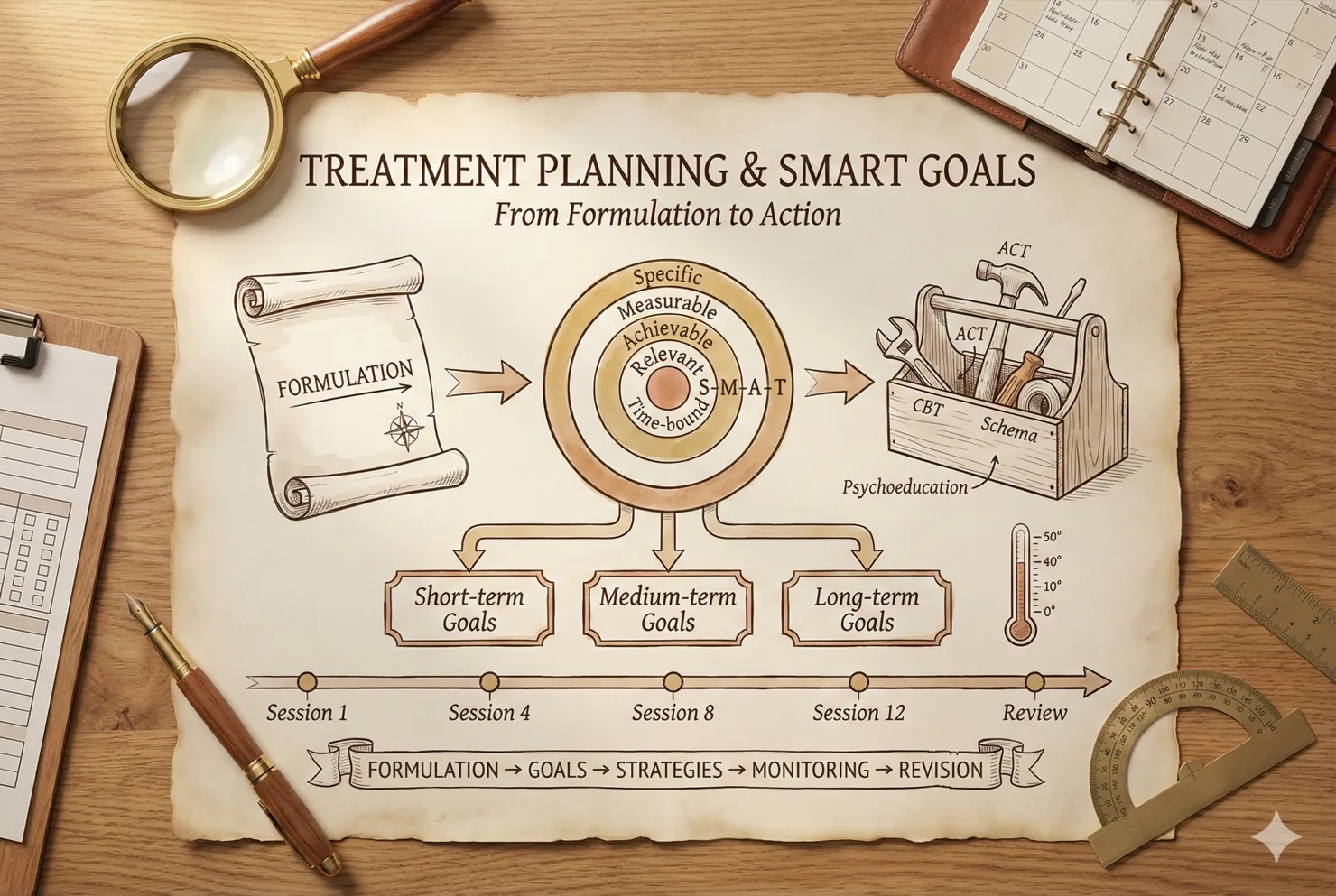
A treatment plan is a written roadmap that translates the understanding from case formulation into a concrete, measurable treatment strategy shared with the client. The plan answers where are we going, while SMART goals (specific, measurable, achievable, relevant, time-bound) answer how will we get there and how will we know we have; this guide covers both through five template approaches and filled examples.
Formulation Complete. Now What?
You've spent three to four sessions assessing. You analyzed symptoms, mapped triggers, built a case formulation. You now understand why your client is at this point. But as you sit down for session five, you ask yourself: "Okay, I understand — but what are we actually going to do?"
Many therapists answer this question in their heads: "We'll do CBT, cognitive restructuring, 12-16 sessions." But this "mental plan" is never shared with the client, can't be measured, and doesn't provide a clear answer when a supervisor asks "what's your treatment strategy?"
In this post, we examine the transition from case formulation to concrete treatment strategies. We explore what a treatment plan actually is, why SMART goals are different from vague targets like "reduce anxiety," and we walk through five template approaches with filled clinical examples.
Why Your "Mental Plan" Isn't Enough
It's not uncommon for therapists to view treatment plans as merely institutional requirements. Yet Sommers-Flanagan and Sommers-Flanagan (2015) emphasize that the treatment plan serves as a compass for both therapist and client: it frames clinical decision-making for the therapist and makes the direction of the process tangible for the client. Client participation in treatment plan creation directly affects treatment adherence.
Locke and Latham's (2002) half-century of goal-setting research points to a consistent finding: specific, measurable goals lead to significantly higher performance than vague "do your best" goals. This holds true in therapy — "reduce anxiety" is not a goal, it's a wish. "Reduce GAD-7 from 14 to below 10 within 8 weeks" is a goal.
Another invisible function of the treatment plan is preventing therapeutic drift. It's natural to focus on responding to the client's current concerns session by session — but without a written plan, losing sight of long-term treatment direction is remarkably easy. Jongsma and Peterson (2014) demonstrated that written treatment plans function as the "therapist's internal compass" and that regular review increases treatment effectiveness.
The Treatment Plan: "Where Are We Going?"
The treatment plan transforms formulation insights into strategic decisions. It answers core questions: What is the primary clinical target? Which therapeutic approach will we use? How long will treatment take? How will we measure success? When will we reassess?
The right time to write a treatment plan is typically around the session when formulation is complete — usually session 3 or 4. Two fundamental approaches exist: a formal format aligned with institutional standards, and a collaborative format created together with the client.
Formal Treatment Plan
Contains diagnostic codes, structured goals, intervention methods, and evaluation criteria. Preferred in institutional settings, insurance requirements, and supervision documentation. Uses clinical language and systematically documents the treatment process.
Example: Can, 34, Generalized Anxiety & Perfectionism — Formal Treatment Plan
Diagnostic Impression: F41.1 Generalized Anxiety Disorder. Co-occurring perfectionist personality traits, sleep-onset difficulty.
Target Symptoms: Cognitive rumination (particularly about work performance), sleep-onset difficulty, delegation avoidance, somatic tension (shoulder/neck).
Long-Term Goals: Functional anxiety management, sustainable work-life balance, developing a distanced relationship with the perfectionist schema.
Short-Term Goals (First 8 Weeks): (1) Reduce GAD-7 from 14 to below 10, (2) delegate at least 2 tasks per week to team members, (3) establish a regular sleep routine.
Approach: Cognitive Behavioral Therapy — emphasis on cognitive restructuring and behavioral experiments. Schema-focused work (perfectionism schema) if needed.
Session Frequency: Weekly, estimated 12-16 sessions.
Baseline Functioning: GAF 62.
Agreement: Treatment plan shared with client, goals collaboratively determined, crisis procedures discussed.
Collaborative Roadmap
A plan created together with the client during the session, using less "clinical" language. It uses the client's own words, clarifies shared vision and responsibilities. A natural choice in private practice settings and client-centered approaches.
Example: Same Client — Collaborative Roadmap
Client's Change Wish: "When I come home from work, I want my mind to not still be at the office. I want to actually be present with my wife at dinner."
Therapist's Vision: Can's perfectionism pattern is fueled by high performance standards while simultaneously creating burnout risk. Experiencing that making mistakes isn't catastrophic could bring relief in both work and relationship domains.
Therapy Focus Areas: (1) Testing the "mistake = catastrophe" belief through behavioral experiments, (2) gradually developing delegation courage, (3) establishing work-home boundaries with concrete rules.
Success Criteria: "Being able to delegate a project to a teammate and wait without checking the results" and "Not opening work email after 7 PM."
SMART Goals: "How Will We Get There?"
While the treatment plan answers "where are we going," SMART goals answer "how will we get there and how will we know we've arrived." The SMART framework introduced by Doran (1981) — Specific, Measurable, Achievable, Relevant, Time-bound — transforms vague intentions into concrete, trackable steps.
Writing "reduce anxiety" in a treatment plan is easy. But what does it mean? How much reduction? How will we measure it? By when? A SMART goal answers each of these questions and operationalizes the abstract target from the treatment plan.
Standard SMART Analysis
Analyzes each goal across five criteria. The most critical step is "Specific" — this is where you work with the client to transform vague expressions like "feeling better" into concrete, observable behaviors.
Example: Can's SMART Goal — Delegation
S — Specific: Delegate at least 2 work tasks per week to team members — clearly specifying task scope, expected deliverable, and deadline.
M — Measurable: Keep a weekly delegation log. Every Friday, answer "how many tasks did I delegate this week and what were the results?" Target: 2+ per week.
A — Achievable: Self-efficacy: 6/10. Three team members are willing to take on tasks. Can's technical knowledge makes the handoff process easier — the challenge isn't technical but emotional (fear of losing control). Starting with 1 task the first week and increasing to 2 from week 3 is a realistic plan.
R — Relevant: Serves the value of "being a good leader." Can himself said in session "if I do everything myself, my team can't develop" — the goal directly aligns with his own values.
T — Time-bound: Start this week. First evaluation at session 8. Begin with 1 task the first week, increase to 2 per week target from week 3.
Goal Laddering: Breaking Big Goals Into Small Steps
Some goals feel so large or frightening to the client that even getting started seems impossible. Asking a client with social phobia to "give a presentation" is like asking them to climb a wall without a ladder. The Goal Laddering approach breaks the summit goal into steps from easiest to hardest. Each step builds on the previous one, and the client gains self-efficacy with each completed step.
For Can's delegation goal, the ladder might look like: (1) delegate a small subtask via email, (2) delegate a medium-sized task face-to-face and provide feedback, (3) delegate an important task and wait 24 hours without checking the results, (4) hand over an entire project to a team member. Each step requires slightly more "letting go of control" than the previous one.
WOOP Model: Planning for Obstacles in Advance
Oettingen's (2012) WOOP model (Wish, Outcome, Obstacle, Plan) goes beyond optimistic goal-setting to proactively address potential obstacles. Research shows that individuals who focus only on the goal tend to give up when encountering obstacles, while those who create "if X happens, I'll do Y" plans are more resilient.
WOOP analysis for Can's delegation goal: Wish — to delegate work tasks comfortably. Best outcome — evenings free, team more independent, ability to focus on strategic work. Internal obstacle — the "what if they make mistakes?" thought and fear of losing control. Plan — "If a mistake is made on a delegated task, I will frame the mistake as a learning opportunity and wait 24 hours without checking the results."
How Treatment Plan and SMART Goals Connect
The treatment plan is the map, SMART goals are the checkpoints. The treatment plan says "we'll work on the perfectionism schema"; the SMART goal translates this into a measurable step like "delegate 2 tasks per week within 8 weeks." The plan sets direction, the goals measure progress.
Review both the treatment plan and SMART goals every 4-8 sessions. If goals were achieved, set new ones. If not, analyze the obstacles — was the goal too ambitious, or is there something in the formulation that needs updating? This review cycle prevents treatment from operating on "autopilot" and keeps the process alive.
5 Principles of Effective Treatment Planning
Write the Plan With Your Client
The treatment plan should be created with the client, not for them. Sommers-Flanagan and Sommers-Flanagan (2015) emphasize that client participation in goal-setting directly affects treatment adherence. Goals expressed in the client's own words are more motivating than "clinical" goals set by the therapist.
Start From the End
Instead of "feeling better," start with the question "what will be concretely different in your life when treatment ends?" This concretization both makes goals measurable and shows the client where the process is heading.
Balance Ambition With Achievability
Locke and Latham (2002) showed that the highest motivation occurs in the "sweet spot" where goals are both challenging and achievable. Too-easy goals don't motivate, too-difficult goals lead to giving up. The client's self-efficacy score (6+ on a 0-10 scale is generally a good starting point) helps calibrate this balance.
Build in Review Checkpoints
A treatment plan is not a document written once and filed away. Conduct a comprehensive review every 4-8 sessions: How close are we to the goals? Does anything in the formulation need updating? Should new goals be added? This regular review practice prevents therapeutic drift.
Don't Hesitate to Revise
A changing treatment plan isn't a sign of failure but of clinical sensitivity. When new information emerges (an unexpected trigger, changing life circumstances, formulation update), revising the plan is natural and necessary. An inflexible plan risks disconnecting from the client's reality.
Common Mistakes
Setting Vague Goals
"Reduce anxiety" or "increase self-confidence" are not treatment goals — they're well-intentioned wishes. When goals aren't measurable, evaluating progress becomes impossible, and neither therapist nor client can answer "is anything changing?" Run every goal through the "how would we measure this?" test.
Targeting Too Many Goals at Once
Listing 7-8 goals in a treatment plan looks comprehensive but leads to scattered focus in practice. Start with 2-3 priority goals. Add new ones as these are achieved or as formulation changes. Clarity in the client's mind is more valuable than comprehensiveness.
Never Reviewing the Plan
Creating a treatment plan in early sessions and never opening it again is a common error. As treatment progresses, the client's needs, priorities, and even formulation change. An unreviewed plan becomes disconnected from clinical reality, and the therapist unknowingly shifts into "autopilot."
Leaving the Client Out of the Process
Goals set solely by the therapist may not align with the client's internal motivation. "Reduce cognitive distortions" is meaningful to the therapist but may feel abstract and disconnected to the client. Goals expressed in the client's own words ("I want my mind to not still be at the office when I get home") strengthen treatment ownership.
Treatment Planning with Mindora
Mindora offers structured templates for both planning approaches discussed in this post:
- Treatment Plan — 2 templates: Standard Clinical Treatment Plan (diagnosis, goals, intervention, evaluation) and Collaborative Roadmap (shared vision, roles, success criteria).
- SMART Goal Planning — 3 templates: Standard SMART Analysis (5 criteria), Goal Laddering (step-by-step plan + readiness scale), and Obstacle & Coping Plan / WOOP (obstacle analysis + if-then table).
All templates can be used as-is or customized to your clinical needs. Treatment plans and SMART goals can be linked to other note types (formulation, session notes, process evaluation) as part of the clinical documentation system.
Frequently Asked Questions
References
- Sommers-Flanagan, J. & Sommers-Flanagan, R. (2015). Clinical Interviewing (5th ed.). Wiley.
- Locke, E. A. & Latham, G. P. (2002). Building a practically useful theory of goal setting and task motivation. American Psychologist, 57(9), 705-717.
- Doran, G. T. (1981). There's a S.M.A.R.T. way to write management's goals and objectives. Management Review, 70(11), 35-36.
- Oettingen, G. (2012). Future thought and behaviour change. European Review of Social Psychology, 23(1), 1-63.
- Wiger, D. E. (2012). The Psychotherapy Documentation Primer (3rd ed.). Wiley.
- Jongsma, A. E. & Peterson, L. M. (2014). The Complete Adult Psychotherapy Treatment Planner (5th ed.). Wiley.