Coping Mechanisms: A Comprehensive Map from Functional Strategies to Safety Behaviors
Simply dividing coping mechanisms into "adaptive" and "maladaptive" in your formulation isn't enough — every mechanism has a context, a developmental function, and a maintaining effect. In this guide, you'll explore the theoretical ground from Lazarus and Folkman's transactional stress model to Salkovskis's safety behaviors, schema coping modes to experiential avoidance, with concrete examples, and learn to build a comprehensive coping map.
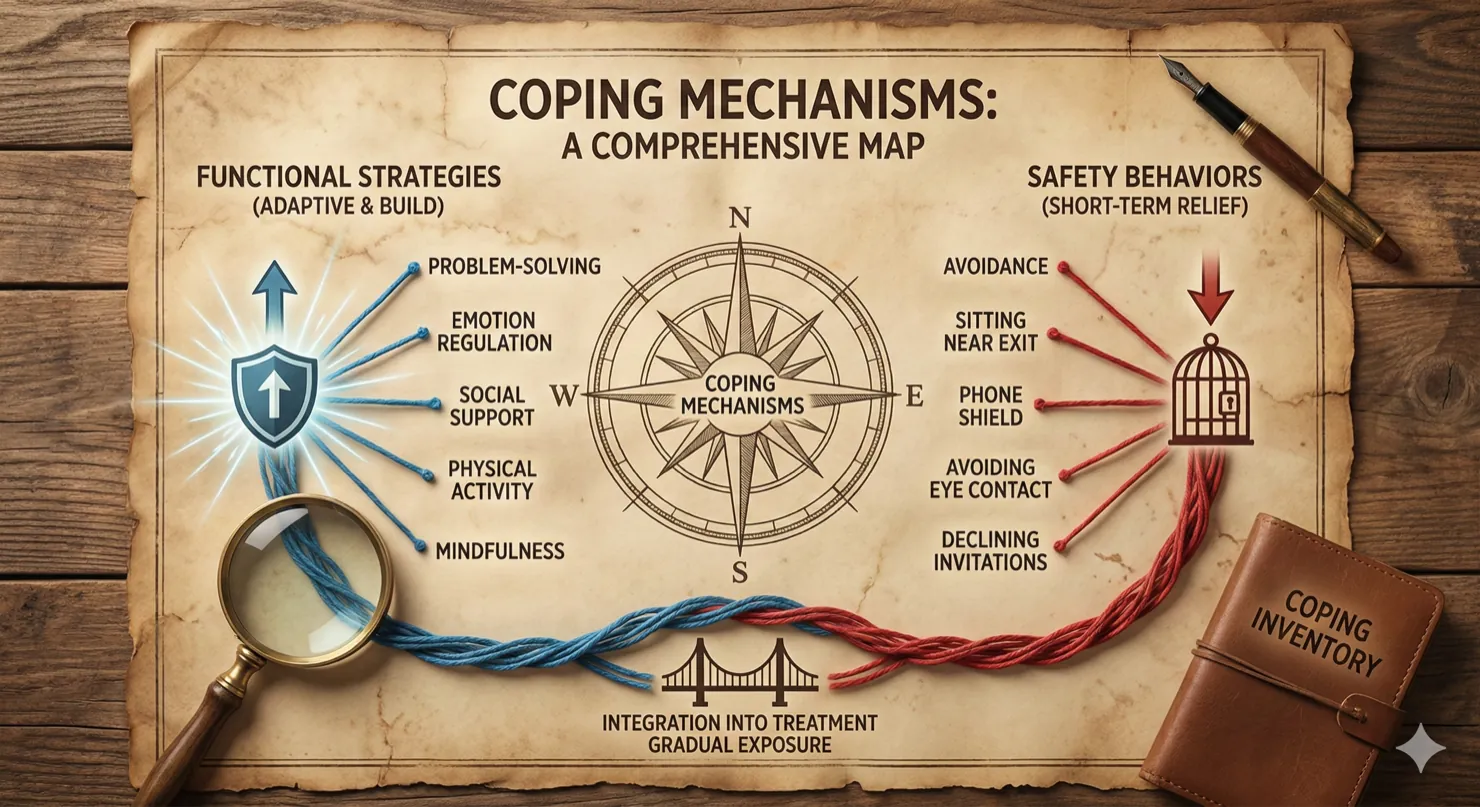
The Two Faces of Coping
You've been seeing Murat for three months for social anxiety. Your formulation is clear: a core belief of "I'll be found inadequate," interpersonal evaluation triggers, and a coping pattern manifesting as avoidance and safety behaviors. He sits near the exit in meetings, uses his phone as a shield in social settings, and systematically declines after-work invitations. You write these in the "coping" box of your formulation — and don't go a step further.
But when you look at Murat's life through a wider lens, the picture shifts: he runs three times a week and says it "clears his head." Every evening he journals for fifteen minutes, organizing his thoughts by writing them down. When his anxiety intensifies, he calls his brother — these calls "let him breathe." Before presentations, he practices breathing exercises he learned. Where are these in your formulation?
In this article, we'll examine why coping mechanisms require a clinical map far beyond the "functional/dysfunctional" binary — spanning the theoretical ground from Lazarus and Folkman's (1984) transactional stress model to Salkovskis's (1991) safety behaviors concept, Young and colleagues' (2003) schema coping modes to Hayes and colleagues' (2012) experiential avoidance formulation — through a concrete case.
Documenting coping as a map yields four concrete gains:
- Intervention becomes precise: seeing each mechanism's function clarifies which strategy to strengthen and which to reduce.
- Safety behaviors become visible: the subtle strategies hidden under the "avoidance" label become distinct and tied to the right intervention.
- Existing strengths get mobilized: the client's already-working strategies become a resource for treatment.
- Empathy with the client deepens: when each mechanism's developmental function is understood, understanding replaces judgment.
Why an "Adaptive and Maladaptive" List Isn't Enough
Lazarus and Folkman's (1984) transactional stress model is the cornerstone of coping research and underscores a critical point: coping is not a personality trait but a continuously changing process in response to person-environment interactions. The same person can respond to different stressors with different strategies within the same day; a mechanism that is functional in one context can become a maintaining factor in another. Therefore, placing a fixed label in the "coping" box of a formulation — "avoidant" or "problem-focused" — cannot capture the complexity of clinical reality.
Skinner and colleagues' (2003) comprehensive review concretizes this complexity: over one hundred assessment systems were examined, and more than four hundred different coping categories were identified. These findings demonstrate that the field itself cannot agree on a single taxonomy. For clinical formulation, this means: understanding a coping mechanism is not about placing it in the right category, but about mapping its function, context, and maintaining effect.
Salkovskis's (1991) safety behaviors concept enters the picture here. Safety behaviors differ from classic avoidance: the person enters the feared situation but tries to prevent the feared outcome through subtle avoidance strategies. A person with social anxiety attends the party but stays in the corner; a person with panic disorder enters the store but always stays near the exit. This provides short-term relief — but in the long term, the experience of "nothing bad happened" is attributed to the safety behavior, maintaining the anxiety. When these mechanisms are labeled simply as "avoidance" in the formulation, the treatment plan remains superficial.
Functional Coping: Beyond Relief
The COPE inventory developed by Carver, Scheier, and Weintraub (1989) conceptualizes functional coping along two main axes: problem-focused coping (strategies aimed at directly changing the stressor — planning, active coping, seeking instrumental support) and emotion-focused coping (strategies aimed at regulating the emotional response to the stressor — acceptance, positive reframing, seeking emotional support). However, this binary distinction can be insufficient in clinical practice, as the same behavior can serve both functions. Murat's running serves both emotion regulation (anxiety decreases during the run) and problem-solving (thoughts clarify after running, work decisions become easier).
What defines a functional coping mechanism is not its category but its outcome: does the strategy improve the stressor or the response to it in the long term? Does it expand the person's behavioral repertoire, or does it narrow it? Fredrickson's (2001) broaden-and-build theory — which we also discussed in our previous article on resource analysis — reappears here: functional coping doesn't just reduce current stress; over time, it builds new resources. Murat's regular running doesn't just reduce his anxiety in the moment — it also nourishes resources like body awareness, a sense of self-efficacy, and sleep quality.
Linehan's (1993) distress tolerance skills within the DBT framework open another dimension of functional coping: some situations cannot be solved immediately, and problem-focused coping is not appropriate. In these situations, the capacity to "sustain the moment without solving the problem" is itself a form of functional coping. Concrete techniques like TIPP (Temperature, Intense exercise, Paced breathing, Progressive relaxation) are emergency strategies that replace impulsive or self-harming responses during crisis. Murat's breathing exercises before presentations fall precisely in this category: instead of canceling the presentation through avoidance, he makes entering the situation possible by tolerating physiological activation.
When documenting functional mechanisms clinically, three dimensions are critical: the mechanism itself (what does the person do?), the trigger context (in which situations does it activate?), and the effectiveness level (how well does it work, 0-10?). Alongside these three dimensions, classifying the mechanism type — problem-focused, emotion-focused, social support, physical activity, creative expression, mindfulness, other — makes it easier to see which domains are strong and which are open for development in the treatment plan. In Murat's example, the physical activity and mindfulness dimensions are strong, while the social support dimension is limited to just one person (his brother) — indicating that intervention should prioritize expanding the social support network.
Dysfunctional Coping and Safety Behaviors: Maintaining the Problem While Solving It
Dysfunctional coping encompasses strategies that provide short-term relief but maintain — or even deepen — the problem in the long term. However, a critical nuance exists here: the "dysfunctional" label belongs not to the mechanism itself, but to its outcome in a specific context. Salkovskis's (1991) safety behaviors concept is the framework that best illustrates this nuance. A safety behavior is entering the feared situation but trying to prevent the feared outcome through subtle avoidance strategies. Murat attends meetings — this is not classic avoidance. But he always sits near the exit, avoids speaking as much as possible, and leaves quickly once the meeting ends. When the meeting "goes well," he attributes this not to his own competence but to his safety behaviors: "Nothing happened because I didn't draw attention." This attribution prevents the core belief from being tested and keeps the anxiety alive.
Hayes, Strosahl, and Wilson's (2012) experiential avoidance concept in the Acceptance and Commitment Therapy (ACT) framework brings safety behaviors into a broader perspective. Experiential avoidance encompasses not just behavioral avoidance but all attempts to control or eliminate unwanted internal experiences (thoughts, emotions, bodily sensations): thought suppression, emotional numbing, distraction, substance use. ACT's central thesis is that these control attempts paradoxically increase suffering — suppressed thoughts come more frequently, avoided emotions are felt more intensely. Murat's use of his phone as a shield in social settings is not just behavioral avoidance but also avoidance of making contact with the thought "I'll be found inadequate" — experiential avoidance.
Young, Klosko, and Weishaar's (2003) Schema Therapy adds a developmental dimension to dysfunctional coping. Schema coping modes — surrender (compliant surrenderer), avoidance (detached protector), and overcompensation (self-aggrandizer) — are generally automatic and unconscious coping patterns that activate when early maladaptive schemas are triggered. The critical point is: these patterns were adaptive responses in childhood. Switching to "detached protector" mode in the face of a neglecting parent — shutting down emotions, withdrawing from the relationship — was a survival strategy for the child. In adulthood, the same mode transforms into avoidance of emotional closeness in intimate relationships. Without this developmental context in the formulation, the "avoidance" label both leaves the clinical picture incomplete and makes it harder to empathize with the client.
When documenting dysfunctional mechanisms, five dimensions are important:
- The mechanism itself
- The trigger context
- The short-term relief level (0-10)
- Which need it serves
- Which themes it maintains in the long term
Documenting these five dimensions together makes it visible — for both therapist and client — why the mechanism persists. Adding an intervention plan section to the documentation — "What functional alternatives could replace it?" and "Which intervention strategies can be applied?" (behavioral experiments, gradual exposure, cognitive restructuring, teaching alternative coping, motivational interviewing) — directly links documentation to the treatment plan.
Comprehensive Coping Map: Seeing the Whole Picture
Documenting functional and dysfunctional mechanisms separately is an important step — but the coping map only gains meaning when both repertoires are evaluated together. The "coping balance" concept emphasized in Compas and colleagues' (2001) stress coping model is critical here: a person's adaptive capacity is determined not just by the strength of their functional mechanisms, but by the ratio between functional and dysfunctional strategies, which contexts each activates in, and the flexibility to transition between them.
Murat's map concretely illustrates this balance: his functional mechanisms (running, journaling, communication with his brother, breathing exercises) cluster in individual and private domains, while his dysfunctional mechanisms (sitting near the exit, phone-shielding, not speaking, declining invitations) dominate in interpersonal and public domains. This "domain separation" is not random — it is consistent with the core belief of social anxiety ("they'll find me inadequate"): in contexts where the risk of evaluation is low, Murat can cope effectively; when perceived risk rises, he shifts to safety behaviors. The comprehensive map makes this pattern visible.
From Wells's (2009) metacognitive therapy perspective, an additional dimension emerges: the person's beliefs about their own coping strategies. Murat believes his safety behaviors work ("If I don't stay quiet in meetings, I'll embarrass myself"). This metacognitive belief is as much a maintaining factor as the behavior itself — perhaps more so. A comprehensive coping map should evaluate, alongside the inventory of mechanisms, these beliefs and the interactions between mechanisms: under what conditions do functional mechanisms fall "short," and when is the transition to dysfunctional ones triggered?
Filled Example: Comprehensive Coping Analysis
Murat, 32 years old, software engineer. Presented for social anxiety. Below is a completed comprehensive coping analysis template for Murat.
Section 1 — Functional Mechanisms
Functional Coping Strategies Inventory: After-work running (3 times per week, 30-40 minutes) — anxiety decreases, thoughts clarify. Journaling for 15 minutes every evening before bed — processing the day's events by writing, thought organization. Calling his brother when anxiety intensifies (2-3 times per week) — "lets me breathe, makes me feel I'm not alone." Box breathing before presentations — reduces physiological activation. Nature walks on weekends — interrupts rumination.
Overall Functional Coping Strength: 6/10
Section 2 — Dysfunctional Mechanisms
Dysfunctional Coping Strategies Inventory: Sitting near the exit in meetings (safety behavior — "I need to feel in control"). Checking phone in social settings (experiential avoidance — reducing social interaction demand). Avoiding speaking in work meetings as much as possible (safety behavior — belief "if I don't draw attention, I won't be evaluated"). Avoiding eye contact with new acquaintances (avoidance). Systematically declining after-work social invitations (behavioral avoidance).
Dysfunctional Mechanism Usage Frequency: 7/10
Section 3 — General Assessment
Coping Map Analysis: Murat's coping map reveals a distinct domain separation. Functional mechanisms (running, journaling, phone calls with brother, breathing exercises) cluster in individual and private domains, while dysfunctional mechanisms (sitting near exit, phone-shielding, not speaking, declining invitations) dominate in interpersonal and public domains. This pattern is consistent with the core belief "they'll find me inadequate": in contexts where evaluation risk is low, Murat can cope effectively; when perceived risk rises, he shifts to safety behaviors. The self-regulation capacity provided by running and journaling has transferable potential to the social domain, but this transfer is not currently occurring.
Strengths and Areas for Change: Strengths — consistent exercise routine (hasn't missed in 3 months), thought organization skill through writing, at least one safe interpersonal relationship (brother). Priority areas for change — gradual reduction of safety behaviors in meetings, extending the self-regulation skills gained through running/breathing exercises to social contexts, questioning the metacognitive belief "I'm safe as long as I don't draw attention."
Section 4 — Treatment Integration
Strengthening functional mechanisms: scheduling social activities after running (exposure following emotion regulation), transforming journaling into pre-session preparation, working on generalizing the trust experience from the brother relationship to other relationships. Reducing dysfunctional mechanisms: gradual dropping of safety behaviors — first step: experiment of keeping phone in pocket during meetings; second step: experiment of speaking once during a meeting. Testing the "evaluation" belief through behavioral experiments: testing the hypothesis "What happens if I speak up?" in a meeting. Integration strategies: incorporating functional mechanisms into daily routine, plan to reduce dysfunctional mechanisms, testing through behavioral experiments.
5 Principles for Effective Coping Documentation
Map the Developmental Function of Each Mechanism
Before labeling a coping mechanism as "dysfunctional," inquire about its developmental origin: when did this mechanism first appear? What did it protect the person from at that time? As Young and colleagues' (2003) schema coping modes demonstrate, many strategies that create problems today were adaptive survival responses in childhood. Including this context in the formulation both enriches the clinical picture and strengthens empathy with the client.
Document Short-Term Relief and Long-Term Cost Together
The power of dysfunctional mechanisms lies in the fact that they work in the short term — this paradox is at the foundation of Salkovskis's (1991) safety behaviors conceptualization. In documentation, answer two questions side by side for each dysfunctional mechanism: "What does it provide in the short term?" (0-10 relief level) and "What does it maintain in the long term?" Seeing these two dimensions side by side concretely shows both the therapist and the client the maintaining function of the mechanism.
Match Functional Alternatives to the Same Need
Telling someone to "just stop" a dysfunctional mechanism is clinically meaningless — because that mechanism is meeting a need. Effective intervention offers a functional alternative that meets the same need. If Murat's phone-shielding in meetings responds to the need to "reduce social demand," the alternative must address this need — for example, lowering physiological activation through a brief breathing exercise before the meeting. In documentation, add the questions "What need does this serve?" and "What functional alternative meets the same need?" alongside each dysfunctional mechanism.
Assess the Breadth and Flexibility of the Repertoire
Coping capacity is not measured solely by the number of "good" strategies — as Compas and colleagues (2001) emphasize, flexibility is at least as important as strength. Can the person switch strategies based on context? Can they use their functional mechanisms across different domains? Murat's map shows "domain separation": flexible in the individual domain, rigid in the social domain. In comprehensive documentation, listing mechanisms is not enough — also record which strategies activate in which contexts and the flexibility of transitions between them.
Transform the Coping Map into Sequenced Intervention
The coping map is valuable as an inventory — but its ultimate purpose is to inform the treatment plan. When transforming the map into intervention, sequencing is critical: first strengthen functional mechanisms (reinforce existing resources), then plan the gradual reduction of dysfunctional mechanisms (safety behavior dropping experiments, exposure hierarchy), and finally transfer functional mechanisms into the space vacated by the dysfunctional ones.
4 Mistakes to Avoid
Treating the Functional-Dysfunctional Distinction as a Fixed Label
As Lazarus and Folkman (1984) emphasized, coping is a context-dependent process. The same mechanism can serve different functions in different contexts: social withdrawal is functional during a post-burnout recovery period ("I need to pull myself together") but dysfunctional as chronic avoidance of closeness. Placing a fixed label of "this strategy is dysfunctional" ignores contextual variation. In your formulation, pair each mechanism with a specific context: "In X situation, Y mechanism serves Z function."
Confusing Safety Behaviors with Classic Avoidance
The difference between safety behaviors and classic avoidance directly affects the treatment plan. In classic avoidance, the person stays completely away from the situation — exposure therapy is appropriate for this. In safety behaviors, the person enters the situation but tries to prevent the feared outcome through subtle avoidance strategies. Salkovskis (1991) has shown why this distinction is critical: exposure conducted alongside safety behaviors loses its effectiveness, because the "nothing bad happened" experience is attributed to the behavior. Documenting these two mechanisms separately in your formulation enables you to choose the right intervention.
Evaluating Only Individual Coping While Skipping Systemic Factors
Coping may appear to be an individual process — but the family system, cultural norms, and social context are largely determinative. In one culture, "seeking social support" is an adaptive strategy, while in a family that emphasizes emotional independence, the same behavior may be perceived as "weakness" and may not be reinforced. A formulation that focuses solely on the individual's strategies cannot see systemic barriers: Murat's competitive workplace culture may be a factor reinforcing his need to "appear strong" in social settings. Include the systemic context in your coping map as well.
Treating All Avoidance as the Same Category
In clinical formulation, the term "avoidance" covers very different mechanisms, each requiring a different treatment approach. Hayes and colleagues' (2012) experiential avoidance is avoidance of internal experiences — its treatment is increasing psychological flexibility. Salkovskis's (1991) safety behaviors are subtle avoidance within the feared situation — their treatment is safety behavior dropping experiments. Young and colleagues' (2003) schema avoidance is avoidance of situations that activate early maladaptive schemas — its treatment is schema work. And sometimes avoidance is protective and adaptive (staying away from a genuinely dangerous situation). Labeling all of these as "avoidance" and applying the same intervention renders treatment ineffective.
Building a Coping Map with Mindora
The functional-dysfunctional distinction, maintaining cycles, and treatment integration dimensions we discussed in this article — documenting all of these in a structured way requires time and systematicity. Mindora's Coping Mechanism module offers three different templates for this need.
Functional Coping Mechanism: Records the client's healthy strategies, the situations in which they activate, the 0-10 effectiveness level, and the mechanism type (problem-focused, emotion-focused, social support, physical activity, creative expression, mindfulness, other). The reinforcement strategies section enables planning to strengthen functional mechanisms.
Dysfunctional Coping / Safety Behavior: Documents the short-term relief level (0-10) alongside the need it serves, the themes it maintains, and its long-term harm. The intervention plan section directly matches functional alternatives and intervention strategies (behavioral experiments, gradual exposure, cognitive restructuring) to the mechanism.
Comprehensive Coping Analysis: Combines both repertoires in a single map. Includes functional and dysfunctional inventories, overall strength and frequency scales, coping map analysis (interactions and dominant patterns), and a treatment integration plan. It's the ideal structure for making patterns like the "domain separation" we discussed in this article visible.
The coping notes you create with all three templates appear chronologically with their own label in the client's clinical timeline, so mechanisms don't get lost over time and the story of the client's coping pattern reads at a glance. Instead of free text, the structured note editor designed for therapists lets you record the mechanism name, trigger context, and effectiveness/relief scale consistently.
MINDORA KNOWLEDGE GRAPHConnect mechanisms to the whole formulationLink coping notes to trigger analysis, theme, and case formulation notes so mechanisms stop being isolated records and become a living clinical picture.Explore the Knowledge GraphReferences
- Carver, C. S., Scheier, M. F., & Weintraub, J. K. (1989). Assessing coping strategies: A theoretically based approach. Journal of Personality and Social Psychology, 56(2), 267–283.
- Compas, B. E., Connor-Smith, J. K., Saltzman, H., Thomsen, A. H., & Wadsworth, M. E. (2001). Coping with stress during childhood and adolescence: Problems, progress, and potential in theory and research. Psychological Bulletin, 127(1), 87–127.
- Fredrickson, B. L. (2001). The role of positive emotions in positive psychology: The broaden-and-build theory of positive emotions. American Psychologist, 56(3), 218–226.
- Hayes, S. C., Strosahl, K. D., & Wilson, K. G. (2012). Acceptance and Commitment Therapy: The Process and Practice of Mindful Change (2nd ed.). Guilford Press.
- Lazarus, R. S., & Folkman, S. (1984). Stress, Appraisal, and Coping. Springer.
- Linehan, M. M. (1993). Cognitive-Behavioral Treatment of Borderline Personality Disorder. Guilford Press.
- Salkovskis, P. M. (1991). The importance of behaviour in the maintenance of anxiety and panic: A cognitive account. Behavioural Psychotherapy, 19(1), 6–19.
- Skinner, E. A., Edge, K., Altman, J., & Sherwood, H. (2003). Searching for the structure of coping: A review and critique of category systems for classifying ways of coping. Psychological Bulletin, 129(2), 216–269.
- Wells, A. (2009). Metacognitive Therapy for Anxiety and Depression. Guilford Press.
- Young, J. E., Klosko, J. S., & Weishaar, M. E. (2003). Schema Therapy: A Practitioner's Guide. Guilford Press.
This Article Is Part of the Formulation Series
This article is one of the deep-dive posts in the formulation series. You can access all posts in the series below.
Case Formulation Guide: 8 Building Blocks & the 5P Model
A comprehensive guide to case formulation in psychotherapy. Learn the 5P model, 8 building blocks, CBT/ACT/Schema Therapy approaches, and real clinical examples.
Session Notes in Therapy: Formats, Principles & Examples
Explore SOAP, DAP, and GIRP formats with real filled-out examples, plus approach-specific components, documentation principles, and common pitfalls to avoid.
Clinical Theme & Pattern Tracking: A Therapist's Guide
Learn how to identify recurring themes using the CCRT model and Schema Therapy framework, with concrete examples and practical principles for theme tracking.
Resource & Strength Analysis: A Therapist's Guide
Learn how to systematically identify and document internal and external resources using strengths-based models, with concrete examples and practical principles.
Trigger Analysis & Mapping in Therapy: A Therapist's Guide
Learn to map internal and external triggers, understand the activation cycle, and distinguish precipitating from maintaining factors with examples.
Values Work and Life Domains in Therapy: A Therapist's Guide
Learn ACT-based value identification, life domain alignment analysis, and committed action with clinical examples and practical principles for therapists.
Critical Life Events and Turning Points: A Therapist's Guide
Document critical life events, analyze turning points with the Lazarus appraisal model, and integrate life-course analysis through concrete clinical examples.
Clinical Hypothesis Building and Testing: A Therapist's Guide
Learn clinical hypothesis formulation, evidence balance analysis, and hypothesis testing cycles with concrete clinical examples and practical principles.