Comprehensive Clinical Assessment: Integrating All Four Pillars
Biopsychosocial anamnesis, symptom analysis, symptom clusters, and psychometric scores — four separate documents sitting in separate files. How do you weave them into a coherent clinical narrative? In this guide, drawing on Hunsley and Mash's (2007) evidence-based assessment framework, learn the process of integrating four assessment pillars, the bridge from assessment to formulation, and the practice of comprehensive assessment through a concrete clinical example.
From Assessment to Formulation: The Missing Bridge
Elif's file is on your desk. Four separate documents: a comprehensive biopsychosocial anamnesis, an ABC analysis of her worry cycle, anxiety-somatic and interpersonal-withdrawal symptom clusters, and GAD-7 and PHQ-9 scores. Each meticulously completed, each meaningful in its own right. But when you step back and look at the whole, you don't see a unified picture — you see four separate photographs. You haven't yet formulated how the childhood neglect from the anamnesis connects to the symptom analysis, how the patterns in the cluster map align with the psychometric scores, what all these findings say together.
This gap is common. In clinical training, we learn how to administer assessment tools — but we rarely learn systematically how to integrate their outputs. As a result, many therapists complete assessment components separately and then jump directly to treatment planning. The skipped step — comprehensive assessment synthesis — is the critical bridge that forms the foundation of formulation and determines the quality of the treatment plan.
In this article, we'll examine the process of transforming four core assessment pillars (initial assessment, symptom analysis, symptom clusters, and psychometric data) into a single coherent clinical picture. Using Hunsley and Mash's (2007) evidence-based assessment framework as our guide, we'll explore how information flows between pillars, the clinical meaning of convergent and divergent findings, and the concrete steps of transitioning from assessment to formulation.
Integrating the four assessment pillars brings concrete gains to clinical practice:
- A coherent formulation: four separate sources distill into a single clinical narrative.
- Catching blind spots: discrepancies across sources reveal hidden mechanisms (such as emotional suppression).
- Accurate prioritization: you focus on the central symptoms with the highest functional impact.
- A measurable baseline: psychometric data provides a concrete reference point for treatment progress.
Explore the Full Assessment Series
Each assessment pillar introduced in this article has its own deep-dive post. You will find a realistic case study, academic references, and actionable principles in every article.
Initial Assessment & Anamnesis: A Therapist's Comprehensive Guide
Learn biopsychosocial assessment, structured interviewing, mental status examination, and risk screening with concrete clinical examples and practical principles.
Problem & Symptom Analysis: ABC, SORKC and Behavioral Chain Analysis Guide
Compare ABC, SORKC, and Behavioral Chain Analysis frameworks. Learn when to use each method with filled clinical examples and practical documentation principles.
Symptom Clusters & Diagnostic Patterns: Connecting the Dots
Learn transdiagnostic symptom grouping, severity and frequency measurement, temporal pattern analysis, and longitudinal tracking with concrete clinical examples.
Psychometric Assessment in Therapy: Scales, Scoring & Clinical Interpretation
Learn scale selection, scoring interpretation, normative comparison, trend analysis, and treatment plan integration with concrete clinical examples and practical principles.
Why Is the Whole Greater Than the Sum of Its Parts?
Hunsley and Mash (2007) summarize the core principle of evidence-based assessment as follows: the quality of assessment is determined not by the individual quality of the tools used, but by the consistency and completeness of the clinical information these tools produce together. No matter how comprehensive an anamnesis is, it remains incomplete without cross-validation through symptom analysis. No matter how reliable a psychometric score is, it can be misleading without contextualization through clinical observation. Assessment tools don't merely complement each other — they validate, enrich, and sometimes challenge each other, leading to deeper clinical understanding.
Fragmented assessment carries concrete costs. Haynes et al. (2011) demonstrated that when systematic integration between assessment components is absent, three common problems emerge:
- the same symptom being reported at different severity levels across different sources (scale score moderate, clinical observation severe) goes unnoticed and one-sided information is carried into the formulation.
- functional connections between related symptoms go unseen because each component has been treated as an isolated domain.
- the client's strengths and protective factors are documented in only one assessment source and fail to be carried into the formulation.
Persons (2008), in her case formulation approach, emphasizes that the quality of formulation is directly dependent on the comprehensiveness and integration of the assessment. Fragmented assessment leads to fragmented formulation — and fragmented formulation produces an unfocused treatment plan. Comprehensive assessment enriches the raw material of formulation, thereby strengthening the starting point of treatment. This is why assessment integration is the critical step that must be taken before formulation.
The Four Pillars Model: A Conceptual Framework for Assessment
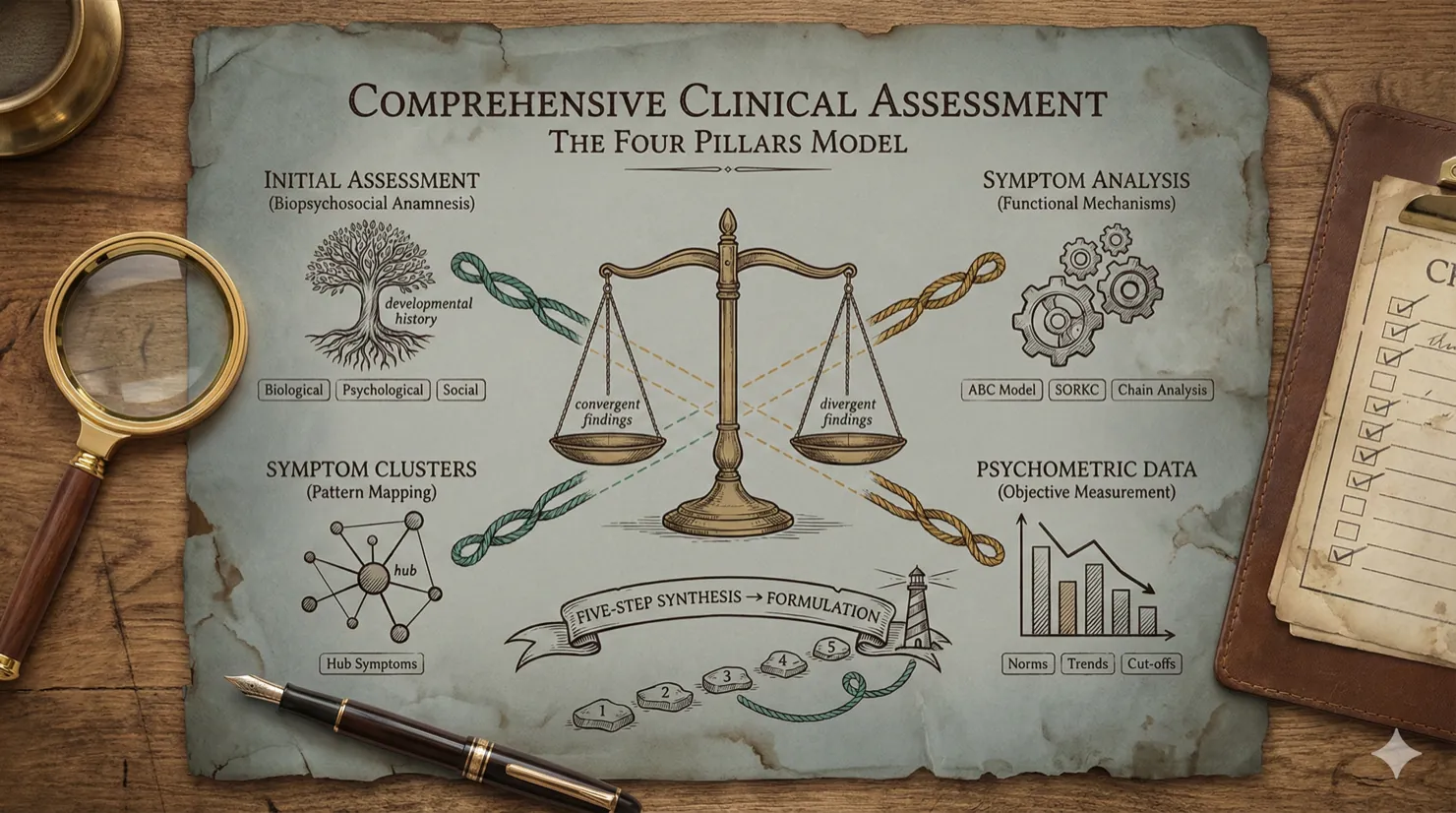
The first pillar is the initial assessment — through biopsychosocial anamnesis, it enables us to understand who the client is, their developmental context, and current level of functioning. Past experiences, family dynamics, cultural context, and medical history are documented here. Barlow (2014) emphasizes that initial assessment is the most critical step of clinical decision-making.
The second pillar is symptom analysis — through ABC models and chain analysis, it illuminates the micro-level mechanisms of specific symptoms. While initial assessment answers the "who" question, symptom analysis answers the "how does it work" question: trigger → thought → emotion → behavior → consequence. This pillar is the primary source of perpetuating factors in the formulation.
The third pillar is symptom clusters — it maps mid-level patterns of interrelated symptoms. It reveals which symptoms move together, which are central, and which are peripheral. Intervention targeting central symptoms also produces improvement in peripheral symptoms, making this pillar critical for treatment prioritization.
The fourth pillar is psychometric data — through standardized measures, it provides an objective measurement of symptom severity. It serves as an anchor for normative comparison, tracking change, and evaluating treatment effectiveness. Antony and Barlow (2010) emphasize that psychometric data is indispensable for validating and correcting clinical judgment.
The flow of information between these four pillars is not unidirectional — it feeds each other through cross-referencing. Anamnesis childhood experiences provide context for triggers, symptom analysis confirms central symptoms in cluster maps, cluster maps guide measure selection, and psychometric scores validate or challenge clinical impressions.
The Integration Process: Five-Step Synthesis
Transforming information from four pillars into a single clinical picture requires a systematic process. The first step is compiling a cross-pillar assessment summary. Gather the key findings from each pillar: what developmental themes does the anamnesis highlight, what cycles does symptom analysis reveal, what patterns do clusters show, what severity do scores reflect? At this stage, summarize what each pillar says without interpreting.
The second step is identifying convergent findings — those that multiple sources point to in the same direction form the most solid ground of the formulation. The third step is identifying divergent findings: inconsistencies across sources are the most valuable clinical clues. The client appears calm in session but the BAI score is high — does this discrepancy point to emotional suppression?
The fourth step is prioritization based on functional impact. Which symptoms most affect daily functioning, which patterns manifest across the most domains? Rather than trying to formulate everything, center on findings with the highest impact.
The fifth step is generating initial hypotheses. A hypothesis such as "the defectiveness schema linked to childhood neglect is activated by criticism triggers and maintained through the worry cycle" distills information from all four pillars into a single sentence. These hypotheses are not definitive diagnoses but testable starting points for formulation.
From Assessment to Formulation: Building the Bridge
Comprehensive assessment flows naturally into case formulation — because assessment pillars feed the building blocks of formulation. Dudley and Kuyken (2006), in their collaborative formulation model, systematically demonstrate how assessment transforms into formulation. This transformation begins with mapping assessment findings to formulation categories.
The developmental history and family dynamics from the initial assessment feed the predisposing factors in the formulation — the background explaining why the client became vulnerable to this problem not earlier or later but now. The trigger-thought-emotion-behavior chains from symptom analysis carry precipitating factors and perpetuating factors directly into the formulation. Cluster maps show how perpetuating mechanisms interact with each other and which intervention points would create the greatest impact. Psychometric data provides the baseline — the reference point for measuring treatment effectiveness.
A frequently neglected component of formulation is protective factors. Comprehensive assessment offers the opportunity to identify protective factors from multiple sources: strengths noted in the anamnesis, effective coping strategies in symptom analysis, buffering factors shown in the cluster map, and relatively preserved areas in psychometric data. Persons (2008) emphasizes that systematically including protective factors in formulation meaningfully improves the quality of the treatment plan.
Filled Example: Elif, 34, Generalized Anxiety & Relationship Difficulties
The following example demonstrates how four assessment pillars are transformed into a comprehensive clinical picture. Examine each pillar's contribution and the cross-referencing between pillars.
Pillar 1 — Initial Assessment (Anamnesis)
Elif, 34 years old, married, mother of one, accountant in the private sector. Presenting concern: increasing worry, sleep difficulties, and escalating conflicts with her husband over the past six months. Developmental history: emotionally distant mother, critical father, conditional attention tied to academic achievement. Elif assumed the "no-trouble child" role in the family, avoiding conflict by suppressing emotional expression. Strengths: analytical thinking, high performance at work, close relationship with her sister.
Pillar 2 — Symptom Analysis (ABC/Chain Analysis)
Trigger: critical comment from husband ("Working overtime again?"). Automatic thought: "I can't do anything well enough." Emotion: intense anxiety + guilt. Behavior: worry cycle ("What if my husband leaves me? What if I'm not a good mother?") leading to emotional withdrawal and over-focusing on work. Short-term consequence: worry provides temporary relief (illusion of control). Long-term consequence: emotional distance from husband increases, anxiety becomes chronic.
Pillar 3 — Symptom Clusters
Anxiety-somatic cluster (central): chronic worry, muscle tension, sleep difficulties, concentration problems — strong positive correlation with each other. Interpersonal-withdrawal cluster (secondary): difficulty expressing emotions, conflict avoidance, social isolation tendency. Cross-link: when worry in the anxiety-somatic cluster intensifies, interpersonal withdrawal also increases — the two clusters feed each other.
Pillar 4 — Psychometric Data
GAD-7: 15 (moderate-to-severe anxiety). PHQ-9: 10 (moderate depressive symptoms). Clinical observation comparison: client appears controlled and calm in session, yet GAD-7 score indicates a higher anxiety level than the clinical impression suggests — this discrepancy supports the emotional suppression hypothesis.
Comprehensive Assessment Synthesis
Convergent findings: All four pillars confirm the central role of anxiety. Conditional attention in childhood (anamnesis), defectiveness belief activated by criticism triggers (symptom analysis), the central position of the anxiety-somatic cluster (clusters), and the GAD-7 score above clinical threshold (psychometric) form a consistent picture. Divergent finding: The discrepancy between the client's calm in-session presentation and high GAD-7 score supports the emotional suppression hypothesis and aligns with the "withdrawal" behavior from symptom analysis. Bridge to formulation: Predisposing factors (conditional attention, critical father) → Precipitating factors (criticism from husband, work intensity) → Perpetuating mechanisms (worry cycle, emotional withdrawal) → Protective factors (analytical thinking, sister relationship).
5 Principles of Effective Comprehensive Assessment
Cross-Reference Across Pillars — Never Trust a Single Source
No assessment tool is sufficient on its own. Does a pattern reported in the anamnesis get confirmed by symptom analysis? Do psychometric scores align with clinical observation? Does the central symptom in the cluster map also stand out in other sources? Cross-referencing is the most fundamental principle for increasing assessment reliability — a formulation based on a single source inherits that source's limitations.
Search for the "Red Thread" That Connects All Findings
Among the hundreds of data points from four pillars, there exists a theme — a "red thread" — that connects them all. In Elif's case, this thread is "conditional worth and defectiveness belief": from childhood conditional attention (anamnesis) to criticism sensitivity (trigger), from the worry cycle (symptom analysis) to emotional withdrawal (cluster), from high anxiety scores (psychometric) to the calm exterior. Finding the red thread forms the core of the formulation.
Distinguish Descriptive from Functional Assessment
Descriptive assessment answers the "what exists" question: what are the symptoms, how severe, how long they've persisted. Functional assessment answers the "how does it work" question: how symptoms interact with each other and with context, what function they serve, what they maintain. Comprehensive assessment includes both — but it's the functional assessment that makes the real contribution to formulation. Remaining at the descriptive level leaves the formulation superficial.
Let Assessment Inform but Not Dictate Formulation
Assessment data is the raw material of formulation — but it is not the formulation itself. The same data can lead to different formulations according to different theoretical frameworks. A cognitive-behavioral therapist might focus on Elif's worry cycle, while a schema therapist might center the defectiveness schema, and a psychodynamic approach might emphasize the attachment pattern. Assessment feeds formulation but does not force a single formulation — this flexibility is the richness of clinical thinking.
Assessment Is Iterative, Not a One-Time Event
Assessment completed in the first few sessions is a starting point, not the final word. As treatment progresses, new information emerges, initial hypotheses are confirmed or revised, psychometric scores change. Comprehensive assessment is a living document, like formulation — it should be regularly updated and refined according to new clinical data. Antony and Barlow (2010) emphasize that assessment must continue as an integral part of the treatment process.
Common Mistakes
Collecting Data Without Synthesizing
The most common trap in clinical training is meticulously administering assessment tools but failing to integrate their outputs. The anamnesis sits in the file, scale scores are recorded in a separate table, symptom analysis is scattered throughout session notes — but what these say together has never been formulated anywhere. Collecting data and synthesizing data are different skills. The former can be facilitated with structured tools; the latter requires clinical thinking practice. Assessment cannot be considered complete without the synthesis step.
Using Assessment Data to Confirm Your Own Biases
Confirmation bias is an insidious trap in clinical assessment. The therapist forms an early hypothesis — for example, "this is an attachment problem" — and then selectively reads data across four pillars to support that hypothesis. Findings contradicting the hypothesis are overlooked, ambiguous findings are interpreted to confirm it. The power of comprehensive assessment lies in letting data test the hypothesis — not searching for data to confirm it. Pay particular attention to divergences: findings that contradict your hypothesis are the most valuable clues for deepening clinical understanding.
Jumping from Assessment Directly to Treatment, Skipping Formulation
Jumping directly to treatment planning instead of moving to formulation when assessment is complete is a common but costly mistake. The approach of "there's anxiety, let's apply CBT" ignores the function of the symptom, the perpetuating mechanisms, and the client's unique context. Formulation is the mandatory bridge between assessment and treatment — without this bridge, treatment becomes a generic protocol application and cannot respond to the client's individual needs.
Failing to Include Cultural and Contextual Factors in Assessment
Assessment tools and norms are developed within specific cultural contexts. A psychometric measure's cutoff score may carry different meanings across cultural groups, symptom expression styles vary from culture to culture, and interpreting family dynamics as "functional" or "dysfunctional" depends on cultural norms. Comprehensive assessment requires integrating the client's cultural context, socioeconomic conditions, and social position into each of the four pillars — otherwise the assessment becomes a reflection of the therapist's own cultural framework.
Comprehensive Clinical Assessment with Mindora
Mindora's Knowledge Network feature is designed to digitally support the cross-pillar integration discussed in this article. By linking assessment documents created in different note types to each other, it enables you to build a comprehensive clinical picture.
Cross-Note-Type Linking: You can link your initial assessment note to your symptom analysis note, your symptom analysis note to your cluster map, and your cluster map to your psychometric records. These links make the cross-referencing between four pillars visible in the digital environment — when one note is opened, related notes from other pillars are accessible with a single click.
Assessment Templates: The Initial Assessment / Anamnesis, Problem & Symptom Analysis, Symptom Cluster, and Psychometric Assessment note types covered in previous articles of this series are ready for use, each with their own structured templates. These templates standardize the assessment process and prevent missing components from being overlooked.
Transition to Formulation: The transition from assessment notes to the Case Formulation note type is supported through a natural flow via the Knowledge Network. Predisposing, precipitating, perpetuating, and protective factors identified in the assessment can be carried to the relevant fields of the formulation template — thus the bridge from assessment to formulation is built digitally.
All of these assessment notes are gathered in the relevant client’s record within Mindora's client management flow, viewed alongside their appointment and session history, so the output of all four pillars meets in a single clinical context. As you create each note, the structured note editor brings the systematic assessment described in this article directly to the screen with checklists, scale fields, and section headers.
MINDORA KNOWLEDGE NETWORKLink your notes togetherConnect initial assessment, symptom analysis, cluster, and psychometric notes with a single click; make cross-pillar referencing visible.Explore the Knowledge NetworkMindora's goal is not to automate the assessment process but to structure it. Clinical thinking and synthesis are always the therapist's skills — Mindora provides the tools for applying these skills systematically.
References
- Hunsley, J. & Mash, E. J. (2007). Evidence-based assessment. Annual Review of Clinical Psychology, 3, 29–51.
- Dudley, R. & Kuyken, W. (2006). Formulation in cognitive-behavioural therapy: "There is nothing either good or bad, but thinking makes it so." In L. Johnstone & R. Dallos (Eds.), Formulation in Psychology and Psychotherapy (pp. 17–46). Routledge.
- Persons, J. B. (2008). The Case Formulation Approach to Cognitive-Behavior Therapy. Guilford Press.
- Barlow, D. H. (2014). Clinical Handbook of Psychological Disorders: A Step-by-Step Treatment Manual (5th ed.). Guilford Press.
- Antony, M. M. & Barlow, D. H. (Eds.) (2010). Handbook of Assessment and Treatment Planning for Psychological Disorders (2nd ed.). Guilford Press.
- Haynes, S. N., O'Brien, W. H. & Kaholokula, J. K. (2011). Behavioral Assessment and Case Formulation. John Wiley & Sons.