Problem & Symptom Analysis: ABC, SORKC and Behavioral Chain Analysis Guide
There is a therapeutic chasm between superficially describing a client's symptoms and functionally analyzing them. In this guide, compare the ABC model's power in cognitive conceptualization, SORKC's depth in behavioral analysis, and Linehan's Chain Analysis precision in resolving crisis behaviors with concrete clinical examples.
Beyond the Symptom Checklist
You've been seeing Murat for three months. He's been diagnosed with panic disorder, and your cognitive restructuring work is going well — he identifies catastrophizing thoughts, generates alternative thoughts, and can even laugh about it in session. But the panic attacks continue. At least twice a week, usually in the evening, usually when he's home alone. "The cognitive work is helping but the attacks won't stop," you think.
What's missing isn't a symptom checklist but a systematic analysis of the behavior's maintaining cycle. What "triggers" Murat's panic attacks isn't just catastrophizing thoughts — a vulnerability schema activated when he's alone (organism variable), the interoceptive monitoring behavior that begins when he notices his heartbeat (response chain), and the negative reinforcement provided by his wife coming home early after attacks (maintaining consequence) are all working together. Seeing this cycle requires moving from superficial description to functional analysis.
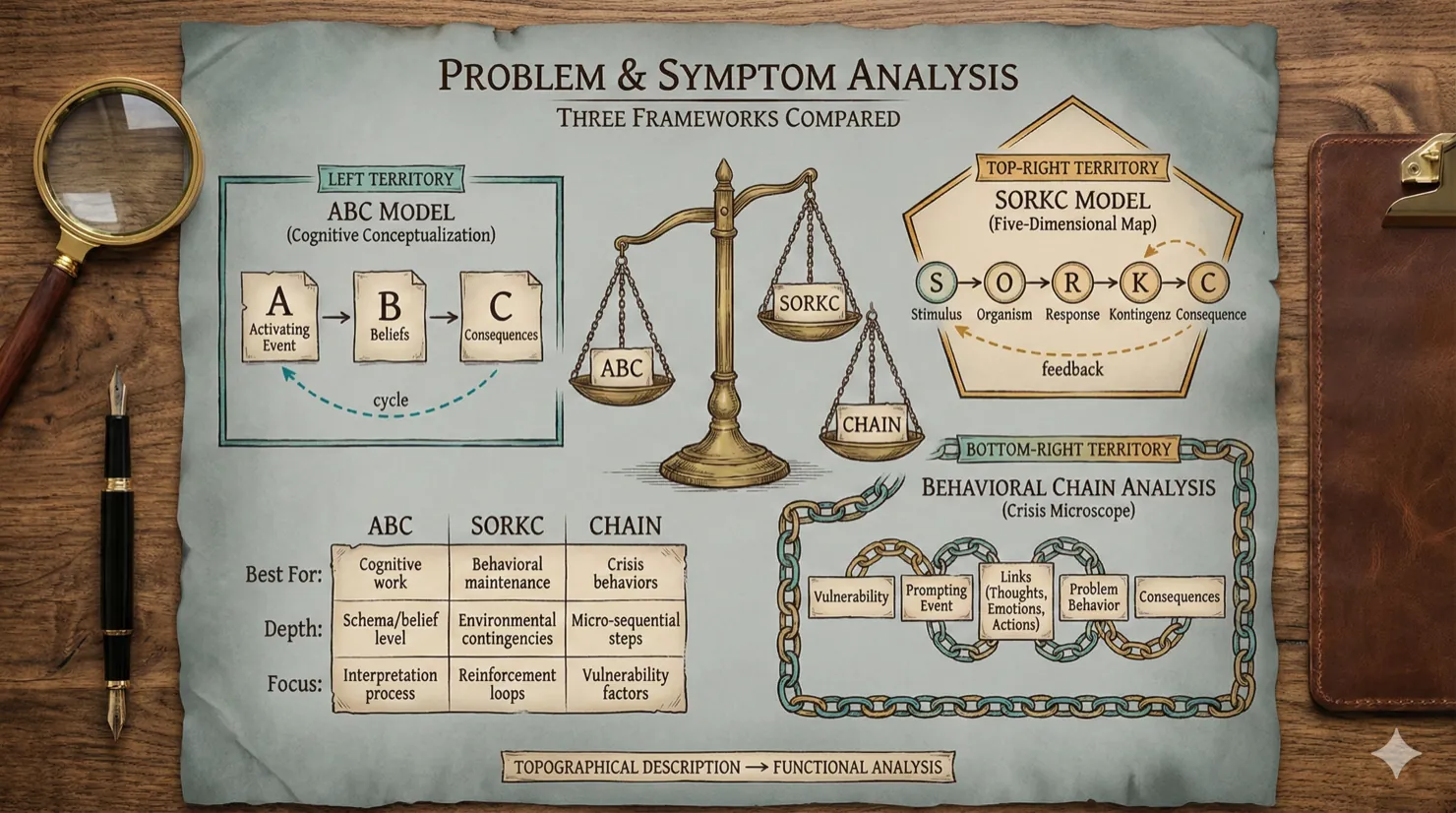
In this article, we'll comparatively examine three fundamental analysis frameworks in clinical assessment — Ellis's ABC model, Kanfer and Saslow's SORKC model, and Linehan's Behavioral Chain Analysis. We'll explore each model's strengths, limitations, and which clinical situations call for which framework with concrete examples.
So why go beyond a symptom list and run a systematic functional analysis? The concrete clinical payoffs:
- The right intervention point: you target the cycle that maintains the symptom, not the symptom itself.
- Unblocking stuck cases: it reveals why "the treatment seems to be working but the symptom persists."
- Choosing the right model: it clarifies when ABC, SORKC, or Chain Analysis fits a given case.
- Trackable progress: you follow change in the cycle concretely from session to session.
Topographical Description or Functional Analysis?
There are two levels of symptom assessment in clinical practice. Topographical description defines the observable features of behavior: frequency, intensity, duration, form. "Three panic attacks per week, averaging 20 minutes, beginning with palpitations and shortness of breath" — this is a useful description, but on its own it cannot guide a treatment plan. Functional analysis goes one step further and asks: "Under what conditions does this behavior occur, what maintains it, and what function does it serve?"
According to Haynes and O'Brien's (2000) functional analytic conceptualization model, the most clinically valuable information about a behavior is not its appearance but its function. The same behavior — social withdrawal, for example — may serve an avoidance function in one client while being an energy conservation strategy in another. The intervention plan should be shaped by the behavior's function, not its form. This is why "symptom analysis" means not merely listing symptoms but understanding why symptoms exist and what keeps them going.
ABC, SORKC, and Chain Analysis are three frameworks that systematize this functional perspective from different angles. Although each was born within a different clinical tradition — ABC in cognitive therapy, SORKC in the behavioral tradition, Chain Analysis in DBT — they share a common principle: understanding behavior not in isolation from its context but within it. This guide aims to enrich your clinical toolkit by comparatively examining when and how to use each model.
The ABC Model: Foundation of Cognitive Conceptualization
Ellis's (1962) ABC model is cognitive therapy's most fundamental analysis tool, offering a powerful clinical framework with impressive simplicity. A (Activating Event) represents the situation the individual encounters; B (Beliefs) represents the thoughts and beliefs attributed to that situation; C (Consequences) represents the emotional and behavioral responses these beliefs produce. The model's core proposition: it is not events themselves that determine emotional responses, but the meanings assigned to events.
Together with Beck's (1979) cognitive model, ABC has become an indispensable tool in clinical practice, particularly for identifying automatic thoughts and cognitive restructuring work. The model's strength lies in conveying to the client the message "events don't directly determine your emotions — your interpretation in between does" within a concrete framework. When a client looks at the chain "my boss gave me an angry look" (A) → "I'm going to get fired" (B) → anxiety, sleep disturbance (C), they can clearly see the intervention point — namely, B.
However, the ABC model also has limitations. It doesn't adequately capture the maintaining consequences (reinforcers) of behavior — C is coded only as "consequence," but how that consequence feeds the behavior is not represented in the model. Additionally, organism variables (biological predisposition, learning history, schemas) are not explicitly represented. Finally, ABC simplifies the temporal sequence: in real life, A→B→C is not a linear line but a cyclical process — C can become a new A. These limitations are why SORKC or Chain Analysis is needed for understanding more complex maintaining cycles.
The SORKC Model: A Five-Dimensional Map of Behavior
Kanfer and Saslow's (1969) SORKC model is behavioral therapy's most comprehensive analysis framework, examining behavior across five dimensions: S (Stimulus) represents the external or internal conditions under which behavior occurs; O (Organism) represents the individual characteristics that influence the person's response to this stimulus (genetic predisposition, learning history, cognitive schemas); R (Response) represents the three-dimensional response — cognitive, emotional, and behavioral; K (Contingency) represents the timing and consistency relationship between behavior and consequence; and C (Consequence/Reinforcers) represents the positive and negative reinforcers that maintain the behavior.
SORKC's most critical difference from ABC emerges in two components: O (Organism) and K (Contingency). The organism variable explains why the same stimulus produces different responses in different individuals — for example, the same criticism may produce an intense rejection response in someone with an insecure attachment history while being processed as constructive feedback in someone with a secure attachment history. K (Contingency) analyzes when the behavior is reinforced and what the reinforcement schedule is: continuous or intermittent reinforcement? Immediate or delayed? This information is critical for understanding why a behavior is so resistant to change.
SORKC is particularly superior to ABC in these situations:
- Habit disorders (smoking, alcohol, eating disorders): reinforcement schedules are key to understanding the behavior.
- Complex avoidance patterns: to see how negative reinforcement (C-) maintains avoidance.
- Psychosomatic symptoms: the organism variable includes biological predisposition in the analysis.
- Behavioral intervention planning: to identify the intervention point at the reinforcer level.
As Sturmey (2009) emphasized, SORKC is not merely a descriptive tool but an analysis framework that directly shapes the intervention plan.
Behavioral Chain Analysis: Microscopic Examination of Crisis Behaviors
Linehan's (1993) Behavioral Chain Analysis, developed within the DBT (Dialectical Behavior Therapy) framework, is an in-depth analysis method that examines a target behavior — particularly self-harm, substance use, and impulsive actions — step by step from prompting event to consequences. Chain Analysis's distinguishing feature is that it resolves the "trigger to response" process at a microscopic level, examining each link separately, whereas other models summarize this in a single line.
A Chain Analysis consists of five core components:
- The target behavior: a specific, non-judgmental description.
- Vulnerability factors: conditions in the hours or days before the event that lowered the person's threshold (sleep deprivation, physical illness, stressful life events).
- The prompting event: the initial spark that started the chain.
- The chain links: every step on the path from trigger to target behavior (thoughts, emotions, bodily sensations, urges, actions).
- Consequences: short-term relief versus long-term cost.
After each link is identified, solution analysis is conducted: at which link in the chain could an alternative skill have been deployed?
Chain Analysis's clinical power comes from its temporal granularity. Where the ABC model summarizes "boss looked at me → I'll get fired → anxiety," Chain Analysis resolves "boss looked at me → my heart sped up → I thought 'not again' → the knot in my stomach tightened → I said 'I can't take this' → instead of taking a deep breath I pulled out my phone and went on social media → lost 45 minutes → 'I failed again' thought → shame" with each link examined separately. This level of detail allows testing Linehan's (1993) "skills deficit" hypothesis: at which link does the client lack an alternative skill? The intervention targets precisely that point.
Comparison: Which Framework for Which Situation?
The three models are not competitors but complements — yet each has a different clinical domain where it is strongest. The ABC model is most productive in cognitive conceptualization and cognitive restructuring work: it is ideal for identifying automatic thoughts, mapping core beliefs, and determining cognitive intervention points. In presentations where cognitive distortion is prominent — depression, generalized anxiety, social phobia — ABC is a natural starting point.
The SORKC model excels in situations requiring behavioral analysis and functional assessment: habit disorders (smoking cessation, alcohol use, eating disorders), complex avoidance patterns, OCD rituals, and any situation where the reinforcement schedule needs to be understood. SORKC's K (Contingency) component provides critical information for understanding why a behavior continues despite medication or why it appears in some contexts but not others.
Chain Analysis is a specialized tool for crisis behaviors and impulsive actions: self-harm, suicide attempts, substance use episodes, anger outbursts, and situations where emotion dysregulation is prominent. Chain Analysis's unique value is identifying intervention points with great specificity by examining a single episode frame by frame. In practice, experienced clinicians often use multiple models together — for example, mapping the general maintaining cycle with SORKC, then applying Chain Analysis for specific crisis episodes.
Filled Example: Murat, 32, Panic Disorder
The following example shows how the same clinical scenario — Murat's panic attack while home alone in the evening — can be analyzed with three different models. This is followed by a detailed Chain Analysis example structured with Mindora's Behavioral Chain Analysis template.
ABC Analysis
A (Activating Event): At 9:00 PM while watching television home alone, he noticed his heart beating fast. B (Beliefs): "There's something wrong with my heart," "I'm going to have a heart attack," "I'm alone, no one can help" (core belief: vulnerability/defenselessness). C (Consequences): Intense anxiety (9/10), shortness of breath, sweating, picked up the phone to call emergency services, called his wife and asked her to come home early.
SORKC Analysis
S (Stimulus): Evening time, being home alone, increased physical awareness. O (Organism): Lost his mother to a heart attack (age 11), hypersensitivity to bodily sensations (high anxiety sensitivity), "physical symptoms are dangerous" schema. R (Response): Cognitive — "I'm having a heart attack"; Emotional — intense fear, panic; Behavioral — calling wife, researching emergency services. K (Contingency): Every time his wife comes home, the attack ends (100% consistency, 30-40 minute delay). C (Consequences): C+ wife's attention and reassurance; C- temporary elimination of loneliness feeling (negative reinforcement).
Behavioral Chain Analysis (Detailed)
Target Behavior: On the evening of February 14th at 9:15 PM, he called his wife crying and asked her to come home, requesting to go to the emergency room.
Vulnerability Factors: He had skipped lunch that day (hunger), had slept only 5 hours the night before (sleep deprivation), a performance review at work was approaching (stressful life event).
Prompting Event: He saw a heart attack scene on television.
Chain Links: (1) After seeing the scene, attention shifted to his own heart → (2) "My heart is beating fast too" thought → (3) Heart rate counting behavior began → (4) During counting, noticed heart rate increasing → (5) "This isn't normal, my mother started the same way" thought → (6) Intense wave of fear (8/10), chest tightness → (7) "I'm going to die now" thought → (8) Breathing accelerated, hands began going numb → (9) "I can't take it, I need help" → (10) Called his wife.
Short-Term Consequences: Wife arrived home in 30 minutes, hugged him, said "there's nothing wrong" — panic gradually subsided (relief). Long-Term Consequences: Wife had to cancel her evening plans (relational cost), Murat felt shame thinking "I failed again," and was more afraid of being alone the next evening (cycle strengthened).
Chain-Breaking Plan: At Link 1 (attention shift) — attention redirection skill (5-4-3-2-1 sensory grounding); At Link 3 (heart rate counting) — "notice and release the counting behavior" mindfulness intervention; At Link 6 (fear wave) — breathing exercise + distress tolerance skill; At Link 9 (help-seeking call) — reading a pre-agreed crisis card instead of calling wife.
5 Principles of Effective Problem & Symptom Analysis
Start with the Specific Episode, Not the General Pattern
"What usually happens?" is the therapist's natural starting point, but it's a trap for functional analysis. General patterns erase critical details — which context, which vulnerability factors, which specific trigger. Instead, focus on a single specific episode with "Can you walk me through the last attack step by step?" Going from specific to general always yields richer clinical data than going from general to specific.
Distinguish Triggers from Vulnerability Factors
Two concepts frequently confused in clinical practice: trigger (prompting event) and vulnerability factor. The trigger is the specific event that starts the chain — "he saw a heart attack scene on television." The vulnerability factor is the background condition that lowered the person's threshold that day — sleep deprivation, hunger, stress. The same trigger may not produce the same response without vulnerability factors. This distinction is critical in treatment planning: while exposure work is being planned for the trigger, management of vulnerability factors should be planned in parallel.
Map Consequences Across Multiple Time Horizons
Evaluating a behavior's consequences only with "what happened right after?" misses half the maintaining cycle. When Murat calls his wife, he experiences immediate relief (short-term consequence: negative reinforcement), but the next day he feels shame and fears being alone even more (long-term consequence: cycle strengthening). Mapping these two time horizons separately in SORKC's C component and Chain Analysis's consequences section allows you to concretely show the client that "the thing providing immediate relief is growing the problem in the long run."
Don't Skip the Organism (O): Include Internal State in the Analysis
One of the ABC model's limitations is that it doesn't explicitly represent the person's internal state — biological predisposition, learning history, schemas. SORKC's O component addresses this gap and asks a critical question: "Would everyone facing the same trigger give the same response? If not, what makes this person different?" In Murat's case, losing his mother to a heart attack at age 11 (learning history) and hypersensitivity to bodily sensations (anxiety sensitivity) — these reside in the O component and directly shape the treatment plan.
Turn Analysis into Intervention, Don't Limit It to Documentation
Functional analysis is not an end in itself but the raw material for the intervention plan. Every analysis should be completed with the question: "How does this information change my treatment plan?" If you've identified B in ABC, you've clarified the cognitive intervention target. If you've identified the reinforcer (C) in SORKC, you've shaped your exposure or response prevention strategy. If you've identified the weak link in Chain Analysis, you've determined the focus of skills training. Without this bridge between analysis and intervention, the assessment remains an intellectual exercise sitting in the file.
Common Mistakes
Confusing Correlation with Function
"The client is anxious every Monday, so work stress must be the trigger" is correlation, not functional analysis. Two events co-occurring doesn't mean one maintains the other. True functional analysis requires identifying the maintaining mechanism — the reinforcer feeding the behavior. Perhaps what maintains the Monday anxiety isn't work stress but the temporary relief provided by Sunday evening's preparatory rituals (negative reinforcement). Without making this distinction, the planned intervention targets the wrong thing.
Jumping from A to C While Skipping B in ABC
A frequently observed error in practice is reducing ABC analysis to an "event → consequence" shortcut. The record "boss criticized (A) → felt anxious (C)" skips the model's most critical component — B, the automatic thoughts and core beliefs. This omission reduces the intervention to "avoid the trigger," whereas ABC's therapeutic power lies precisely in working with B. In every ABC record, asking the client "what exactly went through your mind at that moment?" is essential for capturing the depth of B.
Drawing the Chain as Linear Rather Than Cyclical
Both SORKC's C and Chain Analysis's consequences most often loop back to the beginning of the chain as a new trigger. In Murat's example, the shame felt after calling his wife (long-term consequence) → "I can't be independent" thought → higher vulnerability at the next alone moment → lower triggering threshold → new attack. Ignoring this cyclicality and presenting the analysis as a straight line means missing the most critical piece of the maintaining mechanism — the feedback loop.
Applying Analysis Only to Problematic Behaviors
ABC, SORKC, and Chain Analysis are typically used only for problematic behaviors — but the same frameworks are extremely valuable for analyzing the client's successful coping moments. Drawing a "success chain" with "You faced the same trigger last week but responded differently — what happened?" concretely shows which skills worked and strengthens the client's self-efficacy. As Sturmey (2009) emphasized, functional analysis is the analysis of behavior, not pathology — and behavior can be both problematic and functional.
Problem & Symptom Analysis with Mindora
Mindora brings the three analysis frameworks discussed in this article as structured templates across two note types. Behavioral Chain Analysis is a note type in its own right (Chain Analysis), while SORKC and ABC live under the Problem & Symptom Analysis note type:
- Behavioral Chain Analysis (Chain Analysis type, default): With its four-section structure, it includes non-judgmental description of the target behavior, a vulnerability factors checklist (sleep deprivation, hunger, physical illness, stressful life event, substance use) and background narrative, prompting event and chain reaction fields (thought→emotion→bodily sensation→urge→action), short/long-term consequences, and a table-format chain-breaking plan. The "alternative skill at each link" approach emphasized in this article is directly supported by the solution table.
- SORKC Analysis (Problem & Symptom Analysis type, default): With its single-section but five-component structure, it includes S (stimulus conditions), O (organism variables), R (three-dimensional response table: cognitive, emotional/physiological, behavioral), K (contingency and reinforcement schedule), and C (positive and negative reinforcers). The "don't skip the organism" and "contingency information" principles emphasized in this article are embedded in this template's structure.
- ABC Record (Therapist Version): The second template under the Problem & Symptom Analysis type. With its three-section classic structure, it includes the activating event (A), automatic thoughts and core beliefs/schemas (B — separated into client quote and therapist insight components), and three-dimensional consequences (C — emotional, behavioral, physiological). It structurally prevents the "skipping B" error emphasized in this article because the B section is designed as two separate components.
Analysis notes created with any of the three templates can be linked to case formulation, treatment plans, and session notes through Mindora's Knowledge Network feature — thus digitally supporting the clinical process from assessment to formulation and from formulation to intervention.
Each of these analysis notes, like every note type, appears chronologically in the client's clinical flow with its own type and label, so the assessment doesn't get lost in the flow and you can read the client's story at a glance. You fill in all these templates in Mindora's note editor designed for therapists, in structured sections and fields rather than free text.
Mindora FeatureSee the analysis templatesWalk through the Chain Analysis, SORKC, and ABC templates in the Clinical Notes feature.ExploreReferences
- Beck, A. T., Rush, A. J., Shaw, B. F. & Emery, G. (1979). Cognitive Therapy of Depression. Guilford Press.
- Ellis, A. & Harper, R. A. (1975). A New Guide to Rational Living. Wilshire Book Company.
- Kanfer, F. H. & Saslow, G. (1969). Behavioral diagnosis. In C. M. Franks (Ed.), Behavior Therapy: Appraisal and Status (pp. 417–444). McGraw-Hill.
- Linehan, M. M. (1993). Cognitive-Behavioral Treatment of Borderline Personality Disorder. Guilford Press.
- Haynes, S. N. & O'Brien, W. H. (2000). Principles and Practice of Behavioral Assessment. Kluwer Academic/Plenum.
- Sturmey, P. (2009). Behavioral case formulation and intervention: A functional analytic approach. Wiley-Blackwell.
This Article Is Part of the Clinical Assessment Series
This article is one of the deep-dive posts in the clinical assessment series. Explore the other articles in the series below.
Initial Assessment & Anamnesis: A Therapist's Comprehensive Guide
Learn biopsychosocial assessment, structured interviewing, mental status examination, and risk screening with concrete clinical examples and practical principles.
Symptom Clusters & Diagnostic Patterns: Connecting the Dots
Learn transdiagnostic symptom grouping, severity and frequency measurement, temporal pattern analysis, and longitudinal tracking with concrete clinical examples.
Psychometric Assessment in Therapy: Scales, Scoring & Clinical Interpretation
Learn scale selection, scoring interpretation, normative comparison, trend analysis, and treatment plan integration with concrete clinical examples and practical principles.
Comprehensive Clinical Assessment: Integrating All Four Pillars
Learn to integrate initial assessment, symptom analysis, symptom clusters, and psychometric data into a unified clinical picture that bridges assessment to formulation.