Initial Assessment & Anamnesis: A Therapist's Comprehensive Guide
The initial assessment — the most critical step in therapy — forms the foundation for all subsequent clinical decisions. In this guide, we explore the building blocks of biopsychosocial anamnesis, the systematic application of the mental status examination, the essential principles of risk screening, and how to conduct a structured assessment with concrete clinical examples.
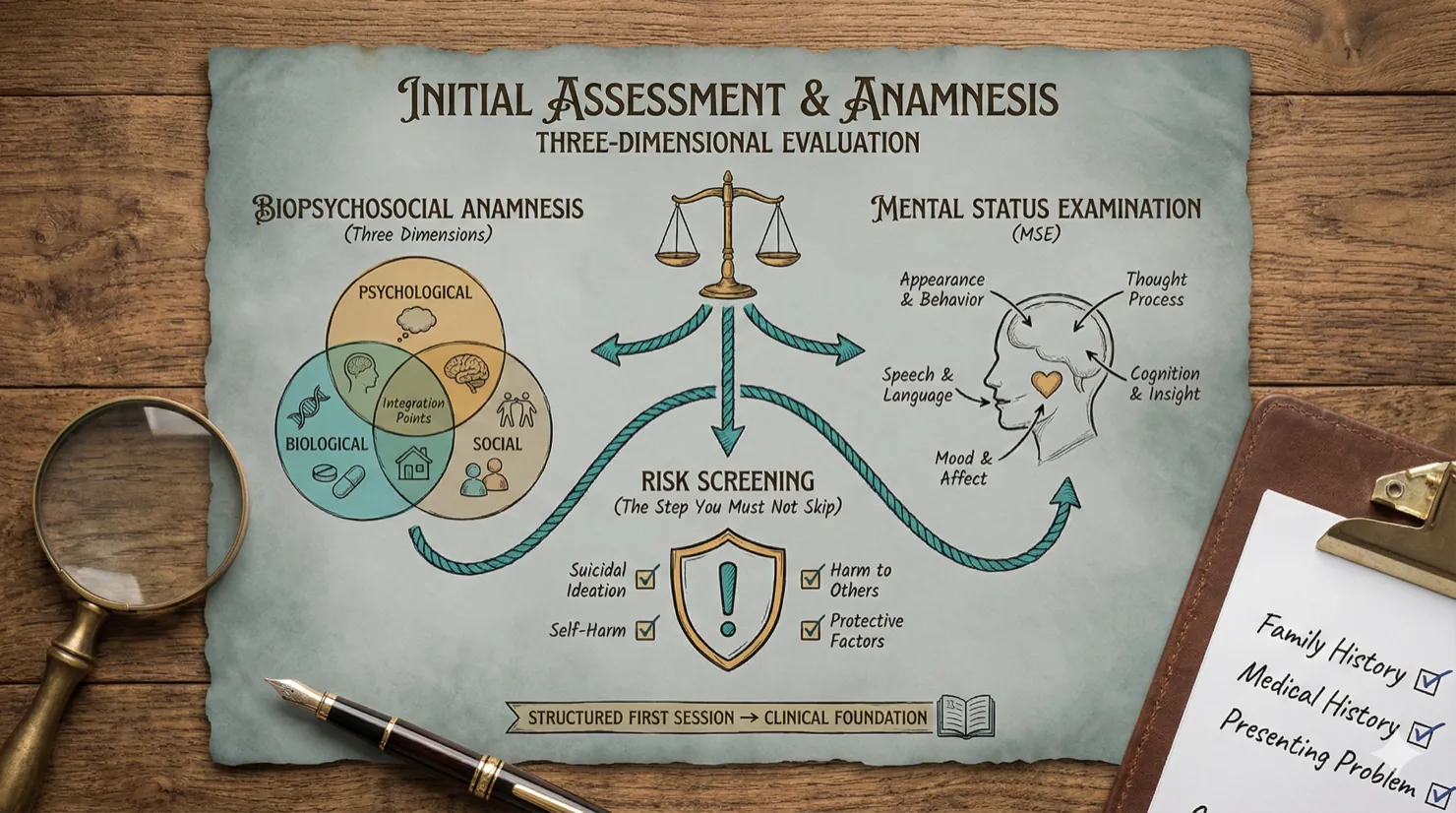
An initial assessment (anamnesis) is a structured clinical interview at the start of therapy that aims to understand the client holistically, within their biological, psychological, and social context. The presenting problem, past history, trauma screening, mental status examination (MSE), and risk screening are its core components, and they form the foundation for all subsequent clinical decisions, the case formulation, and the treatment plan. This guide covers how to conduct biopsychosocial anamnesis, the MSE, and risk screening systematically with a concrete clinical example.
The First Session: Structured Assessment or Free Conversation?
Ahmet's hands were trembling when he arrived for his first session. He began describing the intense anxiety he experiences in social situations — but when you left the session and looked at your notes, you realized: you didn't ask about his medical history, you only superficially explored his family background, you didn't conduct a trauma screening, and you skipped the risk assessment. Ahmet's anxiety narrative was compelling, but most of the information needed for formulation was missing.
This scenario reflects a dilemma that even experienced therapists frequently face: the balance between following the client's narrative and gathering information systematically. An unstructured initial interview may enter the client's emotional world but miss critical clinical information. A fully structured interview may make the client feel "interrogated" and weaken the foundations of the therapeutic alliance.
In this article, we'll explore why the initial assessment is the most defining step of therapy, how Engel's (1977) biopsychosocial model is applied in clinical anamnesis, the systematic structure of the mental status examination (MSE), the core principles of risk screening, and practical ways to integrate all these components — with concrete examples.
So what does investing time in a comprehensive assessment during a busy first session actually gain you in practice? The concrete clinical payoffs:
- An accurate formulation: complete biopsychosocial data is the precondition for a sound case formulation and an effective treatment plan.
- Catching missed risk: systematic risk screening surfaces suicide or self-harm risk that can be overlooked in clients who appear "low risk."
- A solid base, fewer corrections: a comprehensive picture from the start prevents costly backtracking and premature diagnostic corrections in later sessions.
- Measurable progress: SUDs and baseline measurements taken in the first session establish the reference point for tracking recovery with concrete evidence.
Why Is a Comprehensive Initial Assessment So Defining?
As Morrison (2014) emphasizes in his clinical interviewing guide, the initial assessment is not merely "information gathering" — it is simultaneously the moment when the therapeutic relationship is established, the client's sense of safety is formed, and clinical decision-making begins. The information collected in the first session directly influences the direction of the treatment plan, the choice of intervention, and even the quality of the therapeutic alliance. An incomplete assessment can lead to a flawed formulation and consequently an ineffective treatment.
Engel's (1977) biopsychosocial model demonstrated that mental health assessment cannot be limited to a symptom list alone. Understanding a client's anxiety requires evaluating biological factors (genetic predisposition, thyroid function, sleep patterns), psychological factors (cognitive schemas, coping mechanisms, early life experiences), and social factors (relationship dynamics, work stress, cultural context) together. An assessment that skips any of these three dimensions inevitably presents an incomplete clinical picture.
As Sommers-Flanagan and Sommers-Flanagan (2017) note in their clinical interviewing handbook, a comprehensive assessment conducted early on prevents the "premature formulation trap" — the tendency to form a premature diagnosis or formulation based on first impressions. It may be tempting to conclude "this client's problem is X" at the end of the first session, but such generalization made without sufficient data will require significant corrections in later stages of therapy.
Biopsychosocial Anamnesis: Three-Dimensional Assessment
Biopsychosocial anamnesis aims to understand the client not merely through their symptoms but within the wholeness of their life context. This assessment consists of three core domains:
- The biological dimension: medical history, genetic predisposition, neurobiological factors.
- The psychological dimension: cognitive structures, emotion regulation capacity, personality characteristics, early life experiences.
- The social dimension: relationship networks, cultural identity, socioeconomic conditions, environmental stressors.
Each dimension interacts with the others, and understanding these interactions determines the depth of the formulation.
The presenting problem and current symptoms are the natural starting point of the anamnesis. An open-ended question such as "How would you summarize your reason for coming here?" gives the client space to construct their own narrative. However, the critical point here is going beyond what the client tells: the onset time of symptoms, their frequency, severity, course over time, and triggering factors must be systematically explored. Morrison (2014) states that balancing "the story the client tells" with "the questions the clinician needs to ask" is the foundation of effective clinical interviewing.
Past history is essential for understanding the roots of the current presentation. Psychiatric and psychological history (previous diagnoses, therapy experiences, hospitalizations), medical history (chronic conditions, medications, head injuries), family history (mental illness in the family, attachment dynamics, loss experiences), and trauma history (physical, emotional, sexual abuse; neglect; accident or disaster experiences) are the core components of this domain. Trauma screening is a particularly sensitive area — as First (2014) emphasizes in the SCID interview guide, direct and empathic language should be used, and the client should not be pushed into details they are not ready for.
The balance between depth and breadth is the most challenging aspect of initial assessment. Covering every area in equal detail is not possible in a single session — nor is it necessary. Sommers-Flanagan and Sommers-Flanagan (2017) state that "the purpose of the initial assessment is not to learn everything but to ask the right questions and not miss critical information." The presenting problem and risk screening should always be explored in depth, while other areas should be prioritized according to the clinical picture.
Mental Status Examination (MSE): The Systematic Language of Observation
The mental status examination (MSE) is the systematic evaluation of the client's mental state at the time of the interview — it can be thought of as the psychiatric equivalent of the physical examination in medicine. The MSE is based on the therapist's direct observations, independent of what the client says. This distinction is critical: the client may say "I'm fine," but the MSE may reveal decreased eye contact, psychomotor retardation, and restricted affect.
The standard components of the MSE are:
- Appearance: age-appropriateness, self-care, dress.
- Behavior: psychomotor activity, eye contact, gestures.
- Speech: rate, rhythm, tone, fluency.
- Mood and affect: the emotional state reported by the client (mood) and the emotional expression observed by the therapist (affect).
- Thought process: the flow and logical coherence of thinking.
- Thought content: suicidal ideation, delusions, obsessions.
- Perception: hallucinations, illusions.
- Cognitive status: orientation, attention, memory.
- Insight and judgment.
While the Mini-Mental State Examination (MMSE) by Folstein et al. (1975) continues to serve as a standard reference for cognitive screening, in clinical practice all MSE components should be addressed as an integrated assessment.
The most common mistake in MSE documentation is recording only pathological findings. The phrase "within normal limits" is clinically insufficient because it doesn't specify what was observed and what was considered normal. Recording positive findings such as "age-appropriate appearance, well-groomed, appropriate dress, making eye contact, normal psychomotor activity" both ensures the completeness of the clinical picture and makes it possible to track changes in subsequent sessions.
The distinction between mood and affect is a point that clinicians with less experience frequently confuse in the MSE. Mood is the emotional state the client reports — such as "I feel anxious." Affect is the emotional expression observed by the therapist — the intensity, variability, and content-congruence of emotional responses observed during the session. Discrepancy between these two findings (for example, the client saying "I'm fine" while markedly restricted affect is observed) is an important piece of clinical information.
Risk Screening: The Step You Must Not Skip
Risk screening is the most critical component of the initial assessment — and unfortunately one of the most frequently skipped. Many therapists, particularly with clients who appear "low risk," skip the risk assessment or address it with only a superficial question. However, as Posner et al. (2011) emphasized in their Columbia Suicide Severity Rating Scale (C-SSRS) study, suicide risk cannot be reliably predicted by looking at the apparent clinical picture — systematic screening is required.
The core areas of risk screening are:
- Suicidal ideation: passive death wishes, active suicidal thoughts, plan and intent.
- Self-harm behavior: current and past.
- Risk of harm to others.
- Substance use.
Structured tools like the C-SSRS standardize risk screening and prevent clinicians from skipping questions due to their own discomfort. Even experienced clinicians may avoid risk questions thinking "this question will upset the client" — but research consistently shows that directly and empathically asked suicide questions do not negatively affect clients but instead help them feel understood.
When risk is identified, safety planning comes into play. A safety plan is a document prepared collaboratively with the client that specifies step by step what to do during a crisis:
- Recognizing warning signs.
- Internal coping strategies.
- People and environments for distraction.
- People they can ask for help.
- Crisis hotlines.
- Securing the environment (restricting access to means).
A safety plan is not a static form but a living document created with the client and regularly updated.
Filled Example: Ahmet, 28, Social Anxiety
The following example shows an initial assessment structured with Mindora's Comprehensive Biopsychosocial Anamnesis template. Examine how a systematic anamnesis is documented through Ahmet's social anxiety presentation.
Presenting Problem & Current Symptoms
Reason for Referral: Ahmet presented due to inability to speak in work meetings, intense anxiety in social situations, and increasing isolation over the past six months. Precipitating event: "freezing" during a work presentation six months ago and feeling shame from colleagues' reactions.
History of Current Symptoms: Symptoms have been present for approximately three years but showed marked increase over the past six months. Heart palpitations, sweating, voice tremor in social situations; inability to sleep the night before work meetings; ruminative thoughts of "everyone is judging me." SUDs: 8/10. Functional impact: declined a promotion opportunity, attendance at friend gatherings has dropped to zero in the past three months.
Past History
Psychiatric/Psychological History: Received psychological counseling during university (6 sessions, reports "not feeling sufficient benefit"). Diagnosis: not made at that time. No psychiatric medication use. No suicide attempts.
Medical History & Medications: No chronic conditions. Thyroid function test: normal (6 months ago). No regular medications. High caffeine intake (4-5 cups of coffee per day).
Family & Social History: Describes mother as overprotective, father as "distant and critical." One brother (close relationship). No known psychiatric diagnoses in family, but "shyness" described as a hereditary trait on father's side. Single, no romantic relationship for one year. Software engineer; strong technical performance but struggles with teamwork.
Trauma History: No history of physical or sexual abuse. Emotional neglect: grew up in a family environment where the father characterized emotional expression as "weakness." Peer bullying experience during elementary school (lasted 2 years).
Clinical Assessment
MSE: Age-appropriate appearance, well-groomed, appropriate dress. Eye contact intermittently averted (especially on emotional topics). Normal psychomotor activity, but mild hand tremor observed. Speech at normal rate, fluent, but in a low tone. Mood: "tense, anxious." Affect: anxious, restricted on avoidant topics, congruent. Thought process: logical, goal-directed. Thought content: negative automatic thoughts ("everyone is judging me," "I will fail"), no delusions or obsessions. Perception: normal. Orientation: intact. Attention and memory: normal. Insight: partial (recognizes symptoms, doesn't fully grasp causality). Judgment: adequate.
Safety & Risk Screening: No active suicidal ideation. No risk of harm to self/others. No passive death wishes. Social isolation noted as a risk factor — monitoring required.
Strengths & Resources: High analytical thinking capacity, disciplined work habits, strong relationship with brother, regular physical exercise (running 3 days per week). Treatment motivation is high.
Plan
Treatment Goals & Plan: (1) Reduce anxiety in social situations to functional levels, (2) decrease avoidance behaviors, (3) identify and challenge negative automatic thoughts. Recommended approach: CBT (cognitive restructuring + graded exposure). Session frequency: weekly. Reduction of caffeine intake recommended. Psychiatry consultation not deemed necessary at this stage; to be reconsidered based on therapy response.
5 Principles of Effective Initial Assessment
Follow the Client's Narrative, Don't Interrogate
An initial assessment is not a police interrogation. Allow the client to tell their story in its natural flow, then fill in the gaps with structured questions. Morrison (2014) emphasizes the principle of "listen first, then ask": the client's free narrative should precede structured questions. Take notes during the narrative, then close the gaps with targeted questions in the second half of the session.
Balance Structure with Rapport
A fully structured interview may alienate the client; a fully unstructured interview may miss critical information. A semi-structured approach is the most effective balance point: use core assessment areas (presenting problem, past history, risk screening) as a framework, but within each area, allow the client to respond in their own language and at their own pace. The therapeutic alliance is not a byproduct of the information-gathering process — it is the priority.
Document Strengths Alongside Problems
A pathology-focused initial assessment presents the client as a profile "consisting only of problems." The client's coping skills, social support network, personal strengths, and protective factors are also an integral part of the assessment. This information is not merely a "positive addition" but fundamental inputs for the treatment plan and formulation. A client's strong sibling relationship could be a natural environment for graded exposure in social anxiety treatment.
Use SUDs and Scaling from the Start
Using Subjective Units of Distress (SUDs: 0-10) and other scaling tools from the first session serves two fundamental functions: it concretizes the client's experience ("8/10" instead of "very anxious") and establishes a baseline for tracking treatment progress. Ahmet's SUDs score at the first session (8/10) can serve as a reference point in later stages of treatment — providing both client and therapist with concrete evidence of progress.
Don't Rush to Diagnose
It may be tempting to make a definitive diagnosis at the end of the first session, but this is usually premature. The purpose of the initial assessment is not to make a diagnosis but to construct a comprehensive clinical picture. Phrases like "preliminary diagnostic impression" and "differential diagnosis considerations" reflect the uncertainty at this stage and leave room for future revision. Ahmet's presentation strongly points toward social anxiety disorder — but agoraphobia, generalized anxiety disorder, and avoidant personality disorder should be considered as differential diagnoses.
Common Mistakes
Running the First Session Like a Casual Chat
Building rapport with the client is important, but the first session is not a "getting to know you" chat. An unstructured interview risks focusing on the client's most prominent complaint while skipping medical history, trauma history, and risk assessment. Having a checklist doesn't mechanize the interview — on the contrary, it helps you notice which areas haven't been covered yet within the natural flow of conversation. Starting with a structured framework rather than wondering "did we ask about that?" in the last 10 minutes prevents information loss and reflects your professionalism.
Skipping the Trauma Screen
Many therapists skip the trauma screen based on the assumption that "the client will bring it up themselves." However, trauma experiences may not be spontaneously shared due to shame, guilt, or dissociation. A systematic trauma screen — beginning with an open-ended but direct question such as "Have there been deeply impactful difficult experiences in your life?" — both signals to the client that this topic is safe to discuss and reduces the risk of missing critical clinical information. The presence of trauma history can fundamentally change the treatment approach.
Ignoring Cultural Context
The question "How is your relationship with your family?" carries different meanings in an individualistic culture versus a collectivist one. Cultural context directly influences how symptoms are expressed (somatization tendencies), help-seeking behavior (perceiving therapy as "shameful"), the impact of gender roles, and the coping function of spiritual belief. Cultural sensitivity is not about "knowing different cultures" but about curiously and respectfully exploring each client's individual world of meaning.
Relying Only on Self-Report
What the client says is only one dimension of the clinical picture. The fundamental function of the MSE is to collect behavioral and observational data beyond the client's verbal expressions. A depressive client may say "I'm fine" while psychomotor retardation, restricted affect, and decreased eye contact are observed. An anxious client may say "I'm calm" while hand tremors, foot shaking, and elevated voice tone are observed. Discrepancies between verbal and observational data are a rich source of information for clinical formulation.
Initial Assessment with Mindora
Mindora's Initial Assessment / Anamnesis note type is designed to transform the principles discussed in this article into a structured documentation workflow. It offers four templates:
Comprehensive Biopsychosocial Anamnesis (Default): With its four-section structure, it includes presenting problem & current symptoms (reason for referral, symptom history, symptom screening checklist), past history (psychiatric/psychological history, medical history, substance use, family & social history, trauma history), clinical assessment (MSE & observations, safety & risk screening checklist, strengths, preliminary diagnostic impression), and plan (treatment goals & plan). It systematically covers all dimensions of the biopsychosocial model emphasized in this article.
Focused Assessment (Brief Intake): A practical structure designed for solution-focused and brief counseling processes. It includes the problem in the client's own words, SUDs scale, functional impact, safety check, previous solution attempts, expectations & goals, and action plan sections. Ideal for EAP (Employee Assistance Programs) or short-term processes.
Presenting Problem and Complaints: Includes the chief complaint in the client's own words, onset and severity of the complaint (0-10 scale), secondary complaints, complaint areas checklist (emotional, cognitive, behavioral, physical, relational, work/academic), and prioritization with clinical assessment sections.
Mental Status Examination (MSE): With its four-section structure, it covers appearance & behavior (general appearance checklist, psychomotor activity), speech & mood (speech characteristics, mood, affect), thought process & content (thought flow, pathological thought content checklist, perceptual disturbances), and cognitive status & insight (orientation checklist, attention, memory, insight scale, judgment). It presents all standard MSE components emphasized in this article in a structured format.
Initial assessment notes created with any of the four templates can be linked to case formulation, trigger analysis, and session notes through Mindora's Knowledge Network feature — thus digitally supporting the integration of information gathered during initial assessment into the entire treatment process.
These notes are embedded in Mindora's client management flow: each initial assessment is filed in the relevant client’s record, viewed alongside their appointment and session history, and forms the clinical context for every subsequent meeting.
If a client has started sessions but no initial assessment note has been entered yet, Mindora's smart reminders gently nudge you, so the anamnesis that forms the foundation of treatment is never overlooked.
MINDORA NOTE EDITORThe structured note editorComplete biopsychosocial anamnesis, the MSE, and risk screening on screen with checklists, scale fields, and section headers.Explore clinical notesFrequently Asked Questions
References
- Engel, G. L. (1977). The need for a new medical model: A challenge for biomedicine. Science, 196(4286), 129–136.
- Morrison, J. (2014). The First Interview (4th ed.). Guilford Press.
- Folstein, M. F., Folstein, S. E. & McHugh, P. R. (1975). "Mini-mental state": A practical method for grading the cognitive state of patients for the clinician. Journal of Psychiatric Research, 12(3), 189–198.
- Posner, K., Brown, G. K., Stanley, B., Brent, D. A., Yershova, K. V., Oquendo, M. A., ... & Mann, J. J. (2011). The Columbia-Suicide Severity Rating Scale: Initial validity and internal consistency findings from three multisite studies with adolescents and adults. American Journal of Psychiatry, 168(12), 1266–1277.
- Sommers-Flanagan, J. & Sommers-Flanagan, R. (2017). Clinical Interviewing (6th ed.). Wiley.
- First, M. B. (2014). Structured Clinical Interview for the DSM-5 (SCID-5). American Psychiatric Publishing.
This Article Is Part of the Clinical Assessment Series
This article is one of the deep-dive posts in the clinical assessment series. Explore the other articles in the series below.
Problem & Symptom Analysis: ABC, SORKC and Behavioral Chain Analysis Guide
Compare ABC, SORKC, and Behavioral Chain Analysis frameworks. Learn when to use each method with filled clinical examples and practical documentation principles.
Symptom Clusters & Diagnostic Patterns: Connecting the Dots
Learn transdiagnostic symptom grouping, severity and frequency measurement, temporal pattern analysis, and longitudinal tracking with concrete clinical examples.
Psychometric Assessment in Therapy: Scales, Scoring & Clinical Interpretation
Learn scale selection, scoring interpretation, normative comparison, trend analysis, and treatment plan integration with concrete clinical examples and practical principles.
Comprehensive Clinical Assessment: Integrating All Four Pillars
Learn to integrate initial assessment, symptom analysis, symptom clusters, and psychometric data into a unified clinical picture that bridges assessment to formulation.