Opening a Private Practice: A Step-by-Step Guide for Psychologists and Therapists
Learn the complete process of opening your own therapy practice in Turkey: licensing requirements, physical space standards, tax registration, social security obligations, cost estimates, and practical setup tips.
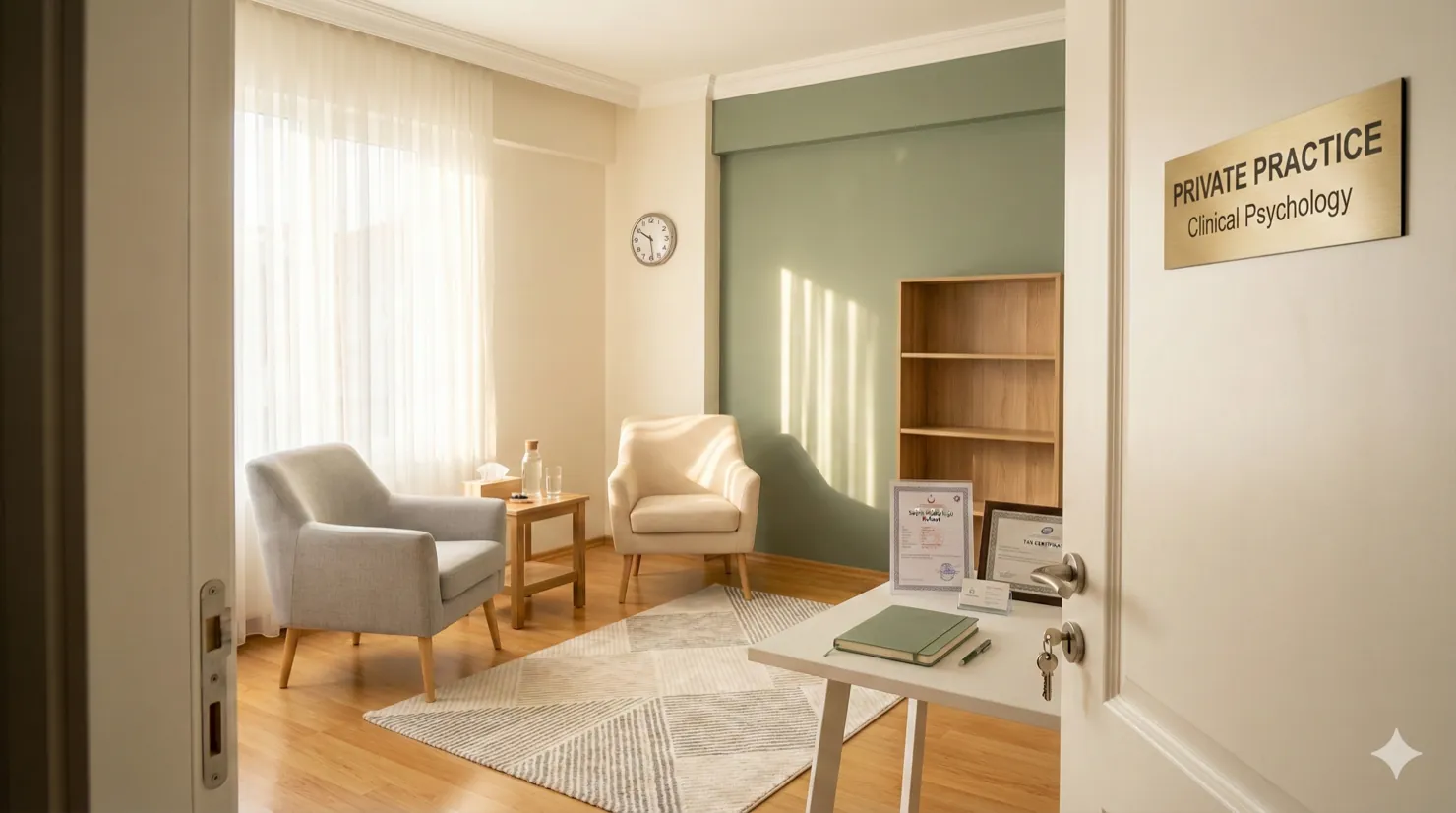
Opening a private therapy practice in Turkey means clinical psychologists obtaining a license from the Provincial Health Directorate to operate as a <strong>Private Health Profession Service Unit</strong>; licensed practices benefit from an <strong>8% VAT rate</strong> (versus 20% VAT applied to unlicensed services). This guide walks through licensing, space requirements, tax and social-security obligations, and 2026 cost ranges through a concrete case example.
Time to Build Your Own Practice
Elif has been working at a psychology center for five years. She has completed her clinical psychology master's, gained sufficient supervision experience, and feels ready to establish her own practice. But the excitement quickly gives way to complex questions: where to apply for a license, what standards the space must meet, how to set up tax registration, how much the monthly fixed costs will be. Many therapists with strong clinical competence continue to postpone this step in the face of administrative and bureaucratic uncertainty.
The Regulation on the Independent Practice of Health Professionals, which entered into force on March 29, 2025, comprehensively regulated the process of opening an independent practice for clinical psychologists for the first time. This regulation brought both new opportunities and new obligations. Operating without a license is no longer legal; however, the licensing process has been clarified beyond expectations.
In this post, we cover the practice-opening process from start to finish: who is eligible, how to apply for a license, what physical standards the space must meet, what the tax and social security obligations are, and what the startup and operating costs amount to. Each section is supported by current regulations and 2026 figures.
Why It Matters: The New Regulation Changed Everything
Before March 2025, the independent practice status of psychologists in Turkey was largely ambiguous. Many therapists operated under sole proprietorships or consulting companies, remaining outside the Ministry of Health's oversight. The new regulation eliminated this ambiguity: clinical psychologists can now open licensed practices under the title of "Private Health Profession Service Unit" and are subject to Ministry of Health supervision.
The consequences of operating without a license are severe: suspension of activities, administrative fines, and tax disadvantages. Licensed practices benefit from an 8% VAT rate on psychological services, while unlicensed services are subject to 20% VAT. This difference alone creates a significant financial impact for both the therapist and the client.
Therapists with existing offices have a limited transition period: license applications must be submitted by December 31, 2026; offices that have not obtained a license by this date may be prohibited from operating. Therapists who have not yet established their practice are in an advantageous position, as they have the opportunity to structure the process correctly from the start.
Who Can Open a Private Practice?
The new regulation limits the right to open a practice to specific professional titles. Clinical psychologists (those with a psychology bachelor's degree and a clinical psychology master's degree) can open an independent practice under their own name and obtain a license from the Provincial Health Directorate. Psychology bachelor's graduates and psychological counselors (guidance and psychological counseling graduates) do not have the right to open an independent practice under this regulation.
Partnership is also an option: up to three clinical psychologists can jointly open a health profession service unit. In this case, a separate license is issued for each partner, and each partner must have their own practice room. Providing therapy services under a corporate entity (company) is no longer permitted.
This regulation is controversial within the professional community. The Turkish Psychologists' Association has applied to the courts for the annulment of certain provisions of this regulation that grant independent practice rights only to clinical psychologists. The legal proceedings are ongoing; it is important to follow potential changes in the legislation.
The Licensing Process
License applications are submitted to the Provincial Health Directorate. The documents to be prepared include: an application petition addressed to the Provincial or District Health Directorate, copies of the psychology bachelor's degree and clinical psychology master's degree (YOK equivalency certificate for international graduates), a fire safety compliance report (obtained from the municipal fire department), an architect or engineer-approved floor plan (showing room dimensions, waiting area, and restroom), tax registration certificate, a copy of the lease agreement or title deed, and SGK (Social Security) entry declarations if staff will be employed.
The timeline for the process is clear: if deficiencies are detected after submission, notification is made within 10 business days and 30 business days are allowed for remediation. Licenses are issued for spaces found compliant after inspection. Plan for the entire process to take several months.
New rules also apply to signage and promotion. Terms such as "therapy center," "specialist psychologist," or "psychological counseling center" can no longer be used on signs or promotional materials. Providing services under a company name is prohibited; only the title and name specified on the license may be used.
Space Requirements and Physical Standards
The regulation sets specific minimum standards for practice spaces. The practice room must be at least 10 square meters and must contain a sink; a maximum of two practice rooms per psychologist can be licensed. The waiting area must be at least 8 square meters, with 5 additional square meters for each extra practice room. The restroom must be wheelchair-accessible with an outward-opening or sliding door. Plan for a total minimum of 30-40 square meters for a single-room practice.
Soundproofing is a mandatory requirement both under KVKK for client data confidentiality and from a professional ethics perspective. Practice room walls must be soundproof; acoustic panels, double glazing, and sound insulation plaster are commonly used materials. Preventing sound leakage from the waiting area to the session room is critical for the client's therapeutic safety.
When choosing a location, verify the zoning status: practices can be opened in buildings with commercial or mixed (commercial and residential) use permits. Make sure to check whether the condominium management plan restricts professional activities, whether the title deed is suitable, and ground-floor accessibility for wheelchair users.
Tax Registration and Financial Obligations
Opening a practice requires establishing a freelance tax registration. You register by filing a Commencement of Business Notification with the tax office; this can also be done through the Digital Tax Office via e-Government. After registration, you need to sign up for the Bookkeeping-Declaration System (defterbeyan.gov.tr), obtain your tax certificate, and set up e-SMM (electronic Freelance Professional Receipt) infrastructure.
Issuing an e-SMM for every session is mandatory; a receipt must be issued for every collection, including cash payments. An electronic signature or financial seal is required for issuing e-SMM. It can be issued through the GIB Portal or private integrators (such as Parasut, Logo, Mikro). Those newly commencing activity must transition to the e-SMM system by the end of the third month following the month they started.
In terms of tax advantage, the license is critically important: psychological services in Ministry of Health-licensed practices are subject to 8% VAT, while unlicensed counseling services carry a 20% VAT rate. This difference directly affects the fees passed on to clients. For more detailed information on financial obligations and accounting processes, see our accounting guide.
Social Security Obligations
Clinical psychologists who open a practice as freelance professionals are insured under SGK 4/b (Bag-Kur). This registration is mandatory and is automatically processed by SGK when the tax registration is opened. In 2026, the minimum monthly Bag-Kur premium is approximately 9,825 TL.
For therapists who work at an institution (hospital, university) under 4/a (SSK) and additionally maintain a private practice, the 4/a insurance takes priority; no additional Bag-Kur premium is payable, but the tax registration continues. Bag-Kur premiums are paid monthly by the end of the following month; delays incur late payment penalties.
Cost Estimates: Startup and Operating
The startup investment for a single-room practice ranges from approximately 200,000 to 650,000 TL in 2026 figures. The wide range depends on the city, neighborhood, existing condition of the space, and preferred equipment quality. Main items include the rental deposit (3 months, 30,000-150,000 TL), renovation and soundproofing (50,000-200,000 TL), furniture (50,000-150,000 TL), license fees and project approvals (20,000-50,000 TL), computer and technical equipment (20,000-50,000 TL), and test kits and professional materials (10,000-30,000 TL).
Monthly operating expenses without staff range from approximately 30,000 to 90,000 TL. Rent (10,000-50,000 TL for 30-50 square meters in a city center), Bag-Kur premium (approximately 9,825 TL), accountant fees (3,000-8,000 TL), utilities, cleaning, professional development, software subscriptions, and digital marketing make up this total. If a secretary or assistant is employed, add approximately 20,000-30,000 TL in additional monthly personnel costs.
Break-even analysis shows that with monthly expenses of 50,000 TL and an average session fee of 3,000 TL, approximately 28-30 sessions per month (7 per week) cover expenses. The return on investment period generally ranges from 18 to 36 months; this depends on the growth rate of the client portfolio, session fees, and the city.
Practical Setup: Documents, Systems, Insurance
Essential documents to prepare when opening a practice include the informed consent form (informing about the nature of the therapeutic process, confidentiality limits, and client rights), KVKK privacy notice, explicit consent form, confidentiality agreement, and data retention and destruction policy. For detailed information on preparing these documents, see our KVKK guide.
Appointment management, payment tracking, and client record systems form the backbone of daily practice operations. Using a digital clinic management software reduces the error risk created by manual tracking and facilitates KVKK-compliant data management. Automatic SMS and email reminders reduce client no-show rates; online payment integration simplifies the collection process.
Professional liability insurance is not legally mandatory for clinical psychologists but is strongly recommended. With the 2025 update, medical malpractice insurance coverage limits have been increased: the annual total compensation cap rose to 9,000,000 TL, per-incident coverage to between 1 and 4 million TL. Annual premiums range from 750 to 3,750 TL, a negligible amount compared to the potential cost of a malpractice lawsuit.
Clinical Example: Mert, 34, Opening His First Practice
Mert is a clinical psychologist who decided to open his own practice after working at a private psychology center for 6 years. After making the decision, he went through a 4-month preparation period.
Licensing Process: He first visited the Provincial Health Directorate to obtain the current document list. Preparing his diplomas, fire safety report, and architect-approved floor plan took 6 weeks. The post-application inspection was completed in 3 weeks.
Space: He rented a 45-square-meter, ground-floor unit with commercial use permit in Ankara Cankaya. It features two practice rooms (one larger for couples therapy), a waiting area, and a restroom. He paid special attention to soundproofing with acoustic panels and double glazing.
Tax and Financial Structure: Together with his accountant, he opened a freelance tax registration, obtained an electronic signature, and began issuing e-SMM. Being licensed, he benefits from the 8% VAT rate.
Insurance: He obtained professional liability insurance. The annual premium is 2,000 TL; he considers it a safety net against the potential cost of a lawsuit.
Cost Reality: The total startup investment (deposit, renovation, furniture, equipment) came to 380,000 TL. His monthly fixed expenses without a secretary are 52,000 TL. He reached the break-even point in his 5th month with 10-12 sessions per week.
5 Core Principles for Opening a Practice
Start the Licensing Process Early
Visit the Provincial Health Directorate before renting a space and obtain the current document list. Some documents (fire safety report, architect-approved floor plan) take weeks to prepare. Paying rent while your license has not yet been issued means wasted costs.
Don't Cut Corners on Soundproofing
Soundproofing is the infrastructure of therapeutic trust. If a client thinks the session can be overheard from the waiting area or outside, they cannot open up. This investment falls in the "must-have" category, not "nice-to-have."
Start with an Accountant, Not Later
Financial steps such as tax registration, VAT rate selection, e-SMM setup, and Bag-Kur registration are processes that are costly to correct if done wrong. Working with an accountant from day one lets you benefit from tax advantages and eliminates penalty risk.
Plan the First 6 Months' Expenses in Advance
A full client portfolio doesn't materialize the day the practice opens. Set aside a cash reserve to cover the first 6 months of fixed expenses. This buffer prevents financial pressure when client numbers are still low and stops you from hastily changing your fee policy.
Structure KVKK and Documents from the Start
Don't leave the privacy notice, consent form, confidentiality agreement, and data retention policy for later. These documents must be ready before your first client. Documents added retroactively can be legally problematic and damage your professional image.
Common Mistakes
Starting Without a License
The "I'll start while the license is being processed" approach carries serious risks. When unlicensed activity is detected, you face suspension, administrative fines, and the 20% VAT rate. Moreover, retroactive VAT differences may also be demanded.
Not Checking Zoning Before Renting
A practice cannot be opened in a space without commercial use permit. Discovering a zoning issue after signing a lease and completing renovation means both financial loss and time wasted. Also check restrictions in the condominium management plan beforehand.
Neglecting Soundproofing
One of clients' most basic expectations is that what they say stays within four walls. Session sounds audible from the waiting area or neighboring offices fundamentally undermine the therapeutic relationship. Avoiding soundproofing costs ultimately leads to client loss.
Postponing Financial Processes
Not issuing e-SMM, not paying Bag-Kur premiums, or not filing declarations may go unnoticed in the short term, but during a tax audit, late fees and penalties create serious financial burdens. Accountant fees are not an expense but a protective investment.
Manage Your Practice Digitally with Mindora
While opening a practice is a physical and bureaucratic process, the day-to-day operations after opening largely depend on digital tools. The needs discussed in this article, such as appointment management, client record systems, payment tracking, and KVKK-compliant document management, become much more efficient with the right clinic management software. Mindora supports your therapy practice's daily operations:
- Appointment and Calendar Management: Manage client appointments from a single calendar. Reduce no-show rates with automatic reminders.
- Client File Management: Clinical notes, treatment plans, and formulations are accessible from a single location in encrypted infrastructure.
- Billing and Payment Tracking: Simplify financial processes with session-based billing, payment status tracking, and accounting integration.
- KVKK-Compliant Infrastructure: Securely manage client data with role-based access control, encrypted data storage, and audit trails.
If you wish to conduct online therapy sessions, our online therapy practice setup guide covers digital infrastructure options in detail.
Frequently Asked Questions
This Article is Part of the Practice Management Series
This article is one of the deep-dive posts in the practice management series. You can explore the other articles in the series below.
Therapist Practice Management Guide: From Framework to Visibility
Build a sustainable therapy practice — from setting fees and boundaries to launching online sessions and getting found on Google. The complete practice management roadmap.
Building a Therapeutic Framework: Fees, Cancellation Policy, and Professional Boundaries
Learn fee setting, cancellation policy design, session duration standards, and communication boundaries with Turkey-specific data and practical examples.
Building an Online Therapy Practice: Platform, Data Privacy, Technical Setup, and Session Management
Learn how to set up an online therapy practice: platform selection, data privacy compliance, technical infrastructure, payment systems, and session management with Turkey-specific regulations.
SEO Guide for Therapists: How to Get Found on Google
Set up your Google Business Profile, conduct keyword research, optimize for local SEO, register on therapy directories, and leverage social media to help clients find you.
KVKK Guide for Therapists: How to Protect Client Data
Understand KVKK obligations for therapists: special category health data, privacy notices, consent management, data security measures, and WhatsApp risks.
Accounting for Therapists: Tax, SGK, and e-Invoice Guide
Learn self-employment tax obligations, SGK contributions, KDV exemptions, e-SMM requirements, and accounting integration for therapy practices in Turkey.
References
- Regulation on the Independent Practice of Health Professionals (2025). Official Gazette of the Republic of Turkey, No. 32856.
- Regulation Amending the Regulation on the Independent Practice of Health Professionals (15.08.2025). Official Gazette of the Republic of Turkey.
- Law No. 6698 on the Protection of Personal Data (2016). Official Gazette of the Republic of Turkey, No. 29677.
- Revenue Administration (2025). Tax Guide for Taxpayers Earning Freelance Professional Income.
- Social Security Institution (2026). Premium Tables for Insured Persons under 4/b Coverage.