Accounting Guide for Psychologists and Therapists: Tax, Receipts, and Financial Management
A comprehensive guide for self-employed psychologists and therapists on e-SMM receipts, income tax, VAT rates, social security premiums, deductible expenses, and the financial calendar.
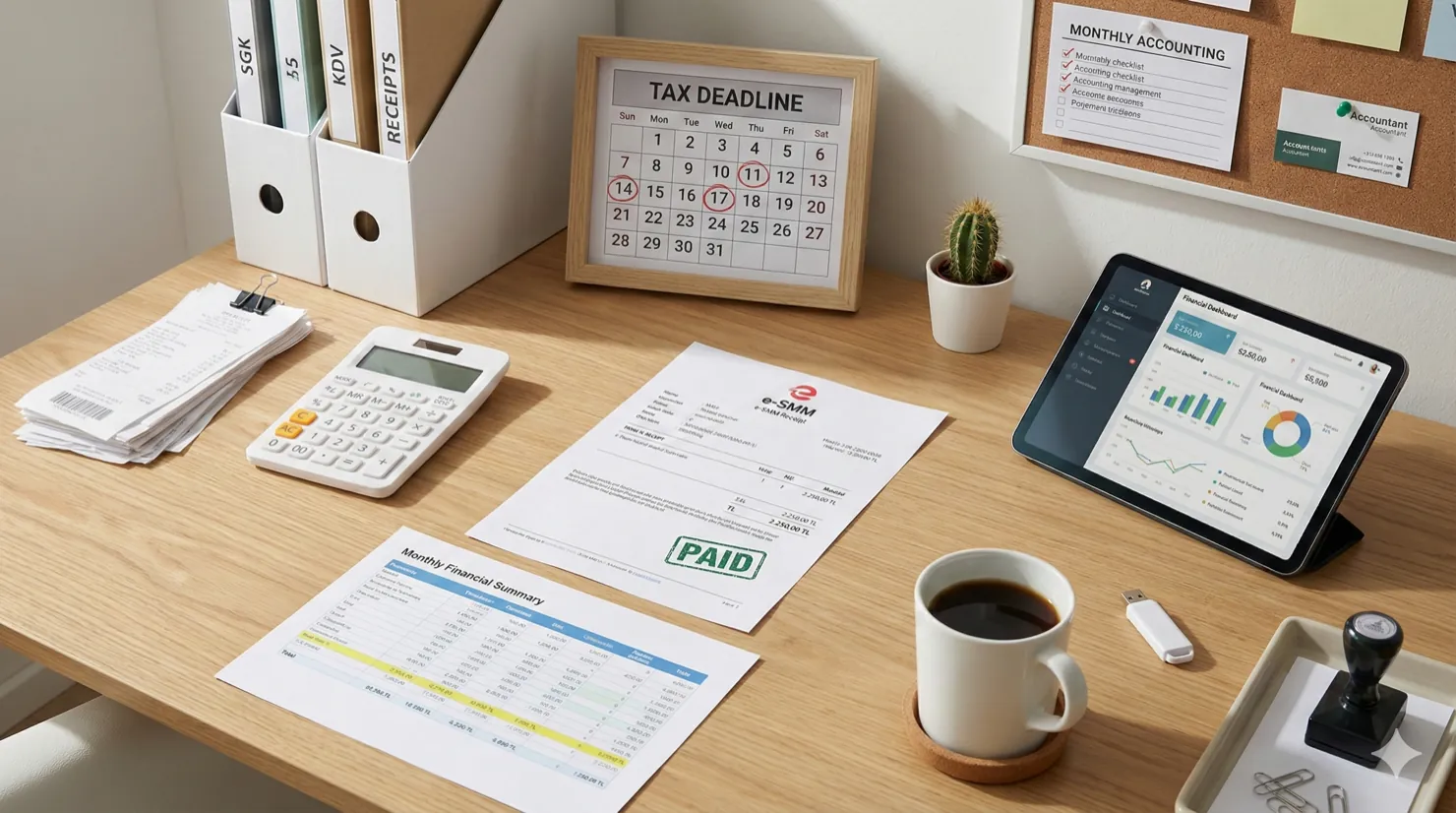
Self-employed psychologists and therapists are obligated to issue an e-SMM (electronic self-employment receipt) for every payment they receive, to declare income tax and VAT, and to pay Bağ-Kur (SGK 4/b) premiums. This guide covers receipt rules, income tax and VAT obligations, Bağ-Kur premiums, tax-deductible expenses, the tax calendar, and digital accounting tools specifically for self-employed practice.
Financial Management Is Not Separate from Clinical Work
Ayse is an experienced clinical psychologist who opened her own practice six months ago. Her client portfolio is growing, sessions are regular, and the therapeutic process is going well. But the same question recurs every month-end: "When was I supposed to issue the receipt? What does provisional tax mean? Did I pay my social security premium this month?" She cannot bring the same diligence to her financial affairs as to her sessions, because she feels unequipped in these matters.
Financial management is a field that does not appear in therapists' degree programs but is an inseparable part of independent practice. Not issuing receipts, not filing declarations, or not properly recording expenses may go unnoticed in the short term, but during a tax audit, late fees and penalties create serious financial burdens. More importantly, a therapist who does not maintain regular financial tracking does not know their true income and cannot set their fee policy soundly.
In this post, we cover the essential accounting topics that self-employed psychologists and therapists need to know: receipt issuance rules, income tax and VAT obligations, social security premiums, deductible expenses, the tax calendar, and digital accounting tools. Each section is supported by current 2026 figures and regulations.
Why It Matters: You Can't Manage Your Practice Without Knowing Your Income
Many therapists perceive their session fee as gross income, but actual earnings are quite different. When VAT (8%), income tax, social security premiums, and operating expenses are deducted from a 3,000 TL session fee, the remaining net amount decreases significantly. Without knowing this difference, it is impossible to set fees, plan for rent increases, or make investment decisions.
The cost of tax errors should not be underestimated either. Late fees and penalties for not issuing e-SMM, delaying social security premiums, or not filing declarations can far exceed the original debt. In 2026, the minimum penalty for failing to file a declaration is 12,000 TL. Financial discipline is not a choice but a condition of professional sustainability.
Good financial management is also part of the therapeutic framework. A practice with unclear fee policies, cancellation terms, and payment arrangements creates insecurity for both client and therapist. When financial processes are in order, it becomes easier to focus your energy on your primary work: your clients.
Professional Service Receipt (e-SMM): Basic Rules
Every therapist working as a freelance professional is required to issue an e-SMM (electronic Professional Service Receipt) for every payment received. This obligation covers all payment methods including cash, bank transfer, EFT, and credit card. Failure to issue a receipt constitutes a tax procedure law violation and incurs an irregularity penalty.
An electronic signature or financial seal is required to issue e-SMM. Issuance channels include the GIB Portal (portal.efatura.gov.tr), Parasut, Logo Isbasi, and other private integrators. Those newly commencing activity must transition to the e-SMM system by the end of the third month following the month they started.
Receipt calculation works as follows: 20% withholding tax (stopaj) is calculated on the gross amount, and VAT is added on the gross amount. The withholding tax is paid to the tax office by the corporate client (company, institution) on behalf of the freelance professional. For individual clients, no withholding tax applies; only VAT is calculated. For example, for a session with a 3,000 TL gross fee for an individual client, the net collection is 3,000 TL plus 240 TL VAT (8%), totaling 3,240 TL.
Income Tax: Brackets and Declaration
Freelance professional income is declared in the annual income tax return. The 2026 income tax brackets are as follows: up to 190,000 TL at 15%, 190,000-400,000 TL at 20%, 400,000-1,000,000 TL at 27%, 1,000,000-5,300,000 TL at 35%, and above 5,300,000 TL at 40%. This progressive structure means the tax burden increases as income rises.
The annual income tax return is filed between March 1-31 each year for the previous year's income. The first installment of the calculated tax is due by the end of March, the second by the end of July. The 20% withholding tax on e-SMMs issued to corporate clients during the year is offset against the year-end calculated tax; excess withholding can be refunded.
Additionally, provisional tax declarations are filed quarterly: by the 17th of March, June, September, and December for each respective period. Provisional tax functions as advance installments of the annual tax and is offset at year-end.
VAT Rates: The License Difference Is Critical
The VAT rate on psychological services is directly linked to the Ministry of Health license. Psychological services provided at licensed health profession service units are subject to 8% VAT. Unlicensed counseling services carry a 20% VAT rate. This difference amounts to a significant sum per session.
The VAT declaration is filed by the 28th of each month for the previous month's transactions. The difference between VAT collected and VAT paid (from expenses) is remitted to the tax office. If your expense-related VAT exceeds your collected VAT, the difference carries forward to the next month. For more detailed information on the licensing process and VAT advantage, see our practice opening guide.
Social Security (SGK 4/b) Premiums
Freelance therapists are insured under SGK 4/b (Bag-Kur). In 2026, the minimum monthly Bag-Kur premium is approximately 9,825 TL, while the 5% discounted premium for regular payers is 10,157 TL. The premium rate is 34.5% of the gross minimum wage and covers disability-old age-death insurance, general health insurance, and short-term insurance branches.
Premium payments are made monthly by the end of the following month. Delays incur late payment penalties, and prolonged non-payment may result in suspension of healthcare benefits. Bag-Kur premiums can be deducted from the income tax base, which is an important advantage that reduces the tax burden.
Tax-Deductible Expenses
In freelance professional income, the tax base is calculated by deducting professional expenses from total revenue. Complete recording of expenses directly reduces your tax burden. Main deductible expense items include: office rent, Bag-Kur (4/b) premiums, accountant fees, professional development and training expenses (supervision, seminars, conferences, certification programs), test kits and professional materials, electricity, water, natural gas, and internet bills, office supplies and stationery, computer and equipment depreciation, professional liability insurance premiums, and staff salaries with social security premiums.
An invoice or document is required for every expense; undocumented expenses cannot be deducted from the tax base. Expense records are maintained through the Bookkeeping-Declaration System. Professional development expenses in particular are a category therapists frequently overlook: supervision fees, personal therapy, conference attendance fees, and professional books are all tax-deductible expenses.
Tax Calendar: Dates You Must Not Miss
The essential tax calendar for freelance professionals is as follows: VAT declaration is filed by the 28th of each month and paid by month-end. Withholding tax declaration (if staff is employed or invoices with withholding are issued to corporate clients) is filed by the 26th of each month. Provisional tax declaration is filed quarterly (in March, June, September, and December periods) by the 17th of the respective period.
The annual income tax return is filed between March 1-31; the first installment is due by the end of March, the second by the end of July. Missing these dates automatically triggers penalties. Your accountant manages this calendar on your behalf, but the ultimate responsibility always lies with the taxpayer.
Accountant: Need or Luxury?
Short answer: absolutely a need. The intricacies of freelance accounting (VAT declarations, provisional tax, withholding tax offsets, social security premiums, expense records) are areas with high error risk. A single penalty for not filing a declaration can exceed the accountant's annual fee. Accountant fees range from 3,000 to 8,000 TL per month in 2026, and this amount is a tax-deductible expense.
When selecting an accountant, prefer one with experience working with freelance professional clients (lawyers, doctors, architects, etc.). An accountant who understands healthcare sector taxation (VAT rates, differences based on license status) will save you both time and money. Accountants who provide clear information about e-SMM setup, Bookkeeping-Declaration access, and the declaration calendar at the first meeting are a reliable starting point.
Digital Accounting Tools
The Bookkeeping-Declaration System (defterbeyan.gov.tr) is the mandatory record-keeping platform for freelance professionals; your income and expense records are managed here. For issuing e-SMM, the GIB Portal (portal.efatura.gov.tr) or private integrators are used.
Pre-accounting software such as Parasut, Logo Isbasi, and Mikro offer e-SMM issuance, income-expense tracking, current account management, and declaration preparation on a single platform. Logo Isbasi offers services including e-SMM integration starting from 342 TL per month. Parasut is known for its client-based invoice tracking and accountant sharing features.
These tools do not replace an accountant but make data entry easier, reduce error risk, and allow you to see your financial status in real time. Integration between your clinic management software (appointment and payment tracking) and your accounting software eliminates manual data transfer and improves consistency.
Clinical Example: Selin, 38, Setting Up Her Financial System
Selin is a clinical psychologist who has been working in her own practice for three years. Realizing in her first two years that she had not given financial processes the attention they deserved, she set up a systematic routine in her third year.
e-SMM Routine: With Parasut integration, she issues an e-SMM with one click after each session. Client information is transferred automatically, and the receipt is instantly recorded in her Parasut account.
Expense Tracking: She obtains invoices for all professional expenditures and records them monthly in the Bookkeeping-Declaration System. She deducts supervision fees, conference attendance, and professional books as expenses.
Tax Planning: Together with her accountant, she tracks a monthly income-expense statement. To avoid surprises during provisional tax periods, she sets aside 25% of her income into a tax account each month.
Social Security: She set up an automatic payment order to ensure her Bag-Kur premiums are paid on time. She benefits from the 5% discount.
Result: Because she knows her net income, she can set her session fees soundly. She experiences no tax surprises at year-end and clearly tracks how much of her income actually remains.
5 Core Principles for Financial Management
Issue a Receipt for Every Session
Issuing an e-SMM for every collection, including cash payments, is a legal requirement. The "I received cash, I'll issue the receipt later" approach is a tax procedure law violation. Post-session receipt issuance should be part of your routine.
Set Aside 25% of Income for Tax
Keep approximately a quarter of your gross monthly income in a separate account. This simple rule prevents cash flow problems during provisional tax periods and at year-end. Your actual tax rate varies with your income level, but 25% is a good starting estimate.
Get Invoices for All Professional Expenses
Supervision, conferences, professional books, personal therapy, office supplies: all of these are tax-deductible expenses, but only with invoices or documentation. Undocumented expenses cannot be deducted from the tax base. Requesting an invoice for every professional expenditure provides significant tax savings at year-end.
Follow the Tax Calendar
VAT declaration (28th of each month), withholding tax declaration (26th), provisional tax (quarterly), and annual income tax return (March). Missing these dates automatically triggers penalties. Add reminders to your calendar or maintain regular communication with your accountant.
Calculate Your Net Income Every Month
Gross income minus all expenses (rent, social security, taxes, accountant, professional development) equals net income. Knowing this figure every month allows you to base your fee policy, investment decisions, and growth plans on realistic data.
Common Mistakes
Issuing the Receipt "Later"
The e-SMM must be issued at the time of payment. Issuing bulk receipts at the weekend or month-end is both legally problematic and carries the risk of omission. Establishing a post-session receipt routine is the safest approach.
Not Recording Professional Expenses
Expenses such as supervision fees, conference attendance, professional books, and therapy room equipment are tax-deductible. Not obtaining or recording invoices for these expenses means unnecessarily paying more tax. Request an invoice for every professional expenditure.
Delaying Social Security Premiums
Delaying Bag-Kur premiums both incurs late payment penalties and puts your right to healthcare benefits at risk. Moreover, you cannot benefit from the 5% discount for regular payers. Setting up an automatic payment order is the simplest solution.
Treating Gross Revenue as Net Income
Your session fee is your gross revenue; however, the amount remaining after VAT, income tax, social security premiums, and operating expenses are deducted is your actual income. Making fee decisions, investment plans, or expansion decisions without calculating this difference leads to financial surprises.
Payment and Receipt Management with Mindora
The processes discussed in this article, such as e-SMM issuance, payment tracking, and accounting integration, become much more efficient when your clinic management software connects with your accounting system. Mindora supports your therapy practice's financial processes:
- Parasut Integration: Create e-SMM with one click. Client information and session amounts are transferred automatically, and the receipt is instantly recorded in your Parasut account.
- Payment Status Tracking: Which sessions have been paid, which receipts have been issued, which are still outstanding? All payment statuses are tracked from a single screen.
- Accounting Tracking Screen: Monthly revenue summary, receipt statuses, and data to be shared with your accountant are displayed on a single screen.
- Automatic Receipt Reminders: Sessions that have been paid but not yet receipted are automatically flagged; no receipt is missed.
For more detailed information on client data security and KVKK compliance, see our KVKK guide.
Frequently Asked Questions
This Article is Part of the Practice Management Series
This article is one of the deep-dive posts in the practice management series. You can explore the other articles in the series below.
Therapist Practice Management Guide: From Framework to Visibility
Build a sustainable therapy practice — from setting fees and boundaries to launching online sessions and getting found on Google. The complete practice management roadmap.
Building a Therapeutic Framework: Fees, Cancellation Policy, and Professional Boundaries
Learn fee setting, cancellation policy design, session duration standards, and communication boundaries with Turkey-specific data and practical examples.
Building an Online Therapy Practice: Platform, Data Privacy, Technical Setup, and Session Management
Learn how to set up an online therapy practice: platform selection, data privacy compliance, technical infrastructure, payment systems, and session management with Turkey-specific regulations.
SEO Guide for Therapists: How to Get Found on Google
Set up your Google Business Profile, conduct keyword research, optimize for local SEO, register on therapy directories, and leverage social media to help clients find you.
KVKK Guide for Therapists: How to Protect Client Data
Understand KVKK obligations for therapists: special category health data, privacy notices, consent management, data security measures, and WhatsApp risks.
Opening a Therapy Practice in Turkey: Complete Guide
Guide to opening a therapy practice in Turkey: licensing process, tax registration, SGK obligations, location selection, and clinical infrastructure setup.
References
- Revenue Administration (2025). Tax Guide for Taxpayers Earning Freelance Professional Income. GIB Publications.
- Union of Chambers of Certified Public Accountants and Sworn-in Certified Public Accountants of Turkey (2025). Professional Service Receipt Guide. TURMOB.
- Social Security Institution (2026). Premium Tables for Insured Persons under 4/b Coverage.
- Income Tax Law No. 193. 2026 Income Tax Rate Schedule. Official Gazette of the Republic of Turkey.
- Revenue Administration (2026). e-Professional Service Receipt (e-SMM) Implementation Guide.